

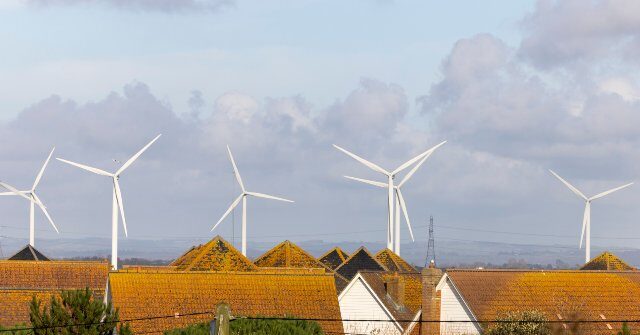
Asbestos has been found in at least 1,000 wind turbines throughout the UK after components containing the banned substance were imported from China, sparking concerns about worker safety and prompting calls for a government investigation.
The Times reports that the hazardous material was discovered in brake components used in lifts and hoists within 1,000 wind turbines in the UK. The parts are believed to have originated from third-party Chinese suppliers and contain chrysotile, a form of white asbestos that has been completely prohibited in the United Kingdom since November 1999. British law makes it illegal to buy, sell, or export any materials containing this substance. The GMB trade union has formally contacted the UK government and the Health and Safety Executive requesting a comprehensive account of the cleanup operation that is currently underway.
Louise Gilmour, the secretary of GMB Scotland, expressed strong concerns about the situation. “Every one of the contracts sent abroad as operators chase the bottom line has cost our country jobs and apprenticeships. To discover we have been exporting skilled work while importing asbestos beggars belief,” Gilmour stated. “Our country banned asbestos decades ago because it was killing workers and their families, but we now pay for it to be ferried here from the other side of the world and then pay again to remove it? We deserve to be told exactly how this happened and what is being be done to prevent it happening again.”
There is no indication that the lift suppliers or wind farm operators were aware of the asbestos presence in the components at the time of installation. The discovery appears to have been made during routine inspections or maintenance activities, though the exact circumstances of how the contamination was identified have not been disclosed.
The Energy Institute, which serves as the membership body for professionals working in the energy sector, has confirmed its awareness of the issue and provided details about the current status of the contamination. According to the organization, industry reporting to date suggests that the asbestos, where present, remains confined within sealed brake housings. The institute indicated that the material is encapsulated and non-friable, meaning it is not generating airborne fibers under normal operating conditions.
The Energy Institute stated that it has been coordinating with member companies to share data with the Health and Safety Executive. The organization is also engaging with lift manufacturers and turbine original equipment manufacturers to confirm replacement components and establish safe change-out methodologies for removing the contaminated parts.
In its statement, the Energy Institute sought to reassure workers and the public about current safety levels. “At present, there is no indication of worker health risk, and no evidence of wrongdoing by turbine operators,” the organization said.
Asbestos was widely used in construction and manufacturing throughout much of the twentieth century due to its fire-resistant properties and durability. However, exposure to asbestos fibers has been linked to serious health conditions including mesothelioma, lung cancer, and asbestosis. The UK began restricting certain types of asbestos in the 1980s, with chrysotile being the last form to be banned in 1999.
The discovery of asbestos in wind turbine components highlights ongoing concerns about the importation of materials from countries with different regulatory standards. While China has restricted some uses of asbestos, it has not implemented the comprehensive bans that exist in the UK and many other Western nations.
The cleanup operation now underway will involve carefully removing and replacing the contaminated brake components while taking precautions to prevent exposure to asbestos fibers. Such operations typically require specialized contractors trained in asbestos handling and disposal, adding to the cost and complexity of addressing the problem.
Read more at the Times here.
Lucas Nolan is a reporter for Breitbart News covering issues of AI, free speech, and online censorship.