

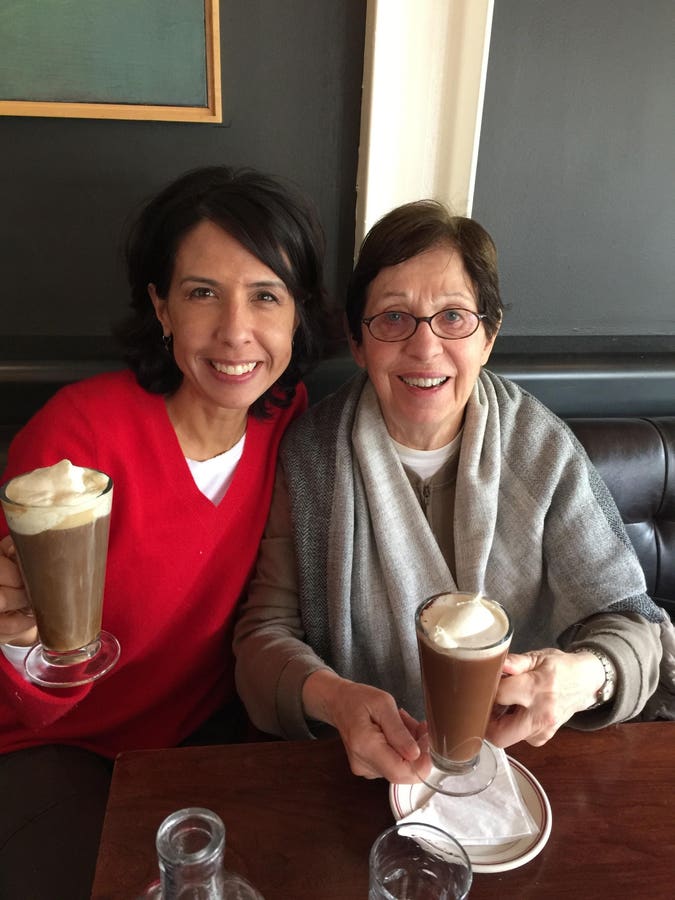
Deborah Kan, Being Patient founder with her mother Alvera
Deborah Kan
At the conclusion of the Alzheimer’s Association’s International Conference (AAIC) in mid-July, I interviewed Deborah Kan, award-winning journalist and founder of Being Patient, a digital web hub dedicated to providing stories and resources for families affected by Alzheimer’s disease. Deborah created the site in 2017 after her mother’s Alzheimer’s diagnosis to help “bridge the gap between patients, caregivers, and scientific research.”
Prior to founding Being Patient you’d interviewed presidents, CEOs, and world leaders. What convinced you that Alzheimer’s was the story you needed to tell?
In 2014, I was running video operations across Asia for The Wall Street Journal, based in Hong Kong, when my sister called from the U.S. to tell me our mother had been diagnosed with Alzheimer’s. I didn’t know much about the disease then, only that it took your memory and that there wasn’t a lot you could do about it.
I’m also the daughter of a University of California San Francisco (UCSF) geneticist, so my instinct was to look for data. And the journalist in me did what journalists do when we can’t find a straight answer. I started calling sources.
One of my first calls was with Mike Weiner at UCSF. He walked me through an imaging study his team had been running for roughly 15 years, and he told me that amyloid plaques show up in the brain a decade or more before a patient ever notices a symptom.
That was the turning point for me. Not because it was hopeful exactly, but because it meant Alzheimer’s was a process, unfolding over decades with a long window before symptoms. And if there’s a window, I thought, there should be something you can do to slow that process down.
I treated it like a story. The news wasn’t all good, but I understood what I was dealing with. I could ask my mother’s doctors better questions. I knew what to watch for. In a strange way, information gave me back a measure of control.
Then I decided to leave a job I really loved. Millions of families were dealing with this, and nobody was giving them what I’d just spent two years digging out by hand.
Was there a single moment after your mother’s diagnosis when you realized the information people needed simply didn’t exist?
I had two simple questions: what research has been learned in the last decade, and where is this heading? I couldn’t get a straight answer to either.
But the even bigger gap wasn’t science. It was: how is a family supposed to handle this? Should I talk to my mom about her diagnosis, or pretend it wasn’t happening? Should we start taking over key decisions, or was she still capable of making them herself?
My parents have a small vineyard in Napa Valley, which my mother ran. Early on, my father, my sister and I were talking about the management of the farm, and we were talking around her. She got furious, and she was right to be. She could feel that we were deeming her incapable, when she was still very capable. We made a lot of mistakes in that first year. Not because we didn’t care, but because nobody had told us what this disease looked like in the beginning.
That’s when I understood this wasn’t a research problem; it was an information problem. Patients and caregivers were siloed from the people doing the work, and journalism could close that gap.
How has being both a journalist and a caregiver changed the questions you ask scientists today?
Instead of trying to figure out what the story was, I was living it. That changes who and what you think to ask. So, when I started reporting, I didn’t only call neurologists. I interviewed a lot of patients and caregivers about their own experience, and I found I was learning as much from them as I was from the well-known scientists.
The question I always ask someone with a diagnosis is: in hindsight, were there earlier signs? Not getting lost on a familiar route, something subtler, or something that just didn’t seem right. Post-it notes kept coming up. Suddenly needing visual reminders to keep track of a schedule they’d always carried in their head. What do we know about behavioral changes at a stage long before memory loss, when nobody would think of seeing a doctor?
The more people I interviewed, the more patterns emerged.
Are we truly at an inflection point, or are expectations getting ahead of science?
We’re at the beginning of what might become an inflection point. Cautious optimism is exactly the right way to describe it.
The biggest change has been in diagnostics. You can now get a blood test that tells you whether the biology of Alzheimer’s is present in your brain. For decades the only way to know that was a PET scan or a spinal tap, which meant most people never found out at all. That’s a monumental shift in how this disease gets diagnosed, and it’s already reaching regular doctors’ offices.
It’s true that we now have the first disease-modifying drugs, and that’s a real scientific milestone. We altered the rate of decline, which we’d never done before.
What’s more exciting to think about is what these drugs might do in combination with others aimed at different parts of the disease process. I think there’s broad agreement among scientists that this will look more like HIV treatment, where you hit several mechanisms at once rather than looking for one drug that does everything.
Artificial intelligence is also changing everything. In our own case, we’ve launched Carey, trained only in our own human-written journalism. It’s for families who have questions at two in the morning, when there’s no neurologist on call.
To me, real-world impact means something narrower than a scientific breakthrough. It means: what changes in your life today? And by that measure, the answer is lifestyle. It’s the only item on that list available to everyone, at any age, without a prescription or an infusion chair.
What habits consistently come up to preserve brain health?
I just got back from the Alzheimer’s Association International Conference in London. Amid an enormous amount of very complex science, I asked Nate Chin, a neurologist from the University of Wisconsin, a simple question: what can I do to protect my brain?
He told me to buy a blood pressure cuff. Monitor it at least three times a week and keep it under 120 over 80. His reasoning was that blood pressure is one of the best windows you have into your brain. Sustained high pressure damages the small blood vessels that feed it, and that vascular damage creates an environment where neurodegeneration can take hold.
The other takeaway for me was metabolic health. Glucose metabolism matters enormously for the brain. If you become insulin resistant, that creates conditions inside the brain associated with neurodegeneration.
Everyone knows they should sleep and exercise. Far fewer people know what sleep does to the brain. In deep sleep, your brain runs a clearance system that flushes out metabolic waste, including the proteins associated with Alzheimer’s. Skip the deep sleep and that cleanup doesn’t happen properly.
To be clear, we’re talking about reducing risk, not preventing disease, and I’ve interviewed people who did everything right and still got a diagnosis. But risk reduction is real, and it’s what we have.
What conversations about long-term financial planning should families have well before cognitive decline becomes a concern?
My number one piece of advice is to have conversation before anyone has symptoms of cognitive decline. Normalizing dementia is far easier when a person is healthy, and much harder once there’s something to be defensive about.
Alongside the power of attorney, I think families should name a cognitive designate. Who is the person in your life you would want to make decisions if you were diagnosed with a neurodegenerative disease? The conversation about who and why, with the whole family in the room, is what makes it work when the time comes.
The other conversation is about money, and families consistently underestimate this. Any way you slice it, dementia is enormously expensive. Private care is astronomical, and Medicare doesn’t cover the custodial care this disease requires, the day-to-day help with bathing and dressing and supervision that can go on for a decade. Most families end up spending down their assets to qualify for Medicaid, which offers more, but usually not enough. That’s the part people don’t see coming.
What have the patients and caregivers you’ve spoken with taught you?
That there’s a way to live with dementia rather than simply dying from it. The stereotype of the old person diminishing into oblivion in a corner is not what I see. I’ve interviewed people who took their diagnosis and set new goals — triathlons, climbing mountains, long-distance cycling — things they’d never have attempted otherwise.
I’ve also learned that creativity persists in ways that surprise scientists. Musical memory seems more resilient than other kinds. I’ve watched people who could no longer reliably recognize a family member sit down and play a piece they learned as a child. Researchers are still working out why. It’s fascinating to read about and far more so to witness.
And I’ve learned that the best caregivers are the ones who keep treating the person as a partner rather than a patient. When someone is still made to feel capable, still given things to accomplish, they stay engaged and they hold on to their sense of self-worth. I don’t think you can overestimate what a good human relationship does in this disease.
What gives you genuine optimism today that didn’t exist when you launched Being Patient?
I can feel the stigma around dementia beginning to diminish, and it’s a virtuous cycle. The less shame there is, the earlier people come forward, and the more people who come forward, the less shame there is.
Being Patient started a campaign called “Journey to Diagnosis,” where people share their own stories about the early signs they noticed and how they eventually got diagnosed. These are people putting their names to the fact that they’re living with neurodegeneration, in public. That takes real courage, and I don’t think as many people would have been willing to do it when I started.