

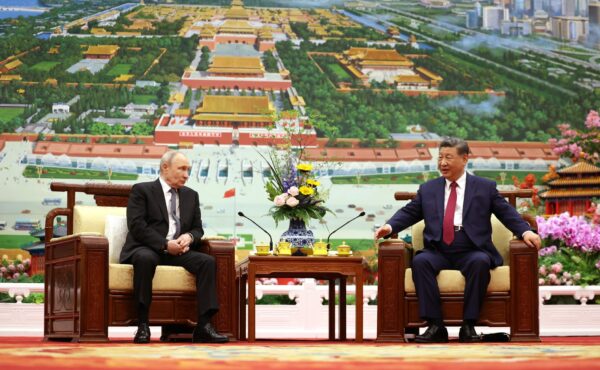
Russian President Vladimir Putin arrived in Beijing on May 20 with a delegation built for a deal: five deputy prime ministers, eight Cabinet ministers, and the chiefs of Gazprom and Rosneft. He left two days later with declarations of friendship, a visa-free travel arrangement extended through 2027, and around 20 cooperation agreements. The one document everyone was watching for was not among them. There was, once again, no breakthrough on Power of Siberia 2, the 50-billion-cubic-meter pipeline Moscow has been trying to sell to Beijing for the better part of a decade.
The two sides reported a “basic understanding” on routing and little else. According to reporting on the talks, they remain split on the same three issues that have stalled the project for years: timetable, financing, and price.
Beijing is holding out for something close to 12 to 13 cents per cubic meter, roughly what Russian industry pays at home. That is not a compromise position. It is a way of saying no while keeping the conversation polite.
To understand why China can afford to be this unhurried, it helps to look away from the Mongolian route Moscow keeps proposing and toward a project running in the opposite direction — westward, into Xinjiang, from the gas fields of Central Asia.
On April 17, in Turkmenistan’s Mary Province, former president and current Chairman of the People’s Council Gurbanguly Berdimuhamedov and Chinese Vice Premier Ding Xuexiang stood in a purpose-built pavilion and, by video link, gave the order to begin drilling on the fourth phase of Galkynysh, the world’s second-largest onshore gas field. Ding was there on behalf of Chinese leader Xi Jinping, with the full senior Turkmen leadership in attendance. “Our country regards China as a strategic partner,” Berdimuhamedov told the room.
Phase Four is expected to add up to 10 billion cubic meters of marketable gas a year, with the field’s seven-phase plan eventually targeting far more. Ashgabat is financing the work itself and has been careful not to say where the gas will go. That reticence is the most revealing part of the announcement, because in the current market Turkmenistan does not really have a choice. China already buys more than 80 percent of the country’s gas exports. The trans-Caspian route to Europe is a diplomatic aspiration. The Turkmenistan-Afghanistan-Pakistan-India pipeline (TAPI), is allegedly making its way across Afghanistan but full completion remains a distant dream.. The buyer for Galkynysh’s Phase Four is, in practice, already decided. What is being negotiated is the price of that certainty.
A Tale of 2 Pipeline Networks
Most Western coverage of Sino-Russian energy treats Power of Siberia 2 as the headline event. The 2,600-kilometer route will stretch from Yamal through Mongolia to China, with a planned 50-bcm capacity. As Anne-Sophie Corbeau, Erica Downs, and Tatiana Mitrova argued last autumn, the long-awaited September 2025 memorandum on the pipeline was heavy on political signaling. But it was conspicuously light on the things that actually commit a buyer: price formulas, take-or-pay volumes, penalties for under-offtake. Gazprom called it legally binding. The market never treated it that way, and this week’s summit confirmed why.
The more consequential story runs along a different axis. The Central Asia-China Gas Pipeline system, currently comprising of Lines A, B, and C, has a nominal capacity of 55 bcm a year, though actual deliveries run closer to 40 bcm, with Turkmenistan supplying around 35 bcm. A fourth strand, Line D, would add another 30 bcm through a shorter route crossing Uzbekistan, Tajikistan, and Kyrgyzstan into Xinjiang. Xi has pressed Central Asian leaders to accelerate it for years, most pointedly at the 2023 China-Central Asia summit. The Phase Four launch at Galkynysh is, in effect, the upstream half of that push.
Fully built out, the expanded network would carry up to 85 bcm westbound into Xinjiang, fed from several countries and feeding China’s West-East Pipeline grid, already the largest in Asia. For comparison, Power of Siberia 1 is rated at 38 bcm. Power of Siberia 2, if built on the terms Moscow wants, would add 50. But not before 2030, and only if Beijing decides it needs the gas.
A word of caution is warranted here. Line D is not a settled fact. Construction on the Tajik section, where it began ceremonially in 2014, has been suspended for most of the years since. As of the Galkynysh ceremony there was still no official confirmation from Beijing or Ashgabat that the pricing disputes blocking it had been resolved. That is precisely the point. China does not need Line D finished to use it as leverage.
The Central Asian Suppliers
The Carnegie Russia Eurasia Center’s Sergey Vakulenko has estimated that Turkmenistan sells to China for roughly $50 per thousand cubic meters more than Russia earns via Power of Siberia 1. By the second quarter of 2025, the Turkmen border price had slipped below $290 per thousand cubic meters — consistent with oil linkage, and well under what Russia once extracted from European buyers.
That gap is not a quirk. It is the instrument Beijing uses to keep both Moscow and Ashgabat in a state of managed discomfort. Russian negotiators have spent years trying to win Turkmen-equivalent pricing on Power of Siberia 2, and China has refused. In 2024, the Financial Times reported, Beijing wanted a price near Russia’s subsidized domestic level and would commit to only a fraction of the pipeline’s capacity. The figure on the table this week, around 12 to 13 cents per cubic meter, is the same demand.. These are not negotiating terms so much as a description of what Beijing thinks the gas is worth to it, which is to say: not very much, given the alternatives.
Turkmenistan cannot bargain from a position of strength either. Its 2025 gas output was 76.5 bcm, still short of the Soviet-era peak of 85 bcm reached in 1989. The Oxford Institute for Energy Studies has noted that the country’s export infrastructure already exceeds its total production, and that the route to its richest market sits idle for part of the year. In that configuration, the talk of diversification, whether trans-Caspian or TAPI, functions mostly as leverage in the room with CNPC. The actual buyer never changes.
The other two legs of the pipeline system tell a subtler story. Kazakhstan and Uzbekistan were never on Turkmenistan’s scale when it comes to gas exports. Kazakh deliveries peaked around 5 to 6 bcm a year, Uzbek deliveries up to 10. But they mattered as marginal suppliers, and they no longer do. Both are becoming net winter importers, and their role is shifting from production to transit.
Uzbekistan’s output fell to 44.6 bcm in 2024 from 59.4 bcm in 2019. The head of UzTransGaz suggested back in 2023 that exports to China might end altogether by 2025 or 2026; in February 2026, for the second consecutive month, no Uzbek gas reached China. Tashkent now imports roughly 7 bcm of Russian gas a year, via Kazakhstan, to cover its own deficit.
Kazakhstan is on a parallel path, with domestic demand growing about 7 percent a year as the north gasifies and industry switches off coal. Its deliveries to China in early 2026 were stuck near a token 100 million cubic meters a month. The real business now, for Astana, is transit and swap: moving Turkmen gas east, Russian gas to Uzbekistan, and collecting fees on both.
From Beijing’s vantage, this is better than a pure supply relationship. Producers that are structurally short of gas cannot credibly threaten to divert it elsewhere; they can only haggle over transit tariffs. As Line D advances, on paper if not yet in steel, the system’s value migrates toward throughput rather than any one country’s output. And throughput is something China controls.
What It Means for Power of Siberia 2
Russian officials have spent months telling domestic audiences that the war in Iran and the threat to the Strait of Hormuz would finally force Beijing’s hand. The logic is intuitive: if a large share of Chinese LNG transits Hormuz, a prolonged closure should make piped Russian gas look safer. But as Mitrova has argued, reserves are not the same as market power. Russia still has the gas. What it lacks is the export architecture that once turned those reserves into leverage. Last week’s summit, where Putin’s outsized delegation went home empty-handed, was the clearest demonstration yet.
The Central Asia-China Gas Pipeline system is a large part of why. Every cubic meter that could flow through Line D is one Beijing need not buy from Gazprom at Gazprom’s price. Phase Four at Galkynysh, by adding capacity with a natural home in that system, effectively caps the upside of any Russian demand. The LNG market reinforces the same logic: China’s import capacity is on track to reach 250 bcm a year by 2027, up from 144 in 2022, with Qatari, U.S., and Australian suppliers all courting Chinese offtake. As long as Beijing has options at sea and overland, any Power of Siberia 2 will end up looking more like Power of Siberia 1 than like the European contracts Gazprom still mourns.
The Mongolian segment of the project, Soyuz Vostok, remains outside Ulaanbaatar’s fiscal plan through 2028. CNPC has signed no binding sales agreement of the kind that would justify the steel. And the gas-for-cash sequence the project depends on requires a price Beijing, for now, has no reason to concede.
None of this means Power of Siberia 2 is dead. The politics of the war in Ukraine, and Russia’s need for a visible demonstration of alignment with Beijing, will likely keep it alive in ceremonial form for years. It may even be built eventually, on terms that look reasonable after the fact. What has already drained away is the project’s strategic meaning.
In the early 2020s, Russia pivoted east hoping to rebuild a European-sized market in China. But Beijing has quietly ensured that no single supplier could ever establish complete dominance over its gas imports. Central Asia is the instrument; Turkmenistan is the anchor; Line D is the threat that does not need to be carried out to be effective. The Galkynysh ceremony in April, for all its state-television polish, was less a celebration of partnership than a reminder of who sets the pace. Putin’s quiet departure from Beijing last week gave the same reminder.
Moscow once had the option to sell its pipeline gas on European terms. It walked away from that market in 2022. What remains is a buyer that has spent a decade building alternatives, and a set of neighbors whose bargaining power, like Russia’s, shrinks with every new phase of the same field.