

In September 2023, Chinese President Xi Jinping first mentioned the “new quality productive forces” and their centrality to advance “high quality economic development” across the country. The message of this new terminology was to prioritize the development of cutting-edge industries that produce high value-added products to spur long-term economic growth. This also included the necessity for controlling the relevant supply chains, from design to manufacturing.
Xi confirmed this new economic policy at his December 2023 speech at China’s Central Economic Work Conference, and Premier Li Qiang also focused on it in his annual work report at the National People’s Congress in March 2024. Most recently, China’s long-awaited Third Plenum in July 2024 restated this technology-driven focus to spur economic growth.
The foundation of Xi’s new productive forces is the “new three” – electric vehicles (EV), lithium-ion batteries, and solar photovoltaics (PV). These are industries that are still emerging, but already have an immense economic impact, and all three are largely controlled by Chinese companies. Going forward, Beijing wants to expand its control over these and other strategic supply chains.
Controlling Global Supply Chains: The Status Quo
China is already the undisputed global champion of the “new three.” For example, the country accounts for over half of the global EV market. Most EVs sold in China are designed and manufactured by domestic producers, as Chinese EVs are not only cheaper, but often qualitatively superior to Western alternatives. Because of this, Chinese EV producers BYD, XPeng, SAIC, Nio, Geely, and other brands are rapidly becoming household names across the world. By some estimates, China has already overtaken Germany and Japan to become the world’s largest car exporter, mainly due to surging global demand for EVs.
One important reason for China’s grip on the global EV market is its even tighter grip over the global supply chain of one key EV component: lithium-ion batteries. CATL, China’s largest EV battery manufacturer, produces a third of all EV batteries globally. Overall, China produces three-quarters of lithium-ion batteries by capacity. This share will likely decrease over time, due to large investments by the United States and the European Union to build up domestic battery supply chains. Nonetheless, China is expected to continue to supply at least two-thirds of global demand until 2030. Apart from lithium-ion technology, China is also rapidly becoming the world leader in alternative energy storage solutions, such as sodium-ion batteries.
The critical minerals needed for batteries and other electronics industries are also largely controlled by China. Chinese companies control most of the mining and refining processes of lithium, cobalt, nickel, graphite, and manganese, which are needed for lithium-ion batteries. China also controls the supply of 90 percent of rare earth elements, and even over 95 percent of rare earth magnets, which are essential for many other green energy technologies, including solar PV.
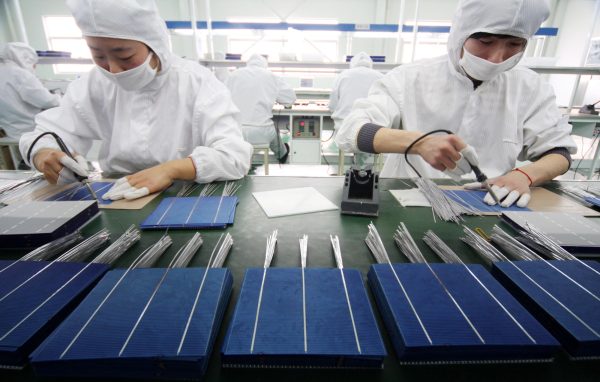
Solar PV, the third of the new three, is increasingly powering global electric grids. Solar energy is on track to overtake coal-fired power plants to become the largest source of electricity by the early 2030s. And within another decade, it may even become the world’s largest source of overall energy. China will play a major part in this energy transition, as it currently controls over 80 percent of the entire solar PV supply chain, with all of the top-10 solar PV manufacturing equipment suppliers being Chinese. In the production of PV wafers, its market share lies at 95 percent.
Ongoing demand growth for the “new three” industries is virtually guaranteed, as they are required for accomplishing the global energy transition. Moreover, Chinese supply chain dominance also encompasses renewable energy production from wind, water, and splitting the atom.
Chinese companies account for 60 percent of the global market for installed wind energy capacity. China adds more wind capacity annually than the rest of the world combined, with two-thirds of wind power currently under construction in China. Ten of the world’s 15 largest wind turbine suppliers are Chinese. China’s top three companies – Goldwind, Envision, and Mingyang – accounted for almost a third of the worldwide total.
China is also the world’s largest producer of hydroelectricity and its hydropower industries have been involved in many international dam projects, which are often part of China’s Belt and Road Initiative (BRI). China has also become a largely self-sufficient producer of nuclear energy and is already a major supplier of nuclear reactors globally.
These green energy technologies account for 9 percent of China’s GDP and made up 40 percent of GDP growth in 2023. However, China’s supply chain dominance of cutting-edge technologies extends beyond green tech and the critical minerals required for them. According to the ASPI Critical Technology Tracker, China already leads the world in 37 out of 44 tracked critical technologies. Apart from the above mentioned, these also include artificial intelligence (AI), communication technologies, advanced material manufacturing, biotechnology, hypersonic engines, advanced robotics, autonomous drones, and quantum communication and sensors.
Out of these emerging technologies, much global attention is currently on China’s leadership in AI. China is now leading in AI research, based on both quantity and quality of research papers, with Tencent, Alibaba, and Huawei being the top commercial contributors. China now also generates around half of the world’s top AI researchers.
China also remains the global leader in communications technologies, despite Chinese vendors having been cut off from many Western markets due to security concerns. Huawei is by far the world’s largest telecommunications equipment supplier, accounting for a third of global market share. The developing world has largely relied on Huawei for 5G adoption.
China is also rapidly expanding its Beidou satellite system as an alternative to GPS and for commercial satellite-based connectivity. And in early 2024, China launched the world’s first 6G satellite. While global standards for 6G have not yet been agreed on, Chinese companies are likely to move ahead with their own standards, as commercial availability of 6G in China is expected by 2030.
Apart from cutting-edge technologies, China also continues to dominate important heavy industries. For example, China accounts for over 50 percent of global shipyard output. And through the BRI, the country remains a crucial provider of infrastructure globally, for which China also controls relevant supply chains. It is responsible for 55 percent of steel, 51 percent of cement, and 59 percent of aluminum production globally. Such traditional, raw material-focused industries are the backbone for comprehensive supply chain dominance of new technologies.
Securing Control Over the Future – in Theory
The examples given here are testament to China’s existing control over strategic supply chains, but Beijing also has its eyes firmly set on securing the technologies of the future. In January 2024, China’s Ministry of Industry and Information Technology, together with six other ministries, released a roadmap for developing “future industries.” These include, among others, next-generation communication technology, quantum technologies, new energy sources and storage, smart manufacturing, biotechnologies, new materials, deep-sea mining, and aerospace technologies.
To this end, Beijing is setting up incubator networks and actively supports research institutions and businesses to conduct research and development. The roadmap includes an ambitious timeline, which foresees its full operationalization by 2025 and expects relevant technological breakthroughs by 2027.
This roadmap is not entirely new, but rather a continuation of a long-term, state-led innovation drive. Back in 2010, China unveiled its Strategic Emerging Industries Initiative, which later merged into the 2015 initiative “Made in China 2025.” The Emerging Industries Initiative focused on seven future technology areas, including new-energy vehicles, energy storage, and energy conservation – in other words, the “new three.”
To cultivate new strategic industries, there are existing and new large-scale funding programs, including the Little Giants program, which identified thousands of small- and medium-sized enterprises of strategic importance. These companies receive subsidies and grants to support their research and help them expand. Many of China’s most successful “new three” companies have already benefited greatly from such state support.
However, it remains to be seen how successful such state-led initiatives will be going forward. Beijing has over the past three years increasingly intervened in the work of its tech giants. This heavy-handed approach may have ended up hampering their innovative strength in the long run. Furthermore, China’s policy of generous state support for strategic industries has led to major tariffs by the U.S. and the EU, which may worsen as Beijing doubles down on subsidies.
Foreign investment has also largely dried up. In 2023, foreign direct investment fell to its lowest level in 30 years and, by the end of the year, even turned negative. In addition, while China’s top universities are among the best in the world for applied research, many international universities and research institutions have cut ties with their Chinese counterparts for fear of interference by the Chinese state. Therefore, achieving scientific breakthroughs in areas where China remains dependent on foreign know-how, such as cutting-edge semiconductor manufacturing, has become more difficult.
China also grapples with an issue domestically known as “involution,” which refers to overheated domestic competition that leads to cannibalization of industries. Both the solar PV and the EV industries are good examples of industries with a multitude of producers that seem due for market consolidation. Prices for solar PVs have dropped so low that profit margins have disappeared, and an increasing number of EV companies are going bust because of fierce competition. In both instances, large national champions will likely emerge from the ashes of many smaller ones, which could result in more unequal growth with far fewer jobs in these industries. This would be quite the opposite of what the government wants to achieve.
Finally, while cutting-edge industries such as AI and quantum technologies are indeed high value and require a highly skilled workforce, they also require much fewer workers than traditional heavy industries. Considering the already highly unequal distribution of wealth in China, and given Xi’s aversion to social welfare policies, one may wonder how such high-value, cutting-edge industries will end up trickling down to the rest of the population.