

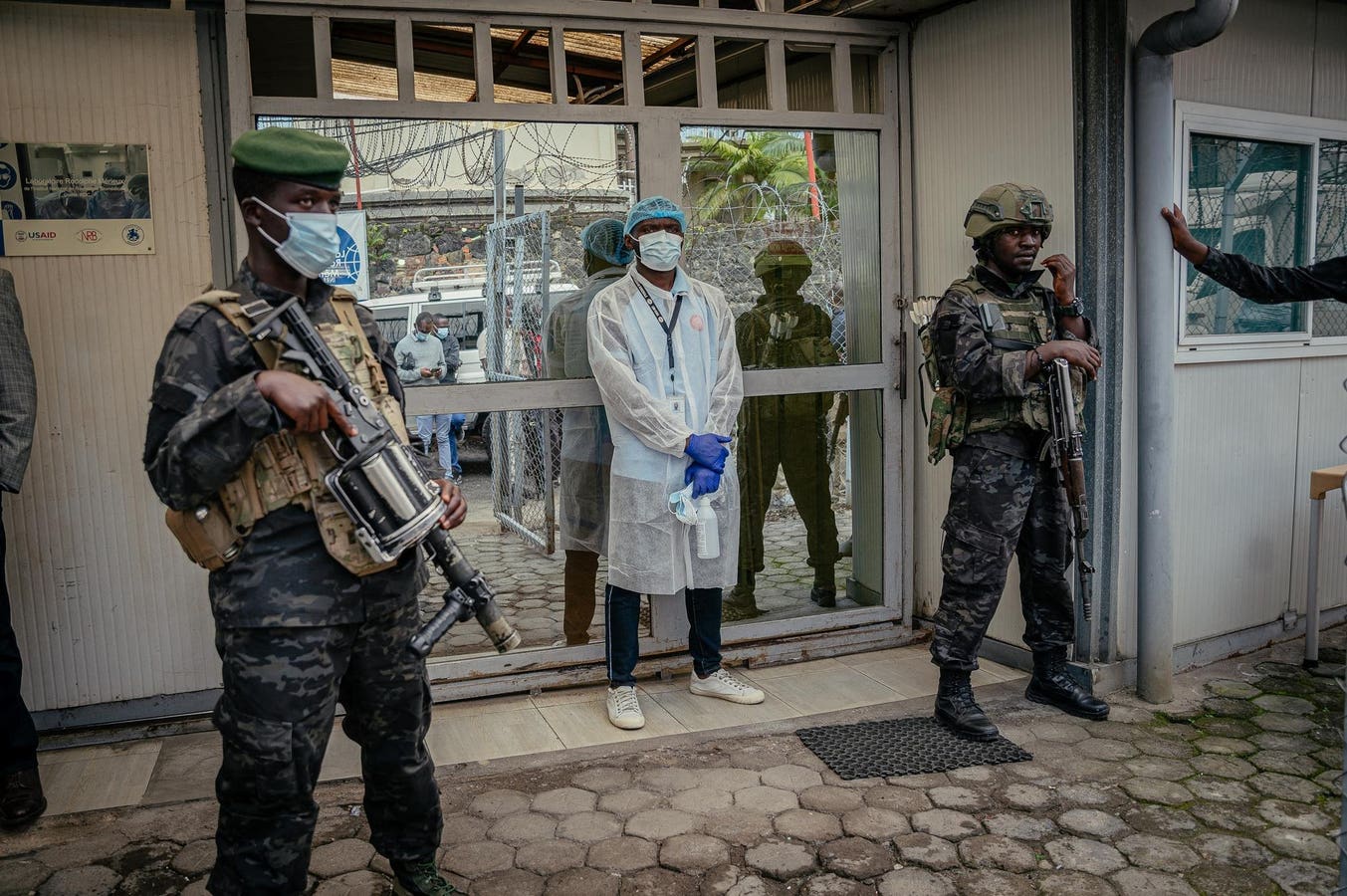
FC/M23 soldiers provide security for the movement’s authorities at the Rodolphe Mérieux Laboratory, National Biomedical Research Institute (INRB) in Goma, on May 19, 2026 during their guided visit to the laboratory responsible for analyzing and handling suspected Ebola cases. The World Health Organization on Tuesday voiced concern about the “scale and speed” of an Ebola outbreak that has killed an estimated 131 people in the Democratic Republic of Congo, and warned it could be lengthy.The UN health agency has declared the surge of the highly contagious haemorrhagic fever an international health emergency and called an urgent meeting on the crisis.No vaccine or therapeutic treatment exists for the Bundibugyo strain of Ebola responsible for the outbreak, which has killed more than 15,000 people in Africa in the past half-century. (Photo by Jospin Mwisha / AFP via Getty Images)
AFP via Getty Images
In August of 2014, as the West African Ebola outbreak accelerated and infected Americans were transported back to the United States, I wrote a Forbes piece titled “Ebola Has Landed.” The concern of 12-years ago was not simply about one virus crossing borders. It was about what Ebola represented: a warning that globalization, fragile healthcare infrastructure, delayed political responses, and inadequate bio-defense planning had combined to create a world increasingly vulnerable to biological crises.
Two weeks later, I made an argument in a Bloomberg-Businessweek Opinion Ebola piece that seemed controversial at the time as my conclusion was blunt: the Ebola crisis would not end without military intervention. That argument challenged policymakers in infectious disease response. Ebola was no longer simply a humanitarian emergency. It had become a national-security crisis.
A Dozen-Years Later, Most Of The Vulnerabilities Exposed In 2014 Ebola Remain Unresolved.
Ebola today occupies a strange place in global consciousness. It is simultaneously remembered as one of the defining infectious-disease scares of the modern era and largely forgotten outside public-health circles. COVID-19 overshadowed Ebola in scale and economic impact, but in many ways, Ebola served as the rehearsal for what followed. The failures that became painfully visible during COVID — delayed diagnostics, fractured public communication, healthcare-system overload, supply-chain collapse, and political paralysis — were all visible during the West African Ebola epidemic.
The Difference Was Ebola Scale.
The original West African Ebola epidemic infected more than 28,000 people and killed over 11,000 across Guinea, Liberia, and Sierra Leone. Entire healthcare systems nearly collapsed. Hospitals became transmission centers. Physicians and nurses died in catastrophic numbers. Burial practices accelerated spread. Fear spread globally even where transmission risk remained low.
The outbreak revealed something profoundly destabilizing: modern societies were far less prepared for biological crises than they believed. What changed after 2014 was not necessarily institutional resilience but scientific capability.
One of the most important advances since the original outbreak has been the development of highly effective Ebola vaccines and therapeutics targeting the Zaire strain of the virus. Ring-vaccination strategies and monoclonal antibody therapies dramatically improved containment capabilities and survival outcomes during later outbreaks in the Democratic Republic of Congo.
In many respects, science played a significant part in solving that Ebola problem. But science alone cannot stabilize a failing system. That remains the central challenge today.
Ebola outbreaks continue to emerge across Central and East Africa, particularly in the Democratic Republic of Congo and Uganda. The virus persists in animal reservoirs and periodically spills into human populations through environmental disruption, migration, conflict, and increased human encroachment into previously isolated ecosystems.
What makes Ebola dangerous is not simply its mortality rate. It is the environment in which it emerges. The current outbreak involving the Ebola Bundibugyo strain demonstrates this clearly. Unlike the Zaire strain, there are currently no widely available licensed vaccines or proven therapeutics specifically targeting Bundibugyo Ebola. Once again, containment depends heavily on early detection, isolation, logistics, infection control, and coordinated international response.
No Surprise, The World Is Still Reactive Rather Than Prepared.
One of the enduring lessons of Ebola is that outbreaks are rarely purely medical events. They are geopolitical and institutional stress tests. Ebola spreads most efficiently where governance is weakest, healthcare systems are underfunded, and public trust has deteriorated. That is why the 2014 discussion surrounding military intervention became so important
At the peak of the West African crisis, Médecins Sans Frontières warned that civilian humanitarian infrastructure alone could not contain the epidemic. Peter Piot, one of the scientists who originally identified Ebola in 1976, similarly called for a “quasi military intervention.” The United States ultimately launched Operation United Assistance, deploying military logistics, engineering support, transport capability, and treatment-center construction into Liberia.
At the time, those statements sounded extreme. In hindsight, they were realistic. Perhaps nothing better illustrates the fragility surrounding Ebola than the current repeated attacks on healthcare workers and treatment facilities themselves.
During the original 2014 outbreak, fear and distrust became so severe in parts of Guinea that healthcare teams were attacked, Red Cross burial teams were assaulted, and Ebola education workers were murdered. In the infamous Womey massacre, eight members of an Ebola outreach team were killed by villagers who believed the disease response itself was part of a foreign conspiracy.
The Ebola Dynamics Have Resurfaced Again In 2026.
Recently, two Ebola treatment centers in eastern Congo were burned by angry residents during confrontations over burial restrictions and distrust of authorities. In Mongbwalu, a treatment tent operated by Doctors Without Borders was set on fire, allowing multiple suspected Ebola patients to flee. Days earlier, another Ebola center was torched after families were prevented from retrieving the body of a suspected Ebola victim because of infection-control protocols.
These incidents are not isolated acts of unrest. They are reminders that Ebola containment depend more on social trust than medical technology. The disease spreads through human contact, care-giving, and burial practices. But fear spreads faster. Once communities begin viewing treatment centers as places people enter but never leave, public-health systems begin to fracture. Patients hide symptoms. Families evade surveillance. Healthcare workers become targets instead of protectors.
This is why Ebola remains uniquely dangerous even in an age of vaccines and advanced therapeutics. The challenge is no longer purely scientific. It is societal.
COVID-19 made those fractures worse. Public-health institutions globally emerged weakened and politically polarized. Healthcare burnout intensified. Vaccine skepticism hardened. International coordination deteriorated. Many healthcare systems remain understaffed and operationally exhausted.
Those conditions create dangerous terrain for managing diseases like Ebola, where rapid public cooperation and trusted communication are essential. And most importantly unresolved vulnerability are reliable diagnostics.
One of the recurring themes across Ebola, COVID-19, monkeypox, Hantavirus, and other emerging infectious diseases is the absence of rapid, field-deployable diagnostic systems in the places outbreaks actually begin. Delays in identifying Ebola cases allow silent transmission chains to develop before containment measures are implemented.
This Is Not Merely A Scientific Failure – It Is An Infrastructure Failure.
The deeper issue is that biological threats increasingly overlap with national security, migration, urbanization, environmental degradation, and irregular conflict. Conflict zones weaken surveillance. Population displacement accelerates transmission. Dense urban centers create new pathways for spread.
Ebola, therefore, has become less a tropical medicine story and more a warning about systemic fragility. Perhaps the most important realization is that Ebola was never an anomaly. It was an early signal.
Since 2014, the world has faced COVID-19, Zika, monkeypox, avian influenza concerns, expanding antimicrobial resistance, and recurring hemorrhagic-fever outbreaks. Each crisis has reinforced the same uncomfortable truth: biological instability is accelerating while institutional resilience struggles to keep pace.
In retrospect, “Ebola Has Landed” was not simply about one virus arriving on American shores. It was about the arrival of an era in which infectious disease would become a persistent geopolitical and economic force.
And the controversial conclusion reached during the darkest days of 2014 — that the Ebola crisis required military-scale mobilization — may ultimately have been the clearest recognition of all: modern epidemics are no longer solely public-health emergencies. They are tests of national capacity, political coordination, logistics, infrastructure, and societal trust.
The virus itself has changed a little. But the world around it has changed a lot.