

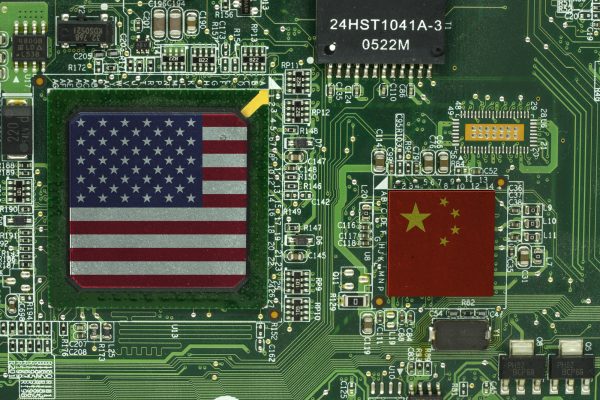
In recent years, the United States has significantly expanded its use of export controls to contain China’s rise and maintain its own technological dominance. At the center of this tech containment are restrictions on the export of advanced semiconductors, which is explicitly aimed at “maintaining as large of a lead as possible” for the U.S. over China in artificial intelligence (AI). The Biden administration launched several rounds of comprehensive controls over China’s access to advanced AI chips, manufacturing equipment, software, and talent. The underlying rationale is straightforward: by denying access to advanced U.S. chips and the hardware and software China would need to develop its own, the United States can “choke off China’s access to the future of AI.”
This strategy initially appeared effective, with OpenAI and other leading U.S. companies maintaining a comfortable edge over their Chinese counterparts. Then came DeepSeek and its latest V3 and R1 models. They appear to have closed the performance gap with leading U.S. models, challenging the idea of a U.S. monopoly over advanced AI models. DeepSeek has thus sparked intense debate about the tech containment policy’s effectiveness. While AI leaders such as Dario Amodei and Miles Brundage quickly argued that DeepSeek’s success did not represent a failure of export controls but rather evidence that restrictions should be strengthened, the development has raised serious questions about the long-term viability of such policies.
Proponents of U.S. export controls argue that DeepSeek actually demonstrates the success of the U.S. policy. The company’s founder, Liang Wenfeng, has openly acknowledged facing significant challenges due to the inability to acquire state-of-the-art chips. The restrictions on advanced chips such as Nvidia’s A100 and H100 GPUs have undeniably created substantial bottlenecks for China in developing large-scale AI models. These chips, critical for training and deploying cutting-edge AI systems, represent the pinnacle of semiconductor technology. Without them, companies like DeepSeek must rely on older, less powerful hardware, limiting their ability to compete directly with Western counterparts. This aligns with the U.S. strategy of maintaining U.S. companies’ competitive edge in the global AI race.
However, DeepSeek’s story reveals a more complex paradox. While U.S. export controls have succeeded in creating mounting obstacles, they have also inadvertently spurred alternative and potentially more important innovation paths. Without the export controls, Chinese tech companies might have just followed their U.S. counterparts’ path of massive capital investment. But instead, companies like DeepSeek have been forced to maximize the potential of less advanced hardware, which the United States is unlikely to restrict given China’s chip companies have developed homegrown options. The result is a cost-effective AI model that not only challenges U.S. technological dominance but also democratizes global access to AI technology.
The implications of DeepSeek’s success for the global AI landscape are significant. By developing highly efficient AI models that perform well using less advanced hardware, DeepSeek has created solutions that are both affordable and accessible to a broader range of users and industries. This contrasts sharply with the prevailing U.S. mode of AI development, dominated by expensive, resource-intensive models requiring massive computing power. U.S. companies have poured billions of dollars into AI development, with each new model requiring vast arrays of Nvidia’s most expensive chips – often deploying hundreds of thousands of H100 GPUs at a cost of tens of thousands of dollars each. The newest Grok 3 model from xAI utilizes 200,000 H100 GPUs. This capital-intensive approach has become the hallmark of U.S. AI advancement, with companies like OpenAI and Anthropic reportedly spending over $100 million on training a single large language model.
For many countries, particularly in the Global South, the sheer cost of developing and deploying such models has been an insurmountable barrier to adopting AI technologies. If the U.S. monopolizes AI, other countries might have to depend on U.S. technology, making access to AI another lever of U.S. power.
DeepSeek’s innovation offers a potential solution to this global imbalance. By reducing reliance on expensive U.S. chips, AI becomes more accessible to countries traditionally excluded from the high-tech revolution. This democratization of technology has the potential to accelerate economic development and innovation in countries long marginalized in the global tech ecosystem. The Global South is rapidly recognizing the opportunities DeepSeek might offer, potentially weakening the United States’ monopoly on AI technology and its future power position.
In the strategic competition between China and the U.S., Washington’s focus on maintaining its edge through export controls might prove shortsighted. The speed of technology diffusion could significantly impact global power dynamics. The ultimate beneficiary of the AI revolution may not be the technology leader but rather the country that most effectively spreads the technology across many sectors. The U.S. model of AI development, while ensuring technological leadership, creates substantial barriers to widespread adoption across economic sectors. This is where DeepSeek’s real significance lies.
By dramatically reducing costs, DeepSeek has accelerated AI diffusion and created market opportunities for China’s less advanced AI chips. In less than two months, its new models have been integrated with major Chinese internet services, the Internet of Things, electric vehicles, schools, and even governments. This list continues to grow rapidly. The fact that DeepSeek runs on Chinese AI chips also demonstrates that these less expensive chips, combined with efficient models, can deliver sufficient AI performance.
DeepSeek has opened a new competitive front – the widespread adoption of AI in society. In this arena, China may hold significant advantages due to its vast domestic market, integrated digital ecosystem, and demonstrated ability to rapidly deploy technological innovations at scale. Unlike the race for cutting-edge development, where the United States maintains clear leadership and stringent export controls might help, this new battleground of AI democratization and societal implementation plays to China’s strengths in commercial application and mass market penetration.
By forcing China to prioritize efficiency over raw computing power, U.S. export controls may have inadvertently accelerated China’s path toward widespread AI adoption. This focus on optimization and cost-effectiveness aligns perfectly with the requirements for mass deployment of AI across Chinese society, where practical implementation and accessibility often matter more than achieving state-of-the-art performance. The resulting models, designed to run efficiently on more modest hardware, could prove to be a crucial advantage in the race to integrate AI into everyday applications and services.
The DeepSeek case encapsulates the fundamental paradox of U.S. export controls: policies designed to stifle innovation in rival nations have inadvertently fueled alternative development paths, opening a new arena where the United States holds no clear advantage. While the restrictions have created immediate obstacles, they have forced companies like DeepSeek to explore different approaches, resulting in accessible AI solutions that challenge U.S. technological dominance. For the global community, this represents potential democratization of AI technology. For China, it serves as proof of concept that a different way of AI development with modest chips is possible. For the United States, it raises critical questions about the long-term effectiveness of restrictive policies and their unintended consequences in reshaping the global technology landscape. Strategically speaking, the success of export controls could lead to the policy’s failure.
As the global tech ecosystem continues to evolve, the DeepSeek story serves as a powerful reminder that innovation often thrives under pressure, and policy decisions can reshape power dynamics in unexpected ways. The success of technology containment may ultimately depend not on its ability to contain an adversary’s advancement, but on policymakers’ capacity to anticipate and adapt to the innovative responses such a policy provokes.