

Eight civilians were killed and over 20 others were injured by two airstrikes carried out by the Myanmar military in Sagaing Region’s Talaing village on June 30. Such airstrikes by the Myanmar military have grown in frequency, especially in resistance strongholds that are under the control of the opposition National Unity Government’s People’s Defense Forces.
The secret behind the Myanmar military’s increasing airstrikes is its unhindered access to jet fuel through an intricate and opaque network of intermediaries, offshore entities, and regional trading partners across several countries.
For several months after the coup of February 2021, the bulk of aviation fuel entered Myanmar as direct sales of fuel shipments, where suppliers were easily traceable. Over time, supplies became more indirect, especially after the United States, United Kingdom, European Union, and other countries imposed sanctions on Myanmar.
From 2023, fuel was bought and sold more than once before being imported into Myanmar to camouflage the original suppliers.
Amnesty International and Reuters have documented the role of Iran in supplying jet fuel to Myanmar through a fleet of ghost ships that actively engage in spoofing – a technique common among cargo ships and tankers making illicit deliveries – to conceal their role.
A probe by a group of independent investigators and Burmese expatriates over the past couple of years found that the supply chain of jet fuel to Myanmar has shifted substantially after the imposition of Western sanctions. After examining official documents from several ports in Myanmar, leaked bank documents and data from open sources, the group was able to identify the network and some suppliers.
We, the two authors of this article, interviewed two investigators in the probe into the jet fuel supply chain and also examined some documents made available to us. We also sent emails to the companies allegedly involved in the jet fuel trade with questions about the findings of the investigators, but did not get replies from them.
Role of BAI Pte Ltd
The investigation revealed that BAI Pte Ltd, owned by Thomas Pek Ee Perh, was set up in Singapore in 2023. The company’s online presence indicates that its core business is in the food industry.
But, according to shipping documents seen by The Diplomat, BAI Pte Ltd supplies petroleum products to Myanmar-related companies and the Myanmar military. The firm is also a supplier to the Myanmar-based Myat Myittar Mon Co Ltd Group and the Shwe Byain Phyu Co Ltd, which were sanctioned by the U.S. Office of Foreign Assets Control (OFAC) on February 1, 2024, and the Canadian government on October 31, 2023. It also supplies petroleum products to Vital Energy Ltd, which Shwe Byain Phyu Co Ltd set up on February 7, 2024, after it came under sanctions.
Investigators into the jet fuel trade say that BAI Pte Ltd sources products from Singapore-based entities to ensure the uninterrupted flow of petroleum products to the Myanmar military and also other entities such as Heyday Energy Trading Co Ltd and Brighter Energy Co Ltd.
“Facilitating Myanmar-related trade in Singapore that involves sanctioned parties would be extremely difficult without high-level intervention or established relationships with Singaporean banks,” one of the investigators told The Diplomat on condition of anonymity.
The probe went on to unearth that the Singapore-based company’s own onboarding document is titled “Iran-Myanmar TCR 1554,” which proves its linkage with both sanctioned regimes.
The company allegedly supplied Jet A-1 fuel to Myanmar as late as June 2026 using a Bangladeshi port-of-call as cover for the actual destination. MT Great Lake, the carrying vessel, was found to have prior confirmed links with both Myanmar and firms associated with Iran.
Investigators claimed that leaked bank documents revealed that funds for these transactions were routed by the Myanmar regime via intermediaries in Thailand, such as Chern Charoen Co Ltd, Multitrade Co Ltd, Khun AR Trading, and Dynasty Power Co Ltd on behalf of Myanmar National Airlines, owned by 24hr Group, whose chairman, U Aung Aung Zaw, enjoys a close rapport with the Myanmar regime.
MT Great Lake’s Discharge at Yangon
The vessel MT Great Lake, which sails under a Panama flag, discharged jet fuel at Yangon on June 5, 2026, as revealed by documents accessed from the Myanmar Port Authority. Investigators said that its automatic identification system (AIS) – the real-time monitoring of a vessel’s global location, speed, and status through satellite technology – exhibited the same evasion tactics as the vessels scrutinized earlier by Amnesty International and Reuters.
Between May 21 and June 9 this year, MT Great Lake became undetectable while loading jet fuel by ship-to-ship transfer in Malaysia, where it was anchored before going untraceable. Global Fishing Watch confirmed to investigators that it anchored at Telok Ramunia, Pengerang, and Pasir Gudang in Malaysia through April and May, then spoofed on May 26, showing that it was on a port visit to Gothenburg in Sweden. On May 26, it broadcast a single position in Skagerrak, which lies between Denmark and Sweden – roughly 9,000 km from where it was days earlier near Singapore.
The vessel reappeared on June 9 at the Yangon river approach, just after the discharge of jet fuel. It then sailed south along the Andaman coast, while still broadcasting its destination as Chittagong in Bangladesh. This routing pattern of listing a third-country port of call to obscure the true Myanmar destination was found to be consistent with established sanctions-evasion techniques used in the supply chain.
“That fix is physically impossible and is best explained by AIS position spoofing or an MMSI (Maritime Mobile Service Identity) collision,” the investigator pointed out, adding that vessel tracking data from LSEG and Global Fishing Watch were also sourced to arrive at the conclusions.
Shipping documents seen by the investigators disclosed that since January 2025, MT Great Lake has supplied about 90,000 MT of petroleum products to Myanmar-based firms such as Myat Myittar Mon Co Ltd, Brighter Energy Co Ltd, Vital Energy Co Ltd, and other firms having strong links with the Myanmar military. Furthermore, it also transported jet fuel to Myanmar National Airlines.
Great Lake is one tanker in a wider fleet of vessels that supply petroleum products, including jet fuel, to Myanmar. The MV Golden ES, sailing under the Palau flag, is another vessel known for its involvement in controversial shipments from Iran, including covert deliveries of urea to Myanmar and trips to the Red Sea region.
Role of Maruti Energy DMCC and Other Companies
Maruti Energy DMCC, a petroleum and shipping company registered in Dubai in the UAE, was also found to be engaged in the movement of Iranian crude and petroleum products. As per the company’s website, it trades in urea, LPG and other petroleum products and in the barter of commodities. In 2025, the U.S. Treasury targeted its vessels and associated companies for operating in the shadow fleet used by Iran to evade international sanctions. It explicitly listed Iranian-manufactured branded products as part of its commercial offering. The company also self-declared Singapore as one of its business associate jurisdictions.
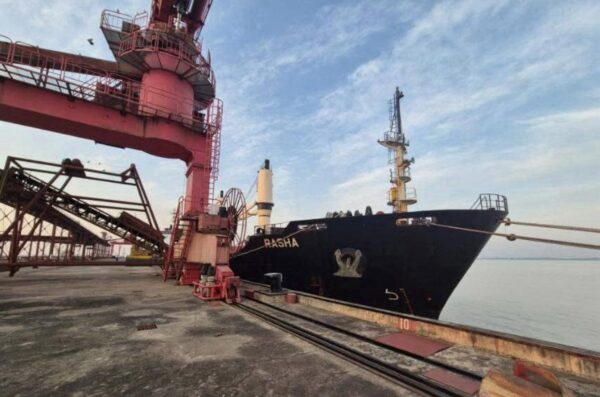
Investigators found that Maruti Energy DMCC and its related shipping companies had supplied diesel and urea to Myat Myittar Mon Co Ltd. Incidentally, this firm was among the largest importers of fuel in Myanmar. It also imported five shipments of urea from Iran on the vessel MV Rasha in addition to lubricants from Iran and Russia, which have dual use.
The UAE-based Phoenix Ship Management FZE is another firm found to have transported colossal quantities of Iranian petroleum products last year, including condensate and naphtha to Myanmar on vessels identified as Nebula Drift, Aether Sail, Tidal Rhythm, and Voyager Haven.
Investigators claimed that there were at least four more vessels supplying diesel and gasoline to Myat Myittar Mon Group and Heyday Energy Trading Co Ltd.
The Diplomat sent emails to BAI Pte Ltd, Maruti Energy DMCC, and Myat Myittar Mon Group of Companies asking for their response to these findings. As of publication time, none had responded.
As Myanmar’s military lost ground to ethnic armed organizations in 2023 and beyond, air strikes have increasingly become one of the junta’s main weapons. It increasingly cannot control the land, but it does dominate the skies. But even that control is only made possible by continued access to jet fuel. Each loophole in the sanctions regime feeds back into deadly airstrikes like the one on June 30.