

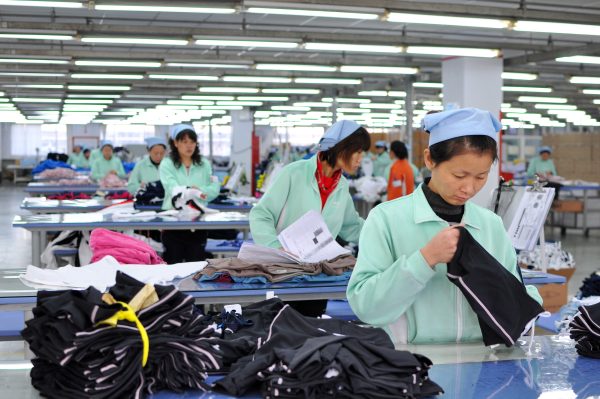
There is rising chatter about Vietnam and Bangladesh harnessing cheap labor to compete head on with the textile manufacturing “Made in China.” What does this mean for the 20 million people in China whose livelihoods are tied to the textiles industry?
When economic reforms began in the 1970s, China desperately needed a way to stimulate its economy and employ its large unskilled, cheap, yet willing workforce. Policymakers turned their attention to making China the manufacturing powerhouse of the world. Their success eventually coined the label “Made in China,” with 83 million people working in factories by 2000.
This push to manufacturing, particularly in the textiles industry, played a large role in pulling a stunning 800 million people in China out of extreme poverty, defined as those living on less than $1.90 per day. As of 2018, more than 700 million people in China have moved into the middle class.
Most of China’s textile manufacturing is clustered around the coastal regions of China, such as Guangdong, Zhejiang, Jiangsu, and Shandong. These provinces have historical and geographic advantage because their proximity to the ocean allows them to reap the benefits of logistics and shipping. After all, the cheapest way for transporting cargo is still via ships despite advances in aviation and trains. Especially with fashion trends constantly changing so rapidly, it’s crucial that the textile manufacturing hubs are near trade ports.
These regions have been the poster-child of China’s rapid development, highlighting how mass manufacturing can play a large role in transforming a developing country like China from rags to (lower-middle income) riches in the matter of three decades.
China’s Changing Landscape: Internal Threats to “Made in China”
Thanks to manufacturing stimulating the economy of China’s coastal regions, these provinces have begun to develop rapidly. The rise in wealth pushed more people to college in recent years, with more than 11.58 million college graduates in China 2023, an increase of 800,000 over the previous year.
As China grows richer and more educated, fewer young people are interested in taking jobs on the factory floor.
In Yiwu of Zhejiang province, a factory owner shared: “Young people come to me as college educated looking for white-collar jobs as accountants, when I only need more blue-collar factory workers on the ground. I offer to pay people more to be blue-collar workers, but there’s a decline in young people willing to work in factories today.”
This is a great sign and incredible feat for China’s development; the country was able to upgrade the public’s skills and education within one generation. More highly educated people enable the freedom of choice and careers of young people, creating a premium cost for blue-collar factory workers. This, in turn, poses new risks, as cheaper labor in countries like Vietnam becomes more attractive for manufacturers.
Couldn’t China just import cheaper labor from its underdeveloped poor communities in western China? In the relatively underdeveloped west, labor is cheaper because of higher unemployment, coupled with lower education and skill levels on average.
However, China already has had the largest migration in human history from 1978 and 2012, with 260 million rural farmers moving to the big cities to take jobs in manufacturing. This placed large burdens on cities to provide healthcare, schools, and social welfare to migrant workers and their families. Another wave of migrant workers from China’s west to serve as cheap factory workers in the east would only add to the strain urban finances, and further inequality with urban poverty.
If moving millions of workers east to staff factories is infeasible, should China relocate its factories inland to these less developed areas in western China? Despite some efforts in that regard, it’s largely still too expensive, since the initial infrastructure for starting these factories is costly.
Another option would be for China to implement more automation in the textiles industry. This would solve the problem of keeping the factories within China, because higher labor costs would be counterbalanced by fewer employees. However, it would mean fewer jobs in textile factories, which would shift the job market for low-skilled laborers toward service and delivery workers.
These ideas are getting closer to a solution.
How E-commerce and Consumerism Saved “Made in China”
China’s population of 1.4 billion people has a growing middle class that has allowed China to enter a consumerist culture with the rise of digitization and e-commerce – despite consumption per capita in China being below the world’s average. E-commerce platforms such as Taobao and Pinduoduo have a business model oriented around affordability rather than high quality, providing more opportunities for different socioeconomic classes of people to shop online. Digitized and instantaneous shopping have become inherent parts of life in China today.
As a result, 70 percent of China’s textile output feeds directly back to the domestic Chinese market. Despite COVID-19 dropping the overall Chinese household consumption by 3 percent, with textiles declining by 2 percent in 2022, China’s overall online consumption has increased since 2022. China delivered 120 billion packages in 2023, averaging nearly 100 packages per person per year, up 8.5 percent since 2022. With the rise of e-commerce and domestic consumerism culture (despite not necessarily guaranteeing an overall consumption increase), there are more small orders being placed online every day.
Amid the e-commerce boom, many rural villages in the coastal regions – where there is still cheap labor – have begun to cluster together to manufacture low-end products like leather jackets to sell on Taobao and other e-commerce platforms. The result is a new trend known as “Taobao villages.”
Many of these Taobao village clusters focus on similar products. One town will specialize in all leather products, while others will specialize in children performance clothing. Through their clustering, small business owners and mom-and-pop factories can lower the supply chain costs by using the same infrastructure roads, logistic centers, and e-commerce platforms.
Clustering also allows the skill transferability to be more seamless, ultimately lowering the barrier to learn and enter the manufacturing market in China. If you don’t know how to make your village’s specialty, you could simply ask your neighbor.
By clustering together, these Taobao villages have created a semi-self-sustaining ecosystem that creates a cushion to external shocks. Thus, despite the rising labor costs, China is able to lower the other factors that impact the costs of Chinese-produced clothes. Many labor economists often forget that it takes more than just the cost of factory workers’ labor that’s factored into “Made in China” clothes. Vietnam hasn’t invested as early and as heavily as China has in their roads and infrastructure to create this type of clustering ecosystem.
E-commerce has incentivized more people to join the production and consumption era, keeping “Made in China” clothes relevant. China alone has 1.4 billion people that will still consume their own textile output. Moreover, unless Vietnam and Bangladesh can reduce its non-labor related factors to reduce the supply chain costs, China can stay alive in this cutthroat competition.