

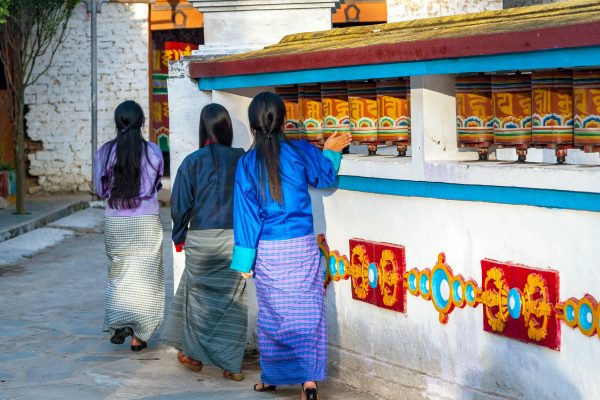
Bhutan is the world’s most mountainous country, when measured by the percentage of the landmass covered in mountains. The only strip of flatland lies to the south, bordering the Indian states of West-Bengal and Assam. It is on this flatland, stretching across multiple Dzongkhags (districts) where most of Bhutan’s industries and factories are located.
One such factory we refer to by the pseudonym of “Himalayan Distillery.” The liquor produced here is made out of Himalayan spring water and its end products, known by different brands, dominate the domestic market. The majority of the workface in this factory consists of single women labor migrants.
An Asian Development Bank report in 2011 established that “the poorest members of Bhutanese society are women who head rural households due to divorce or widowhood. While the survival of their households depends on their income-earning potential, they face limited employment opportunities.” The report added that “low educational levels among rural women” further exacerbate their plight. Single female-headed households in rural Bhutan are therefore identified as particularly economically vulnerable.
It’s been almost a decade-and-a-half since the publication of this report, and the intervening period witnessed a steep rise in internal migration in Bhutan. Single (whether unmarried, divorced, or widowed) and undereducated rural women are part of this trend. In the southern industrial belt, the Himalayan Distillery serves as a symbol of hope, granting employment opportunities and financial independence to marginalized groups of mostly undereducated women.
According to a factory official, of the nearly 400 current employees, around 70 percent are women. This gender distribution is notable, as it contrasts with the typically male-dominated workforce in other factories, such as those producing steel and chemicals. The vast majority of these female employees are single women.
The factory prefers to recruit single women as they are seen as more flexible in their working hours, including their willingness to work night-shifts and overtime. The nature of the work – mostly packaging, but also cleaning, quality-control, and administration – is also considered to be well-suited to women. Crucially, the factory demands no formal educational qualifications and so appeals especially to those women with limited schooling.
Many of the female employees interpret the factory’s hiring preference for single women as a form of generosity. For female labor migrants, the Himalayan Distillery offers a sense of financial independence. Depending on the number of shifts they work, as well as their seniority, the workers earn anywhere between 8,000-10,000 Bhutanese ngultrum (roughly $95-$120) a month. While considered a low wage in Bhutan, this is significantly higher than their expected earnings in their home villages, mostly in agriculture.
The migrant workers rent accommodation. Housing is often simple, with rusty corrugated metal sheets as the roof, uneven flooring, and irregular water supply. Toilets must be shared between residents and this at times makes maintaining hygiene a challenge.
Due to the constrained toilet and water facilities, women are regularly compelled to bathe in open areas near public water taps. This compromises their privacy and makes them feel vulnerable. Female workers at the factory complain about the occasional insinuating and snide remarks that are thrown at them by passers-by while bathing.
On the flipside, the housing is considered affordable, with a rent of approximately 2,000 ngultrum, excluding water and electricity. The salary and accommodation together provides the women with a much-desired sense of livelihood security, something the workers highlighted in interviews. To a degree, then, their employment in the Himalayan Distillery helped to alleviate their earlier economic vulnerabilities.
However, their status as single female labor migrants in the Himalayan Distillery also comes with a new set of vulnerabilities, most of them strongly gendered. The absence of privacy while bathing and related snide remarks is just one example. Within the wider society, the single female workers of the distillery have come to be associated with the product they help to produce: alcohol.
While the consumption of alcohol is widely accepted in Bhutanese society, and alcohol carries cultural and ritual significance, its consumption is often evaluated differently for men and women. Women’s public association with alcohol, whether as consumers or – in our case – as producers, invites social labeling, negative stereotyping, and stigma. It is widely associated with an assumed moral laxity, which results in female migrant laborers in the factory being presumed to be of “low character” and “sexually available.”
Pema is a 44-year-old ex-employee of the distillery who now runs a small grocery shop. She shared her experiences of being judged by society for working in the Himalayan Distillery. She highlighted how the company bus that daily shuttles in and out of the distillery is referred to as maal gari, which freely translates to “goods train” – a slang phrase to describe women who can be easily possessed or desired by men.
In fact, one reason why few married women are employed in the Himalayan Distillery is because their husbands actively discourage or even forbid them from taking up employment in the factory due the social stigma that surrounds it. Single female workers in the factory diagnose a paradox in their treatment. They point out that the same men who speak derogatorily about them one day try to persuade them to get married the next, promising to be good fathers to their children and provide them with a better livelihood. However, most of the workers understand that these proposals aren’t genuine and ignore them.
Wangmo, a 20-year old single female factory worker, confessed that her relatives in the village strongly opposed her joining the factory. They worried about the social stigma that existed against women employed in the alcohol industry. Despite this resistance, Wangmo felt compelled to take the job because, as the eldest daughter, she had to assume financial responsibilities, especially following her parents’ divorce.
Wangmo dropped out of school when she was in grade 10 and it was the Himalayan Distillery that offered her a job without having completed her education. She is now able to regularly send remittances to her father, as well as some pocket money to her siblings.
Wangmo is well aware of the gossip and negative stereotypes that exist about her and other female factory workers. However, she also stressed that her employment in this factory offers her much-desired economic security and independence, while she also has made many friends on the factory floor, with whom she socializes after working hours.
Overall, Wangmo argues that her living standard has increased due to her employment in the Himalayan Distillery.
There of course exist internal dynamics and hierarchies within the women workforce. Different age groups express different interests. There are instances in which workers who have been regularized (permanent workers) assert dominance over newly hired casual workers, seizing preferred tasks within the processing plant for themselves and their friends, thereby limiting opportunities for casual workers.
Similarly, during bus rides while going to or returning home from work, the permanent workers secure seats for their friends by reserving them with personal belongings, leaving no space for casual workers. The latter may even be asked to vacate seats they managed to secure, occasionally leading to arguments.
Another paradox is that for more than a few of the female workers in the Himalayan Distillery, the societal judgments they face in relation to their employment constitute their second victimization by alcohol. Some of the workers shared their past experiences of having endured domestic violence and abandonment by their husbands, often linked to alcohol. They talk about the role of alcohol in their divorces, or even in them becoming widows.
These women now find themselves producing the very product that had earlier significantly contributed to their economic vulnerability. But while this time alcohol has been their pathway to economic security, the same alcohol also created new gendered vulnerabilities for them.
Sonam, a divorcee, shared how she married at a very young age to an alcoholic. “My husband would come home drunk and abuse me. Because of this constant suffering I got depression and began to suffer from migraines. There was a time when I had to take anti-depressant pills to sleep at night. After I migrated here things have improved, but I still fall sick often.”
Because of her health problems, Sonam only earns around 3,000 to 4,000 ngultrum a month. As she is a “casual worker,” the factory pays her for the number of shifts she works. This income barely covers the house rent.
Casual female workers at the factory, such as Sonam, receive their pay in cash. Many of them are unfamiliar with mobile banking. They lack savings, as their salaries barely cover housing, living expenses, and pocket money for their children studying in boarding schools.
Most of the single women workers who have children stress the importance of their children’s education. Sonam, who has two children, is adamant that they should finish their education till at least the 12th grade. She is illiterate but understands the value of education, especially as she suffered from a lack of it. In the future, Sonam wants to learn how to drive and to open a pan shop. However, her illiteracy holds her back. She worries that she wouldn’t know how much money she should get from customers and how to calculate the change she must return.
When we asked about her other aspirations, Sonam said that she longed to visit Dochula, which is a pilgrim site currently at the top of her wish-list. It came as a surprise to learn that, despite having worked in Thimphu for several years prior to migrating to the south, Sonam never had the opportunity of visiting Dochula, which is just a 45-minutes drive from Thimphu. This illustrates the degree to which Sonam has sacrificed her personal aspirations due to economic constraints at home.
Sonam found solace in the fact that she had visited Buddha Point during her time in Thimphu, not once but twice.
Overall, the Himalayan Distillery has emerged as a source of employment for single female labor migrants, including those with little or no formal education, offering them an opportunity to alleviate their economic vulnerabilities. However, employment in the Himalayan Distillery simultaneously exposes them to gendered vulnerabilities.
They endure labeling and negative stereotyping, as well as often inadequate housing and water supply that compromise their privacy. These challenges are often augmented by their illiteracy and lack of financial knowledge. Internal competition and division among the women on the work floor further add to the complexities.
Nevertheless, many of the single female migrant laborers also display a remarkable sense of resilience. Like Soman, these women are supporting themselves, striving for a brighter future, and supporting the education of their children.
The life-histories and narratives of single female labor migrants in the Himalayan Distillery offer a poignant illustration of the complex interplay between economic and gendered vulnerabilities. While these vulnerabilities everywhere strongly intersect, both in rural and urban Bhutan, for many of the single female workers in the Himalayan Distillery, their migration to the southern flatland and subsequent employment in the alcohol industry is experienced, to some degree, as a trade-off between the two.
The funding support for this study came from the CLimate Adaptation and REsilience (CLARE) program funded by the United Kingdom’s Foreign, Commonwealth and Development Office (FCDO) and Canada’s International Development Research Centre (IDRC) under the Successful Intervention Pathways for Migration as Adaptation (SUCCESS) coordinated by International Centre for Integrated Mountain Development (ICIMOD). Partial funding came from ICIMOD’s core fund contributed by different member countries.