

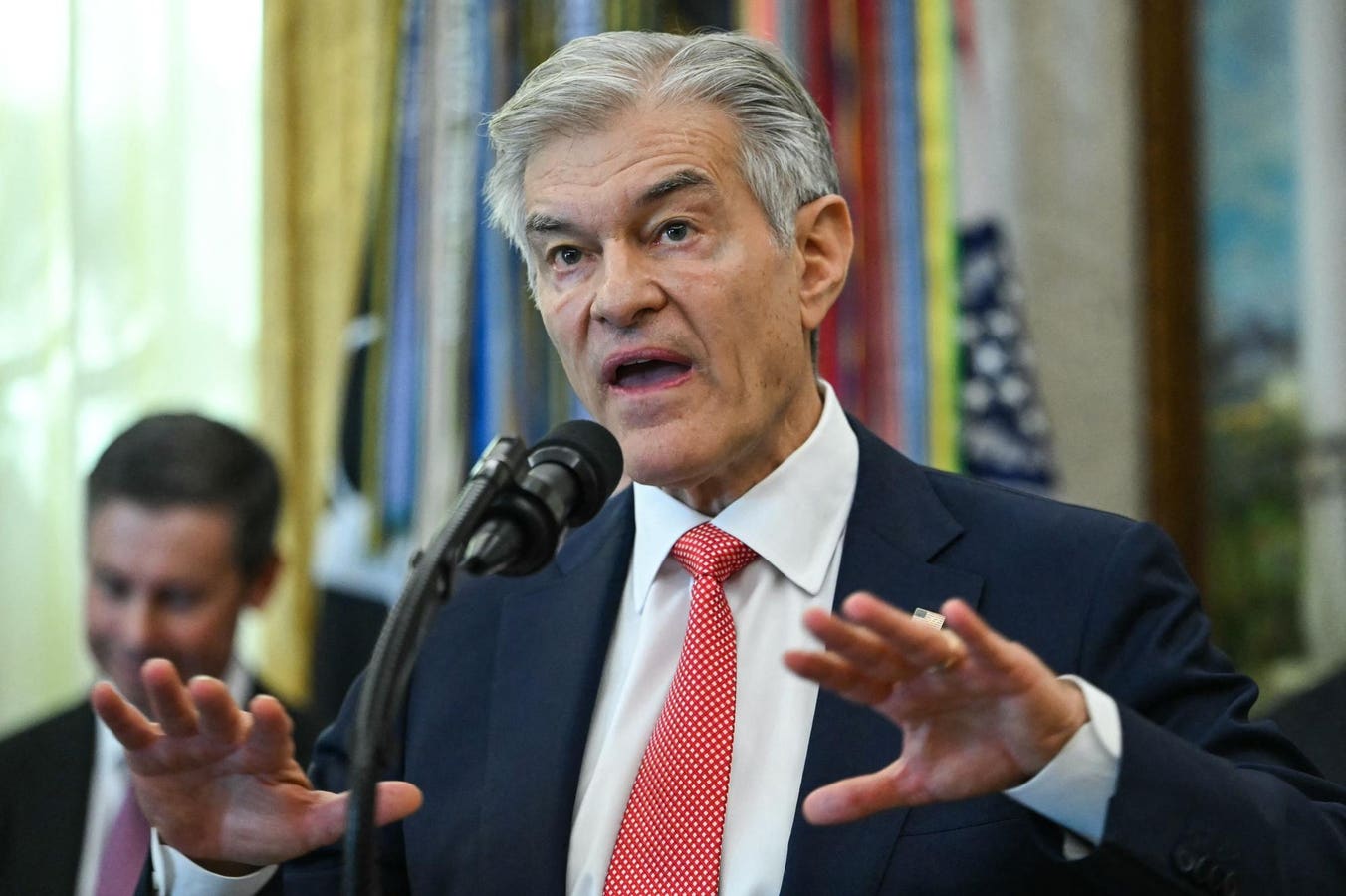
Centers for Medicare and Medicaid Administrator Mehmet Oz speaks in the Oval Office during an event about weight loss drugs at the White House in Washington, DC on Nov. 6, 2025. Starting in July 2026, Medicare recipients will be able to access GLP-1s for weight loss under certain conditions for $50 a month. (Photo by ANDREW CABALLERO-REYNOLDS / AFP) (Photo by ANDREW CABALLERO-REYNOLDS/AFP via Getty Images)
AFP via Getty Images
For some seniors and others enrolled in Medicare who want more affordable access to popular weight loss medications, they’re getting it this month for the first time through a so-called Bridge program initiated by the Trump administration. But questions linger with respect to the pilot and its cost.
The Medicare Bridge program is a temporary demonstration project running from July of this year through December of 2027 that provides people over 65 and certain disabled individuals access to select weight loss medications, including Zepbound (tirzepatide), Foundayo (orforglipron) and Wegovy (semaglutide). Beneficiaries pay a flat co-payment of $50 per month, regardless of income.
Although individuals seeking access must be enrolled in Medicare’s outpatient drug benefit called Part D, the Bridge program operates completely outside Part D ‘s payment and insurance structure. Prescribers must submit a beneficiary’s prescription and prior authorization directly to Bridge’s central processor managed by the Centers for Medicare and Medicaid Services rather than the recipient’s drug plan.
Because the Bridge program runs independently of Part D, plan sponsors don’t carry financial risk for eligible glucagon-like peptide-1 drugs furnished under the demonstration project.
GLP-1s are used to treat a wide range of conditions, including type 2 diabetes, obesity, sleep apnea, chronic kidney disease, a form of fatty liver disease called MASH and risk reduction related to cardiovascular events.
While GLP-1s are popular and have demonstrated effectiveness, they’re prohibited by law from coverage by Medicare for weight loss alone. To bypass this statutory restriction, the Trump administration proposed the Bridge program coupled with a five-year pilot called BALANCE, which stands for Better Approaches to Lifestyle and Nutrition for Comprehensive hEalth. This is a voluntary initiative aimed at expanding access to GLP-1s for obesity while providing manufacturer-supported lifestyle support.
By negotiating lower net prices with drug manufacturers, CMS established in theory a favorable condition for Part D plan participation in BALANCE. But CMS had to indefinitely pause the initiative due to insufficient plan sponsor participation (did not reach an 80% threshold).
Though BALANCE has been put on hold, CMS is moving ahead with the Bridge program. Millions of Medicare beneficiaries will become eligible to receive obesity medicines for $50 a month. To qualify, individuals must meet strict Body Mass Index guidelines (a BMI of 35 or higher, or between 27 and 35 with an obesity-related comorbidity).
Approximately 16 million Medicare recipients already qualify for GLP-1 coverage through existing conditions such as diabetes or cardiovascular disease risk factors. But now about 13 million overweight and obese beneficiaries, including some who don’t have co-morbidities, will also be eligible for coverage through 2027.
This said, for some seniors and disabled folks, $50 a month is still a big expense. In particular, low-income beneficiaries are accustomed to paying $5 to $10 for their standard prescriptions, making $50 a major barrier, according to KFF Health News. Additionally, because the $50 co-payment circumvents Part D, the amount doesn’t count toward a beneficiary’s annual deductible or out-of-pocket maximum. Moreover, Medicare recipients who qualify for the low-income subsidy are not allowed to use that assistance to lower the $50 GLP-1 co-payment.
Further, with Bridge scheduled to expire at the end of 2027, a question looms regarding what will happen when the program expires. If the Trump administration doesn’t extend it, this could lead to people stopping their medications. In turn, this would likely result in weight gain and the return of co-morbidities.
There are no guarantees that Bridge will be extended. The program’s cost may prove to be a limiting factor. Spending on GLP-1 drugs for currently covered indications such as type 2 diabetes under Medicare and Medicaid has increased substantially in a relatively short period of time. Adding coverage of GLP-1s for obesity, even at the lower net prices CMS will pay for these medications under Bridge, could add another financial liability for the government that may be called into question.
When the Biden administration first proposed adding coverage of drugs for obesity alone to Medicare’s outpatient drug program Part D in 2024, it estimated the cost at between $25 billion and $35 billion over 10 years.
Such large numbers could have been a driving factor in the reluctance or unwillingness of plan sponsors to participate in the BALANCE model as it was originally designed.
Curiously, CMS documentation hasn’t included potential financial implications for the government from either BALANCE or Bridge. The agency’s decision not to publicly release cost estimates is especially odd given how expensive this could be for taxpayers who foot the bill. Is the agency afraid to be wrong? Or is CMS deferring to the Congressional Budget Office which has crunched the numbers?
The CBO has estimated that if every eligible beneficiary enrolled in the Bridge initiative annual taxpayer spending on the program could exceed $30 billion. Of course, it’s not likely that so many folks will actually take the medications. But suppose that 20% do, the cost would be roughly $6 billion annually, a large number that could crowd out the ability of government to fund other healthcare items.