

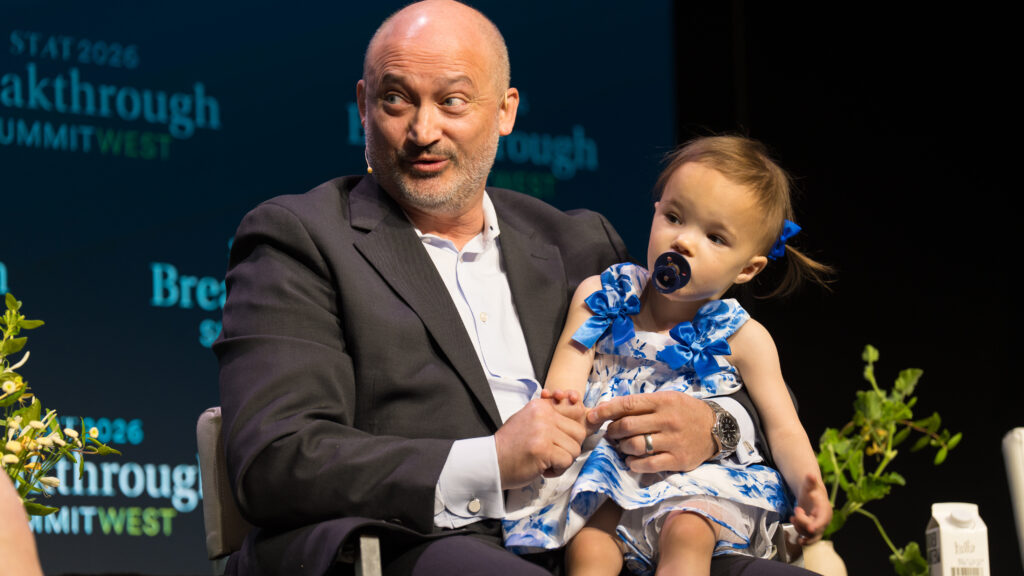
In the first, tenuous weeks of her life, Jorie Kraus and her parents faced her possible death repeatedly. Muscles throughout her tiny body simply didn’t work properly. Her heart. Her legs. Her larynx. Even the involuntary action of breathing was labored, and constantly faltering.
In those panicked days, through a haze of terrible news and incomprehensible instructions, something incredible happened: A long-shot attempt to discover the root cause of her problems identified a widely available, yet previously unknown, treatment.
“The results were so fast,” Joanie Kraus, Jorie’s mother, told the audience at STAT’s Breakthrough Summit West in San Francisco Tuesday. Suddenly, she recalled, a child who spent 73 days in a neonatal intensive care unit and then the first two years of her life facing developmental plateaus, could move freely, maneuver around obstacles, and look at a Fisher-Price toy, hold it up, and say “(s)quare,” even if dropping the s.
“I said, ‘This can’t be,” Joanie Kraus recalled. “It can’t be, and it can’t be so fast. It was almost like a light switch.”
What turned the switch on, improbably, was Klonopin, a widely available muscle relaxer commonly used to treat seizure disorders and panic attacks.
A program at Mayo Clinic discovered that Jorie was born with an ultra rare condition caused by a deletion of genes connected to chromosome 10, causing her to suffer a constellation of neurodevelopmental and motor symptoms. Doctors rapidly sequenced her genome and used an artificial intelligence tool known as Biomedical Data Translator to identify Klonopin in a vast database of available compounds as a drug with the characteristics to counteract many of the disorder’s debilitating effects.
During the Breakthrough West Summit, Jorie’s parents, with the now almost 3-year-old child playing easily in her father’s lap, discussed how to scale the technologies and processes that gave their daughter a chance to thrive.
“We don’t know the ceiling” for Jorie, her mother said, noting that she has neurodevelopmental delays that will require lifelong care. “You guys, our kid got a second chance at life!”
Whitney Thompson, the physician who identified Jorie’s treatment with her Mayo colleague Laura Lambert, said multiple barriers stand in the way of bringing such rapid and effective treatment to other children with rare and undiagnosed conditions. One is the lack of widespread availability of genomic sequencing. Another is the difficulty of doing rapid laboratory testing to confirm a potentially effective — and available — treatment.
But she said, through the process of treating Jorie, a crucial truth became undeniably clear about the series of discoveries that saved her.
“I don’t think we would have gotten there without the AI tool,” Thompson said. “It’s able to make inferences across all the biomedical literature, things that we wouldn’t have been able to connect otherwise. So the AI portion of this was absolutely critical.”
That AI tool, the Biomedical Data Translator, was built by a consortium of researchers working with funding from the National Institutes of Health to create an open-source knowledge graph that can harmonize, integrate, and reason over disparate data sources. It has been used in recent years to identify treatments for multiple patients with ultra-rare conditions, although implementing it consistently and reliably across health systems, in diverse geographies, remains a work in progress.
Jorie’s parents started an organization called the Jorie Effect to provide funding and other resources to help children and families with the same condition. Jorie’s example has already begun to have an effect, even for children considerably older than her for whom development was stymied by similar genetic deletions.
Joanie Kraus recounted the case of a patient several years older whose family reached out on Monday. The child’s neurologist had followed the same steps used to treat Jorie and prescribed Klonpin, generating a breakthrough effect.
“The child is five years old, has a different type of mutation but the same diagnosis — and went from not talking to speaking sentences,” Joanie recounted. “It’s huge.”
Dave Kraus, Jorie’s father, said the possibility of helping suffering children and families makes talking publicly about his family’s experience an imperative. It feels that way, he said, even though doing so plunges him into the worst moments of his life, when through beeping machines and maze of wires, doctors were telling him about his child’s long odds, and the possibility that she might never participate in the activity she is now undertaking: planning her third birthday party.
“The whole reason we continue to talk about it is hope,” he said. “I will continue to keep talking about it as long as someone will listen, because parents need it.”