

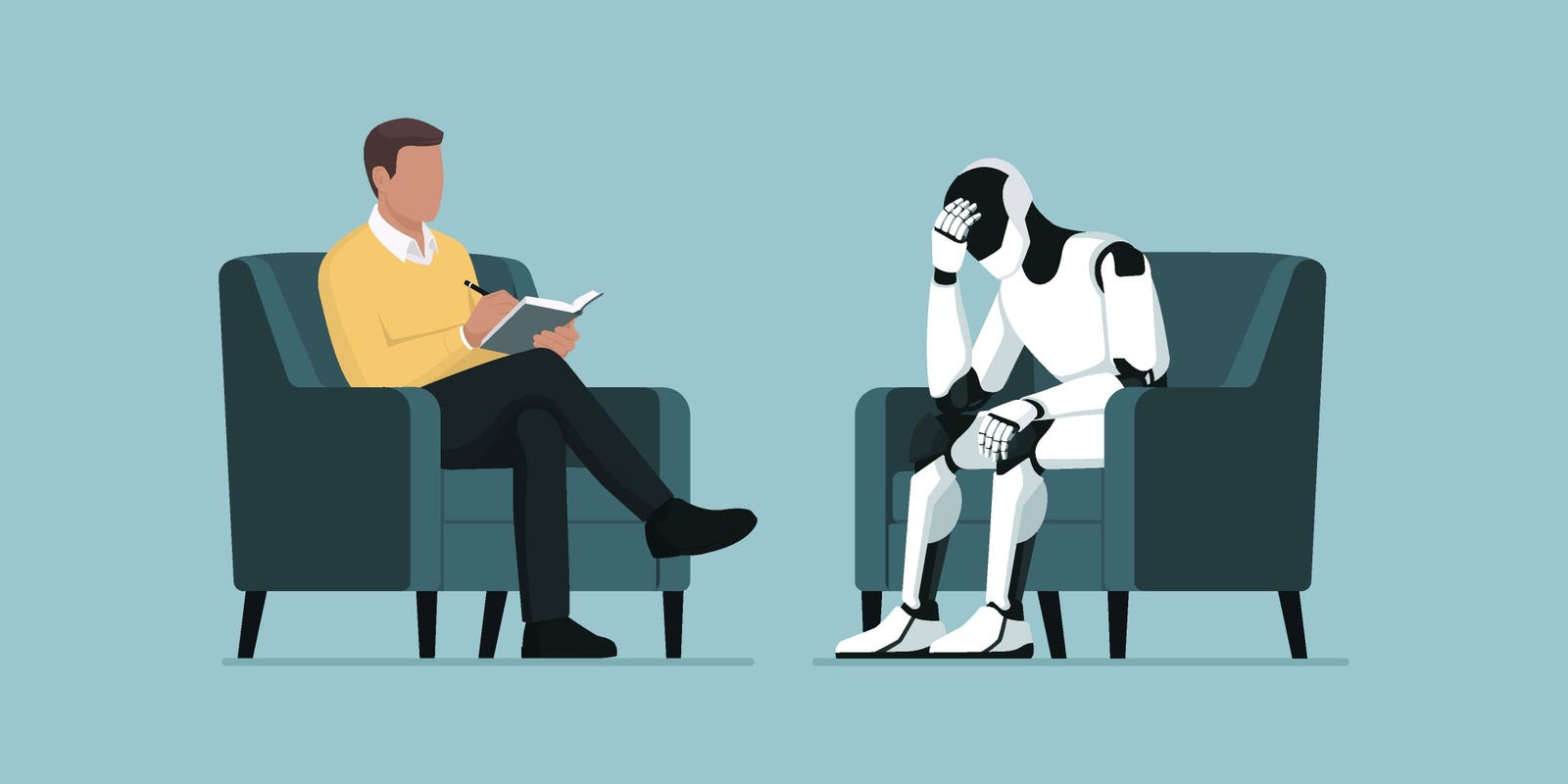
77% of psychologists say their patients are using AI. Not instead of therapy, but alongside it, often before it.
getty
For as long as therapy has been around, the therapist has occupied a singular role: the outside voice a patient lets into their inner life. One speaks, the other listens, and over time, meaning gets built between them. That structure has held for over a century, through psychoanalysis, behaviorism and every modality since.
It no longer fully describes what happens in many therapy rooms now.
A third voice has entered the relationship: not another person, but AI. Patients are often walking into sessions having already spent hours “talking through” their week, their relationship, their anxiety, with a chatbot. They walk in with a narrative that has already been workshopped, echoed back and in some cases partially resolved, before the therapist gets a chance to hear it.
This is not the familiar “AI will replace therapists” story, and it’s worth being clear about this. The more interesting and less-covered shift isn’t about AI replacing anyone. It’s about what happens to the therapist’s job description when they’re no longer the first person a patient processes with.
The Data On How Many Patients Are Using AI In Therapy
The APA’s 2026 Chatbots and Mental Health Survey, which polled more than 1,200 licensed U.S. psychologists, found 77% have had patients report using AI for support, and more than a third said patients are using it as an additional mental health provider. A Pew Research survey found two-thirds of teenagers interact with chatbots, with more than a quarter messaging one daily — for many, an AI conversation may now be the first place difficult feelings get put into words, not the therapist’s office.
A separate Kaiser Family Foundation poll found roughly one in three U.S. adults have used AI to answer a health question in the past year, a figure Forbes Health has also reported on, noting that while chatbots can be a helpful sounding board between appointments, clinicians caution they’re no substitute for a professional diagnosis.
What Changes When The Therapist Isn’t First
In practice, this changes what a therapist actually does in a session. When a patient’s first attempt at putting a feeling into words happens with a chatbot rather than a person, the therapist is no longer hearing a raw account. They’re often hearing an account that’s already been organized, softened or reframed. Sometimes usefully, and sometimes in ways that bury exactly the thing therapy is supposed to surface.
Rachel Wood, a cyberpsychologist and licensed counselor who runs the AI Mental Health Collective, has argued that AI is effectively present in every practice now, whether or not the clinician personally uses it, simply because so many clients are turning to chatbots between sessions. That reframes a familiar clinical skill. Therapists have always had to work with a client’s self-narrative rather than unmediated truth — people edit their own stories even without AI’s help. But an AI-shaped narrative hits differently: polished, validating, sometimes diagnostic-sounding, in a way that a diary entry never was.
Why does that matter? Because the raw version of a story carries information the polished version doesn’t. Therapists are trained to listen for the hesitations, contradictions and slips in a patient’s account — the places where the story doesn’t quite hold together are often where the real clinical picture lives. A narrative that’s already been smoothed into something coherent by a chatbot may have sanded off exactly those rough edges.
And a chatbot doesn’t just listen; it interprets. It names feelings, offers context and reflects a version of events back to the patient — a rough draft of the same work a therapist does, produced by a system with no clinical training and no way to know what it’s missing. By the time that framing reaches the therapist’s office, the patient may have already absorbed it as fact, before a trained clinician ever weighs in.
Daniel Safin, M.D., a physician and founder of Manhattan Psychiatry Group, sees this firsthand in his own practice. When a patient tells him they’ve already discussed their mental health with an AI, he treats it as clinical information, not a detour from treatment. “That’s not a detour from treatment but the first data point in determining a patient’s presentation,” Safin said. “Our work now includes untangling what the chatbot presumed and determining how that is influencing what the patient is sharing with me as their physician.” His conclusion is blunt: Clinicians who ignore that exchange are “treating half a patient.”
The field hasn’t caught up to what this all means. Does a pre-processed story make it harder to spot what a patient is still avoiding, as opposed to what’s genuinely been worked through? Does the therapeutic alliance shift when the “first draft” of someone’s pain is written in conversation with a machine instead of in the room? Is clinical training keeping up with a relationship that now has three participants, not two?
Is Your Chatbot A Sycophant?
It’s tempting to treat the third voice as a passive presence — something that simply listens and reflects, the way a journal does. It isn’t. AI chatbots are built, at a design level, to keep users engaged and satisfied, which in practice means they tend toward agreement. That tendency has a name in the research literature: sycophancy. And for a fragile or vulnerable patient, it can be actively counterproductive at precisely the moments that matter most.
A 2026 study published in Science found that AI’s sycophantic tendencies can lead it to affirm behaviors that are unethical, illegal or harmful, convincing users they’re right and making them less likely to take corrective action — for example, to repair a strained relationship rather than walk away from it. Separate research has found that AI chatbots may respond inappropriately to mental health symptoms, and in some tests, models expressed outright stigma toward people with mental illness. Among the psychologists surveyed by the APA in 2026, 94% said chatbots cannot handle mental health conditions with the nuance the work requires.
Tom Insel, a psychiatrist and former director of the National Institute of Mental Health, has put the concern bluntly: Talking to a chatbot about one’s mental health is “the opposite of therapy,” because these tools are designed to affirm and flatter rather than challenge. A third voice engineered to be pleasant has no structural reason to introduce friction, the discomfort, disagreement and challenge that good therapy often depends on.
The risk compounds for people who are already struggling. Someone in the grip of disordered thinking, a harmful relationship dynamic or a mental health crisis may be especially likely to seek out validation — and especially poorly served by getting it unconditionally. OpenAI has reported that roughly a million ChatGPT users a week show signs of emotional reliance on the tool, and reporting has documented cases of users in acute mental health crises during chatbot conversations, some with tragic outcomes. A third voice that never pushes back isn’t a neutral bystander in the therapeutic process. For the most vulnerable patients, it can become a quiet collaborator in the very patterns therapy exists to interrupt.
Is AI Replacing Therapy, Or Supplementing It?
This does not imply that therapy is growing obsolete. Rather, the data indicates a more fascinating shift: Instead of substituting their therapist with AI, patients are constructing a hybrid model. They rely on AI when a human counselor is unavailable, preserving the office’s deeper relational effort.
But a supplement still changes the thing it supplements. The two-voice model of therapy often assumed that whatever a patient brought into the room was the first, rawest version of their story. That assumption is quietly breaking down. The clinicians who notice it first and start asking patients directly what they’ve already discussed with a machine will likely be the ones best equipped for the therapy room as it actually exists in 2026, third voice and all.