

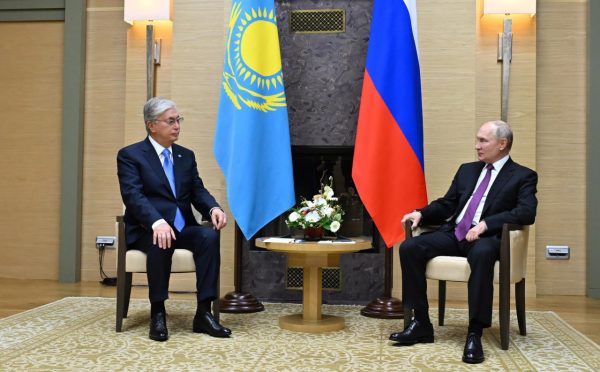
During a recent visit to Germany, President of Kazakhstan Kassym-Jomart Tokayev made several conflicting statements. Tokayev stated that, on the one hand, Kazakhstan will pursue comprehensive cooperation with Russia, while on the other hand, it will adhere to the sanctions imposed against Russia.
Why do these these promises contradict each other? Because it is technically impossible to strictly adhere to a sanctions regime and simultaneously support comprehensive economic cooperation with the sanctioned country. In this case, there is both a customs union and free currency conversion between Kazakhstan and Russia which smooths trade between the two and complicates sanctions enforcement.
Despite Tokayev’s assurances of Kazakhstan’s compliance with the sanctions regime, the country remains an important source of “parallel imports” for Russia.
The table below reflects an anomalous growth in Kazakhstan’s external trade turnover in 2022, which is worth considering closely.
It’s notable that Kazakhstan’s exports had not exceeded $60 billion annually over the last seven years, until 2022. In a longer-term view, the highest historical export figure – $80.3 billion – was reached in 2013, when Brent crude oil prices hit a historical high at $108.5 per barrel.
On average, in 2022, considering discounts, Kazakh oil was trading at around $70 per barrel. The exponential and uncharacteristic growth of exports to $84.4 billion in 2022 is quite challenging to explain solely by an increase in oil exports, Kazakhstan’s main commodity. Oil exports in 2022 increased by $15 billion compared to 2021.
This is significant and explains a lot. However, total exports in 2022 increased by $24.4 billion compared to 2021, with a positive difference of $10 billion that stands out from the usual export structure. Oil alone does not explain the total increase in exports.
Interestingly, this difference coincides with the increase in imports over the same period.
If we look at the volume of imports in 2022 and compare them to the average annual import level over the past seven years, we can see that, on average, since 2015, Kazakhstan’s imports have hovered around $34 billion. The sharp increase in imports from $40 billion in 2021 to $50 billion in 2022 is unprecedented in the country’s modern history and is difficult to explain in terms of domestic consumption growth.
In 2022, there were no significant changes in the incomes of citizens in Kazakhstan. This is important because if household incomes had increased, the $10 billion year-on-year increase could have been explained by consumption rising, meaning greater demand from businesses for foreign goods and semi-finished products. But that didn’t happen.
The most reasonable explanation for what the data shows is a phenomenon called “parallel imports.” The $10 billion increase in both imports and exports indicates that Kazakhstan imported goods and services worth $10 billion and then rapidly “exported” them somewhere else.
Italian Strike, Kazakh Style
Kazakhstan is arguably observing the sanctions regime following the “Italian strike” principle. Astana does exactly as much as regulations and restrictions require, but not a single cent more, nothing as far as impeding parallel imports. Kazakhstan’s strategy is aimed only at avoiding secondary sanctions.
If the United States’ Office of Foreign Assets Control (OFAC) poses questions to the Kazakh side, Astana has a reliable excuse. Kazakhstan’s banks do not open correspondent accounts for sanctioned banks, they also do not process contracts involving sanctioned goods and services, and Kazakhstan does not collaborate with companies under sanctions or Russian banks disconnected from SWIFT. Furthermore, Kazakhstan regularly confiscates small quantities of prohibited goods at the border with Russia.
However, parallel imports operate in a different reality and function within a different economic coordinating system. For the bank to approve a contract, the most important thing is to enter into an agreement with a Russian company that is not on the sanctions list and to specify in the contract that the relevant goods are not subject to sanctions.
It is common today, however, for the goods actually being imported into Russia to not match what is stated in the contract. In practice, the government is not very concerned about what is being transported into Russia. On paper, a truck could be transporting women’s wigs or canned goods, but in reality, it’s loaded with drones or microchips. One reason for this is the customs union to which both Kazakhstan and Russia are party.
The absence of customs posts on the border with Russia allows shippers to avoid inspections, and the most scrutiny a shipment might encounter is a check of shipping documents on its way to the border. Many sub-sanctioned goods are bought with cash and transported across the border in car trunks, big bags, passenger buses, and so on. Estimates suggest that the value of “unrecorded” trade in monetary terms could be comparable to what is what is transported officially.
Registering a Kazakhstani company for Russian citizens takes only a few days and requires minimal documents. Kazakhstani companies may then enter into agreements with proxy companies of Russian enterprises that are under sanctions. And that’s exactly how parallel imports work.
In addition, Russian money transfer services have begun to penetrate Kazakhstan, enabling substantial sums to be transferred in rubles from Russia to Kazakhstan without fees and with minimal conversion costs. These services also play a role in “pumping” the foreign exchange market in Kazakhstan with ruble-denominated cash and acquiring sub-sanctioned goods for Russian consumers.
Particular attention should be paid to the active involvement of major Russian marketplaces that have started an aggressive expansion into the country’s logistics services market. One such player, Russia’s OZON, has made significant investments in logistics infrastructure in Kazakhstan, including the construction and acquisition of large logistics centers. OZON’s actions reveal an intention to consolidate cargo, including those related to parallel imports through Kazakhstan to Russia. Moreover, alongside Kazakhstan, OZON has initiated an active expansion into the logistics services markets of Kyrgyzstan and Armenia as well. There are reasons to believe that OZON may have been chosen by the Russian government as a key player in the logistics field for parallel imports.
The main factor that facilitates, and essentially makes “parallel imports” through Kazakhstan to Russia available, is the free conversion of rubles to tenge. Currently, rubles can be freely exchanged for dollars (through double conversion ruble-tenge, tenge-dollar) at any Kazakhstani bank or currency exchange point. This provides Russia with almost unrestricted access to the Kazakhstani currency market. Through the free conversion of the ruble into tenge, Russia gains indirect control over Kazakhstan’s sovereign currency reserves, which Kazakhstan acquires from the export of non-renewable natural resources. At the same time, the Central Bank of the Russian Federation can print unsecured ruble “paper” in any quantity and “export” it to Kazakhstan, effectively exporting its inflationary chaos.
This is in line with the former Deputy Head of the Presidential Administration of the Russian Federation Vladislav Surkov’s ideas about social entropy, which Surkov said needs to be “exported for disposal on foreign territory.” Similar processes are currently taking place in Ukraine. Kazakhstan, it appears, is also becoming an object of Russian “export” but this time of economic entropy. The consequences of such “exports” can be unpredictable. Essentially, Kazakhstan is becoming a kind of “piggy bank” for Russia that can be broken open at an opportune moment.
On one hand, rubles are used to purchase foreign currency in Kazakhstan, while on the other, they impact the commodity market. Together, this significantly weakens the tenge, causing the currency to appreciate, and, in proportion, imports become more expensive. Since imports make up 90 percent of the goods consumed in Kazakhstan, the country has experienced rampant inflation across almost the entire product range.
The losers in this scheme are Kazakhstanis, whose incomes are eaten up by inflation, and whose natural resources are exchanged for Russian “play money” through conversion. This is how Kazakhstan’s society effectively pays a “war tax” to its “ally.” This may explain why the inflation rate in peaceful Kazakhstan is around 20-30 percent, while in a country in conflict and under sanctions like Russia, inflation is limited to 5 percent.
Today, Russia may not request military assistance from Kazakhstan in the form of tanks or aircraft, as it can benefit from the economic advantages that Kazakhstan already provides.
It would be a completely different story if Russians couldn’t convert rubles and only used dollars and euros for transactions. In that case, Kazakhstan’s currency market would receive an additional influx of foreign currency; the tenge would strengthen due to increased demand; the cost of imports, with a weakening dollar, would begin to decrease; and prices for goods in the country would start to fall. But as long as the “wooden” ruble can be converted, that remains a distant possibility.
Kazakhstan’s Customs Gives the Green Light for Smuggling
The parallel imports that pass through Kazakhstan represent a complex equation with several variables. The first two variables in this equation are free currency conversion and the existence of a unified customs space due to the economic union with Russia. The third variable is smuggling from China, which, according to various expert estimates, ranges from $6 billion to $10 billion annually.
According to data from Kazakhstan’s Ministry of Finance, discrepancies between China’s recorded exports to Kazakhstan and Kazakhstan’s recorded imports from China over the past four years have been consistently around $5.6 billion annually, indicating that a significant portion of Chinese goods enter Kazakhstan without undergoing customs procedures at the Kazakh border – in other words, through smuggling.
In 2022, trade with China was conducted based on 95 HS (Harmonized System) commodity groups. Out of these, 36 groups reported a higher import value into Kazakhstan (according to Kazakhstan’s data) compared to China’s exports (according to China’s data), amounting to a total of $914.1 million (Kazakhstan’s imports exceeded China’s exports). According to the data from Kazakhstan’s Supreme Audit Office, among neighboring countries, Kazakhstan had the largest disparities in preliminary data for 2022 regarding the import of goods, with a deficit of $5.4 billion in trade with China. In conditions where it’s impossible to control a country’s imports, it’s reasonable to suggest that it is also impossible to control exports to Russia, especially with the absence of customs posts.
Corruption Serves Parallel Imports
Another significant variable in the parallel imports equation in Kazakhstan is corruption. According to the Corruption Perceptions Index published by Transparency International, Kazakhstan ranks 101st among 180 countries, scoring 36 out of 100, where zero indicates the highest level of perceived corruption, and 100 represents its total absence. This places Kazakhstan alongside countries like Albania, Panama, Peru, Serbia, Sri Lanka, and Ecuador, indicating the country’s vulnerability to corruption. In this context, corruption affects parallel imports by making borders and transportation routes less susceptible to sanctions and anti-sanction measures.
It can be concluded that the parallel import system continues to develop on a large scale in Kazakhstan. The country’s control over this phenomenon is limited due to the customs union with Russia, free ruble conversion, significant levels of smuggling, and high corruption risks. When mulling handy solutions, one might consider the scenario of Kazakhstan exiting the Eurasian Economic Union (EAEU) and discontinuing the free conversion of the ruble. However, this option is unlikely to be seriously considered by the country’s political elite due to concerns about potential retaliatory measures from Russia.
Such countermeasures could target existing social, economic, and political divisions in Kazakhstan and impose some material costs on the country. These measures could include suspending the operation of the Caspian Pipeline Consortium (CPC), initiating information warfare, supporting local ethnic conflicts in some regions, and imposing economic embargoes on regions dependent on Russian imports.
As a result, Kazakhstan remains vulnerable from various angles and is subject to the Kremlin’s influence. This situation is largely due to the inaction of the political elite, which, for over 30 years, has focused on political maneuvers, self-promotion, and resource distribution, rather than the systematic strengthening of statehood through economic development, diversification of transportation infrastructure (including the development of alternative oil export routes), creating a competitive and secure information environment, increasing the population’s welfare, and forming a stable middle class.