

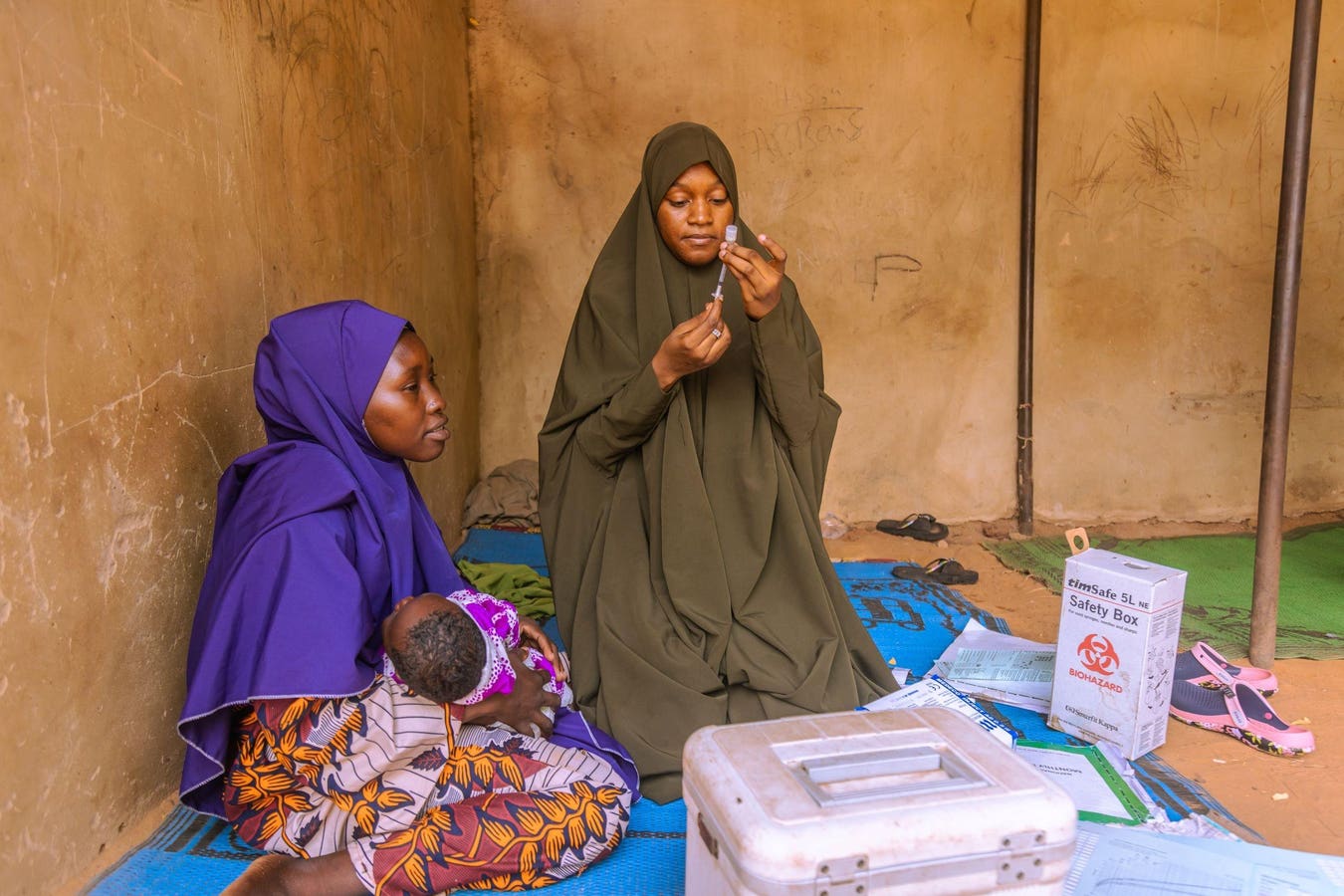
A health worker and a patient in Sokoto, Nigeria
Yagazie Emezi
The demise of the world’s biggest agency for international development, USAID, has had resounding effects. Michael Audu, an independent malaria policy researcher based in Abuja, Nigeria, refers to it as “the 2025 restructuring of the global health financing that created almost the most significant disruption to malaria program supply chain in recent memory.”
The Nigerian government has tried to plug the gaps in its health budget overall. But, Audu explains, “Nigeria faced a deficit exceeding $600 million, even after approving the emergency fund of $200 million.” Audu is now researching “how countries can build greater resilience against future financing shocks so that the next disruption—when it comes, not if, because it has become a recurring situation—when it comes, it does not produce the same consequence.”
Audu previously worked in the northwest Nigerian state of Sokoto, which faces some distinctive challenges related to malaria. USAID funding for Sokoto malaria programs ended in September 2025. The immediate impacts showed the risk of dependence on one big donor, comments Syed Akber, the Nigeria project director for the international development consultancy Acasus.
The cutoff was especially disruptive because it happened in the middle of the funding cycle, Akber notes. “When it happened that suddenly, it was very difficult for the state to figure out” how to fill the gap. Sokoto was able to prioritize some of the most urgent malaria drugs, using state money. But finding the resources wasn’t easy. “It’s not increasing the size of the pie, it’s just redistribution of the same pie,” Akber says. “Let’s be very clear, the pie is not enough to be able to get what is needed.”
USAID previously supported hundreds of sites in Sokoto with free, regular malaria commodities (including medicines and tests), as well as data collection to track logistics. Without USAID’s involvement, some shelves have run bare. From March to April 2026, Sokoto had a 48% stockout rate for malaria commodities, reports the Sokoto State Malaria Elimination Agency (SOSMEA).
Around the country, the drastic, abrupt withdrawal of free malaria medicines has led more Nigerians to source their antimalarials from the private sector, which has long struggled with substandard or counterfeit malaria medicines being sold on the street or in open-air markets. “If there is a disruption to malaria services, people have the tendency to go out to the nearest informal markets,” Audu says. The proliferation of poor-quality medicines may worsen the malaria situation both now and further down the road, by helping the malaria parasite build resistance to antimalarial drugs.
One of the biggest impacts of the funding cuts in Sokoto is that rapid diagnostic tests have run low. According to Acasus, the number of these tests plummeted from around 21,000 a quarter, with USAID support, to roughly 700 in one quarter of 2025. The state warehouse currently has no rapid diagnostic tests.
The alternatives in Sokoto are slower and less convenient methods like microscopy. This may mean that some cases are going undetected, notes Muhammad Habibu, Sokoto’s director of pharmaceutical services. He hopes that the situation will prompt Nigerian manufacturing of the badly needed rapid diagnostic tests: “I believe this exit of the USAID funding is a clarion call for the country generally to start something so that we can achieve that in the near future.”
William Moss, a professor at the Johns Hopkins Bloomberg School of Public Health in Baltimore, points out that in general, the most immediate risk of withdrawal of donor funds is disruption to health commodities, including rapid diagnostic tests. That’s deeply concerning. When it comes to malaria, Moss says, “The transmission is so intense, the burden is so high, that even temporary disruptions in some of these commodities, like rapid diagnostic tests or artemisinin and combination therapy or bed net distributions, can result in a high number of severe malaria cases, hospitalizations and deaths.”
One thing that has helped to cushion the effect in Sokoto was that USAID had also previously supported the state to establish an agency and a fund “to take over the supply chain activities in the state,” Habibu notes. In general, he says, flexibility has been crucial to absorbing the impact of this major change. Sokoto’s governor also helped to fill the commodity gap. But “the government cannot support us fully,” says Hajiya Luba Hassan, the executive secretary of the Sokoto State Malaria Elimination Agency (SOSMEA).
Sokoto’s Drugs and Medical Supplies Management Agency has a good balance between speed and cost-effectiveness, according to Akber, of the consultancy Acasus. But it just can’t negotiate the same discounts that USAID did, with its massive purchasing power. So Sokoto, like other states, faces higher prices and tough decisions about what to prioritize. States, and perhaps even countries, can increase their purchasing power through pooled purchasing, but this has been slow to take off in West Africa – unlike for instance in the Caribbean.
One type of important drug is still widely available as a preventive measure. Seasonal malaria chemoprevention (SMC), or preventive malaria medication, is especially effective in northwest Nigeria because the malaria burden there is mostly compressed into the four months of the rainy season. “It performs exceptionally well in this environment because you can actually predict it,” explains the researcher Audu. “It has been actually the most consistent effective malaria intervention.”
In Sokoto, the NGO Malaria Consortium is gearing up to once again, in July, start providing SMC to children under 5. It’s key to target such young children because their weak immune systems make them especially vulnerable, and because northwest Nigeria has such a large young population, explains Ridwan Jega, a zonal program manager for Malaria Consortium, based in Sokoto. He believes that this tried-and-true prevention strategy is even more important now, because of how funding disruptions have created a gap in testing for and treating malaria.
“We’re making headway despite the challenges,” Jega says. Sokoto reported a 10.6% drop in malaria prevalence from 2021 to 2025, according to SOSMEA. But the big question is how the withdrawal of USAID funding will affect that rate.
And overall, data has become harder to track because of the gutting of data capacity. With USAID support, there was a 100% reporting rate of key performance indicators for malaria control in Sokoto. Now that rate is just 43%, as reported by the Sokoto State Malaria Elimination Agency (SOSMEA). “This has shown that, yes, the withdrawal of partners greatly affects the performance,” says Kabiru Abubakar Abdullahi, the procurement and supply chain director for SOSMEA.
Malaria Consortium’s community drug distributors go house-to-house in Sokoto in an effort to offer SMC to every young child. And they’re seeking to leverage this network to provide other health services, such as zinc, oral rehydration solutions, and information on routine immunization.
But a major hardship is the banditry and violence afflicting northwest Nigeria. “Unfortunately the insecurity is a very, very huge factor affecting the fight against malaria in the northwest,” Audu comments. People who are displaced from their homes can’t be as consistent with malaria control strategies.
Health workers adapt in a variety of ways. Malaria Consortium works with state governments, community leaders and other local residents to understand and build support for SMC even in areas affected by insecurity. At some points they might need to swap the door-to-door distribution for a fixed site.
Pharmaceutical services director Habibu explains that in places with security issues, they can plan proxy deliveries of medicines, for instance to nearby facilities that are safe. “The security issue is like a flute,” he says. A place that is safe for this delivery may not be safe for the next one, so the authorities have to remain nimble to maintain full coverage.
With all these challenges, it was always going to be very difficult for Sokoto and other Nigerian states to achieve the highly ambitious national goal of eliminating malaria by 2030. It’s now gotten even tougher. “Without partners, it’s impossible,” says SOSMEA’s Abubakar. “The partners are augmenting the effort of the states and the nation. So we need the partners to come together to make sure that by 2030, malaria is eliminated.”