

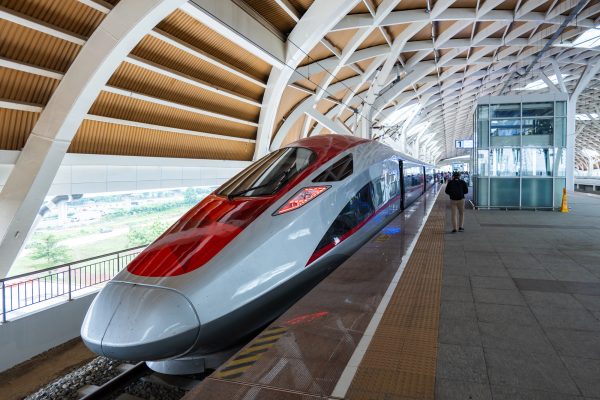
Whoosh, Indonesia’s first high-speed rail, opened to much fanfare in October 2023. The line, which stretches 143 kilometers from Jakarta to Bandung and reaches speeds above 300 kilometers per hour, has been intensely scrutinized in the years since. Led by Chinese firms and financed primarily through the China Development Bank, the project was delivered late and over budget. The eventual price tag was a little over $7 billion.
Whoosh has lost hundreds of millions of dollars since becoming operational, and many have questioned the sustainability of the debt as well as whether the very large costs can be justified given the fact that Jakarta and Bandung are not that far apart and were already well-served by existing modes of transport including buses, toll roads, and conventional rail. Here on the blog, we have been following this project for several years. So did 2025 shed any new light on these issues?
Whoosh is structured as a joint venture called PT Kereta Cepat Indonesia China or PT KCIC. 40 percent of the joint venture is held by Chinese firms, and 60 percent by Indonesian firms through an entity called PT Pilar Sinergi BUMN Indonesia (PT PSBI). The two main Indonesian partners are state-owned railway operator Kereta Api Indonesia and state-owned construction company Wijaya Karya, which also participated in the railway’s construction.
From KAI’s 2025 financial report, we can see that PT PSBI lost a total of IDR 5 trillion, which is around $279 million at current exchange rates. Of this, KAI absorbed around $162 million, which is up from $124 million in 2024. Wijaya Karya reported a loss of IDR 1.6 trillion in 2025 from its participation in the joint venture, which is about $90 million.
It is very likely that Whoosh will continue operating at a loss in the years ahead. For now, that figure seems to be a little under $300 million. The next question is, does this place an unsustainable burden on Indonesia’s fiscal resources?
In my opinion, the answer is no. Yes, Indonesia’s fiscal space is tightening but the government can clearly afford $300 million a year to cover losses at Whoosh. Other modes of transportation, including long-distance rail and urban transit systems like Jakarta’s commuter rail system, are already heavily subsidized. Of course, people can reasonably disagree about whether this is a good and proper use of public funds, especially given mounting fiscal pressures, but it almost certainly does not pose a systemic risk to Indonesia’s fiscal solvency or ability to repay its foreign debts.
While the government of Indonesia has the fiscal space to cover Whoosh’s operating losses, the real question is where those losses should be allocated. Currently, they fall on the state-owned companies in the joint venture, an arrangement which is becoming increasingly untenable. KAI has a reasonably healthy balance sheet with $5.9 billion in total assets, and equity of $2.2 billion. The railway operator posted net income of $128 million in 2025, and positive operating cashflow of around $400 million. As state-owned companies go, that’s not bad. The problem is that if every year they have to absorb nearly $200 million in losses from their share of the Whoosh joint venture, this will slowly eat away at that equity buffer.
The situation is much more precarious for the other main Indonesian partner, Wijaya Karya. Many of Indonesia’s state-owned construction companies, including Wijaya, are not in great financial shape following years of debt-fuelled construction activity during the Jokowi administration. Wijaya reported a net loss in 2025 of $565 million, and a very thin equity position of just $94 million. With assets barely exceeding liabilities to begin with, the state-owned contractor will be hard-pressed to absorb another $90 million loss from Whoosh in 2026.
The government can offset these losses through capital injections pretty much indefinitely, but a larger question is: should they? Is the value created by the high-speed rail worth the costs incurred? Whoosh ridership in 2025 was reported at 6.2 million passengers. As a point of comparison, the Jakarta MRT (constructed and financed in partnership with Japan) had a ridership of 45 million and the Greater Jakarta LRT (constructed by a consortium of state-owned Indonesian firms and financed mainly through domestic sources) had 35 million. Both projects cost a lot less than $7 billion.
Beyond ridership there are other metrics that matter, such as the participation of Indonesian firms like Wijaya Karya in the construction process. The logic behind this joint venture model, as opposed to a direct government-to-government deal, was that Indonesian SOEs would be more active stakeholders and participants in construction and operation, thereby expanding their capabilities and skills. Of course, even if Wijaya did expand its capabilities by participating in the joint venture, one does wonder how much value that creates if the company cannot continue as a going concern.
Indonesia, through state-owned investment fund Danantara is reportedly in talks with China to restructure the debt on the Whoosh project. And Indonesia’s big state-owned construction companies, including Wijaya, are likely going to be merged or restructured soon. One way or another, the state will probably end up absorbing more of the financial burden from the Whoosh project, for the simple fact that the Indonesian joint venture partners (especially Wijaya) cannot keep eating the losses.
While this is unlikely to impose a serious financial strain on the state, it does little to answer the big question that has loomed over this project from the outset: in the end, was it all worth it?