

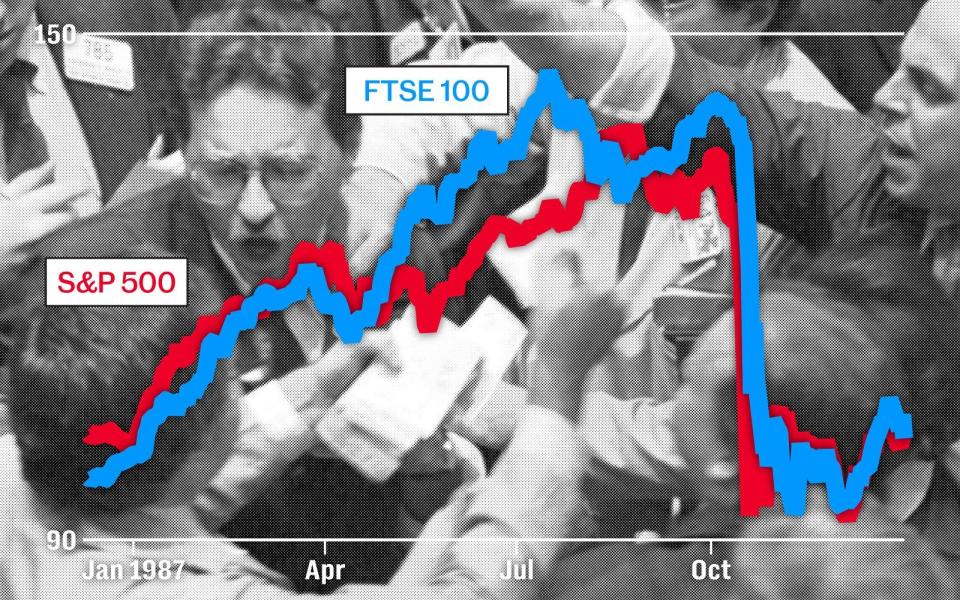
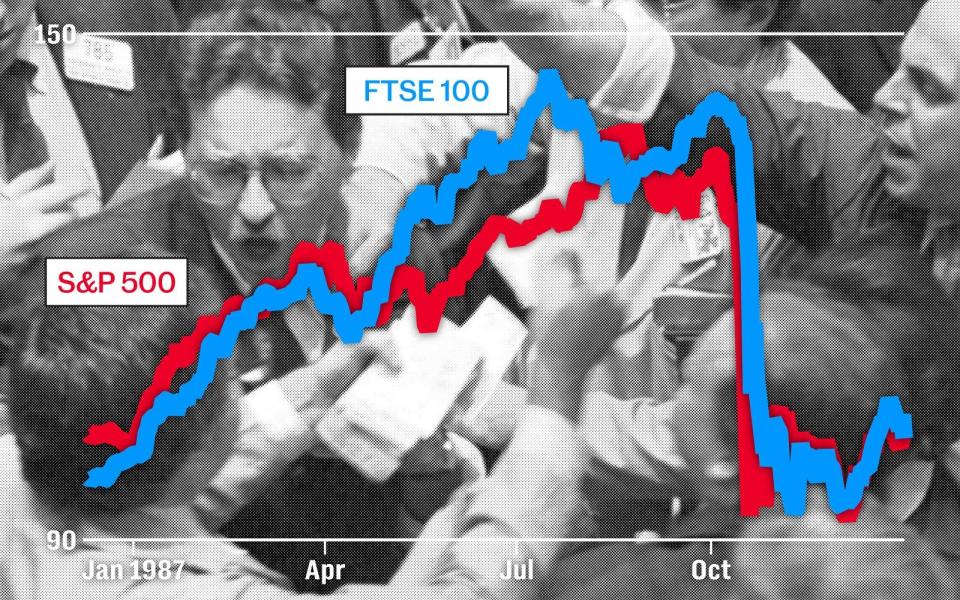
Even almost four decades later, it remains an event scarred into the memory of the financial markets. After a violent storm had ripped across the country, knocking down trees and shuttering roads, trading systems that still relied on brokers shouting at each other across open floors had closed early for the weekend as the damage was cleared up.
As London trading re-opened on Monday, after closing jitters in New York the Friday before, the reaction was swift and brutal. The FTSE-100 fell 11pc in a single session, while in the United States the Dow Jones ended the day down by a terrifying 20pc.
It became known as Black Monday, the worst single day of trading since the great stock market crash of 1929, and one that shaped policy for the rest of the decade.
As we approach October 19th, the 36th anniversary of that fateful day, could the British and global markets be heading for a replay? To many financial experts, there are already worrying parallels between the two eras.
The bond markets are crashing around the world, just as they did in the run-up to the crash of 1987. Debts have been ramped up. The equity markets are overstretched, with company values stretched to the point of breaking in many cases. A seemingly indestructible bull market is coming to an end. It is not hard to see how that could end in a gale of destruction blowing through the markets.
If it came to pass, a market crash on the scale of 1987 would prove a cataclysmic political and economic event. It would send interest rates soaring, increasing costs for mortgage holders and for highly indebted companies, especially in the property sector. Business would fail and pension funds would be hard.
Perhaps most importantly of all, the already-high cost of servicing national debts would climb even higher. It would force profligate politicians to finally face up to the consequences of their wild spending.
There is plenty about the financial markets over the last few weeks that looks very similar to the late 1980s. There is, however, an important difference. Policy-maker still had fiscal room to respond to the crash of Black Monday. After two decades of easy money, and constant buffering of the markets with quantitative easing to prevent a crash, that no longer exists.
It remains to be seen whether we witness a rerun of 1987. One point is certain, however: if we do, this time around it will be far worse.
Bond market blitz
Investors are beginning to fret about a repeat of Black Monday primarily because of a sell-off in the bond market, where companies and governments issue debt and promise a guaranteed rate of return. Usually a sleepy corner of financial markets, the bond market has been gripped by a wave of selling in recent weeks.
If you want a vivid illustration of the rout in the bond markets, the place to look is Vienna. At the height of the bull market in government debt, Austria very smartly launched a 100-year bond, and then reissued it in 2020. With a coupon of just 0.85pc, investors would have to wait a whole century to get their money back, and for all that risk and patience they would get less than a 1pc return.
Amazingly, in retrospect, the issue was 16 times oversubscribed as investors scrambled to give away their money for practically nothing until long after they were dead. And today? The bond has, perhaps not very surprisingly, crashed in value. If you sell it, you will get back only 33 euros for every 100 you invested.
Why anyone wanted to lend the Austrian government money for 100 years is perhaps a question that only psychologists can answer. What is certain is that the bond market has fallen in value on a spectacular scale over the last few months. The Austrian 100-year bond is an extreme example, but the value of most of the major bonds have fallen by between 40pc and 50pc over the last year, with the losses accelerating over the last month.
The crisis is most often measured in yields – the rate of return offered by a bond, which moves inversely to price.
Yields have spiked to levels that even seasoned market professionals can barely remember. The yield on a 10-year US Treasury Bill, the key instrument that determines prices across the world, was closed to 4.9pc on Friday, a level not seen since 2007. In Britain, the government is now paying above 4.5pc on a 10-year gilt, significantly more than when Liz Truss supposedly “crashed” the economy a year ago.
The Italian government is paying close to 5pc, the highest level since 2011 when the eurozone came close to falling apart. Germany, which has had negative yields for most of the last decade, meaning investors were effectively charged a fee for lending money to the government, is now paying close to 3pc. In every major market, the cost of money is rising rapidly.
The bond market does not get the same kind of attention as equities or property. Most of us are not aware of owning any bonds, in the same way as we might own our home, or a portfolio of shares. But bonds are the crucial underpinning of the financial system, and your pension fund will certainly own lots of them, as will your bank, while your employer and of course the government will depend on the debt market for its financing.
In total, the global bond market is worth $133 trillion (£109 trillion), or rather it was when it was last properly measured in 2022. When it crashes, it has far more impact on the everyday economy than any other part of the financial system.
High interest rates are not ‘transitory’
There is no great mystery about why prices are crashing and, as a result, yields are going up. Investors are beginning to believe interest rates will remain high for longer than previously thought. As a result, they are demanding a higher rate of return on their investments. 100-year Austrian bonds that pay out 0.85pc no longer cut it.
The latest surge in government borrowing costs began with messaging from the US Federal Reserve in early September that interest rates will need to stay higher for longer.
Continued strong jobs figures in the world’s biggest economy have also stoked concerns – a tight labour market drives inflation. Bond yields lurched higher on Friday after figures showed the US economy added nearly twice as many jobs as expected in August.
Investors and economists are also concerned about high levels of government borrowing. Both Italy and France have raised their deficit forecasts over the last month, and show little willingness to bring borrowing back under control, while President Biden’s wild spending carries on regardless of the impact it might have on the economy.
In the background, the huge spike in inflation in the wake of the Covid pandemic and the war in Ukraine has proved stubbornly resistant to higher interest rates. The central bankers who only a few months ago complacently assured us that the rise in prices was merely “transitory” have started to concede that inflation has become embedded in the same way it did in the 1970s, and that rates will have to “stay higher for longer” to control that again.
We won’t be seeing rates of less than 1pc again for a long time. The result? Bonds have been massively repriced, even five or ten years out, for a world in which money is far more expensive than it has been for a generation.
Stock markets remain wildly over-stretched
So far, we have not yet seen the sell-off in the bond market feed through to equities, even though higher borrowing costs will mean lower growth potential for companies. But it may well be only a matter of time.
In a note sent to clients late last week, Barclays argued that the only way the rout in the debt market could finally stabilise would be if equities effectively crashed as well, amid a general re-pricing of financial assets.
“We believe that the eventual path to bonds’ stabilising lies through a further re-pricing of lower risk assets,” the bank’s analysts argued. “We believe stocks have substantial room to re-price lower before bonds stabilise.”
More pertinently, as the chart shows, the rise in bond yields looks very similar to the surge in borrowing costs that led up to the Black Monday crash of 1987. In the year before the crash, US bond yields had been steadily rising, following almost exactly the same trajectory as they have done over the last six months. That only ended with the massive sell-off that came in October.
In 1987, equities were not even significantly over-priced compared to their long-term averages; most share prices reflected a realistic assumption of profits, growth and value.
Now most indices, with the exception of a few dogs such as Britain’s FTSE-100, stock markets are already wildly over-stretched by any historical comparisons – meaning they have much further to fall if a crash does materialise.
There are of course plenty of signs of stress in the financial markets. The first tremors were felt here in the UK in the wake of the mini-Budget last September. The markets were unnerved by the scale of the borrowing planned by the Government. Sterling crashed and borrowing costs spiked.
The surge in bond yields triggered the LDI crisis, with pension funds over-committed to instruments that assumed bond markets would not move for years. A fire sale began and the Bank of England was in short order forced to step in and stop things spiralling out of control.
It was a vivid illustration of how issues in the bond market can spill over but perhaps will prove to be a relatively minor one in future.
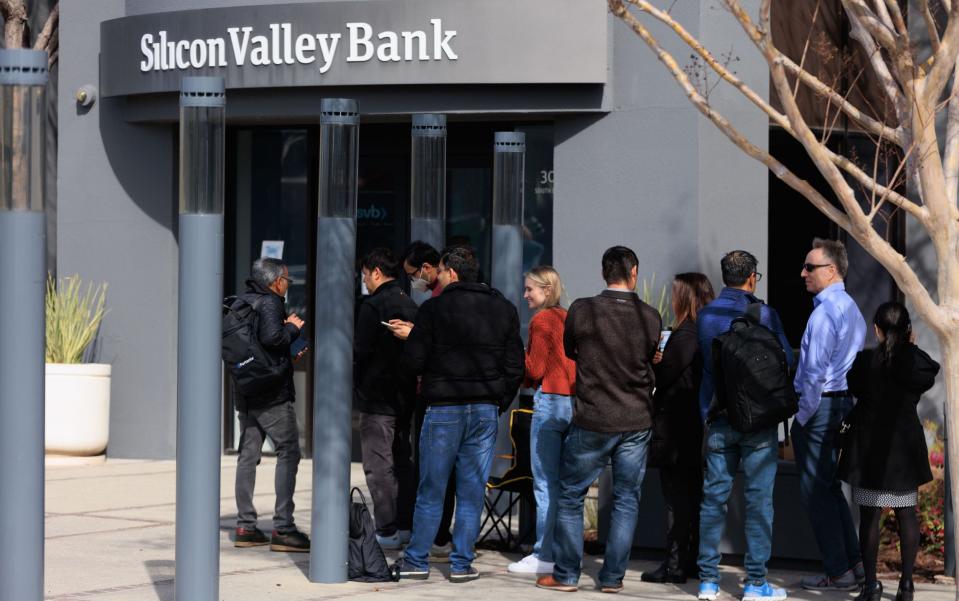
There are plenty of warning signals elsewhere as well. In the US, there was a small-scale panic in the spring prompted by the collapse of Silicon Valley Bank, caused at root by its over-exposure to a falling bond market. Only intervention from the Federal Reserve, in much the same way as the Bank of England had to step in over the LDI debacle, prevented that from spreading to other banks in the US, and several other regional financial institutions were hustled into mergers.
In Germany, there is a growing property crisis, with values falling by almost 20pc so far this year and developers starting to go bust. In China, the country’s debt-fuelled property bubble is rapidly running out of air.
If there is a crash, it will be easy for anyone to look back at all those events and conclude that the warning signs were all in plain view.
Growing global debt mountain
If the financial contagion does spread, the main casualties are not hard to work out. In the UK, we have already witnessed a steep rise in mortgage rates and some modest falls in house prices, but if there is a full blown crash it will get much worse.
It is just as bad elsewhere. In the US, the average mortgage rate has hit 7.5pc, the highest level since the millennium. House prices are falling at an annual rate of 7pc in Germany, the steepest decline in 23 years.
A market crash will be felt by companies that borrowed cheaply, and complacently assumed that rates would never rise again, especially in the private equity industry. The sector bought up huge swathes of the economy with cheap money and will have to start selling at huge losses once all that debt has to be refinanced at far higher rates.
The consultancy firm Alvarez & Marsal estimated in a report last week that $500 billion of corporate debt will have to be refinanced next year; all of those companies will find they have to pay far higher rates, putting pressure on their businesses.
But it will be felt most painfully by governments, for the simple reason that they have borrowed so much over the last decade.
In the UK, the cost of servicing our huge debt mountain has risen to £100 billion a year, double the amount only a year ago, and almost 11pc of total government spending. In France, debt costs are now the biggest single budget item, forcing the free-spending Macron government to make savings elsewhere. Interest on Italy’s debts already consumes 4pc of GDP every year and that is only going to rise as it borrows more and more simply to stay where it is.
In the US, interest payments on the national debt are forecast to rise from $475 billion last year to $1.2 trillion by the end of the decade: all President Biden’s investment in “green technologies” will have to generate huge returns to make all that borrowing look worthwhile.
In reality, all the major governments across the developed world will have to start cutting their spending, and reducing their borrowing, simply to bring their cost under control. Add it all up, and it is going to be very tough to adjust to higher rates.
What would happen if there was a financial crash as spectacular as the Black Monday collapse in 1987?
“Back then, we didn’t have a big recession in the UK, for example, until the early 1990s,” says Neil Shearing, group chief economist at Capital Economics. “This time, the UK economy is adjusting to a sustained period of rate rises which means the economy is already struggling. There will be no buffer for a shock.”
Western economies lose their lustre
There are some big differences between 1987 and 2023. The overall debt levels were far lower back then, and government debts far less burdensome. In the US, the debt to GDP ratio was just 48pc then, compared to 120pc now, and the UK was also comfortably below 50pc, compared with 100pc now. Interest rates were significantly higher and households and companies were holding significantly less debt, which gave them a lot more flexibility to cope with the crash.
Perhaps more significantly, governments had already started the hard work of making their economies more competitive. The 1987 crash came in the middle of the Reagan-Thatcher project of rebooting the Western economies, curbing the overwhelming power of the trade unions, privatising inefficient state owned monopolies, and handing power back to companies and entrepreneurs.
All of that was just starting to pay dividends, unleashing a wave of innovation and growth that enabled economies to grow even through periods of financial turbulence. That is not to say it didn’t matter. The loosening of financial policy in the wake of the Black Monday crash led to a round of inflation that arguably led to the fall of the Thatcher administration in 1990, and the defeat of Reagan’s successor Geoge HW Bush in 1992. But it also came at a time when the major developed economies were getting stronger.
That is certainly not true today. In reality, all the Western economies have been steadily enfeebled over the last fifteen years. State spending has grown exponentially, much of it paid for by printed money. Regulation has been endlessly increased. Governments have been captured by lobby groups, and corporations have fallen under the sway of ideologically driven managers committed to social values instead of innovation and growth.
The corporate raiders who disciplined bloated management hierarchies in the 1980s are a distant memory. The crash of the 1980s proved in retrospect to be little more than a punctuation mark instead of the closing of one chapter and the opening of another.
That won’t be true of the crash of 2023, if it happens. It may well mark the point at which two decades of relentless government expansion, increased welfare entitlements, and soaring debt levels, all of it financed by cheap money, starts to unravel. Governments, corporations and households will all have to start living within their means again, and growth will only be possible through greater innovation and productivity instead of through printed cash.
When we look back from the 2030s or 2040s, that may well be seen as a good thing. A collapse will force us to focus on restoring real growth. But there will be a lot of pain getting to that point. We have already seen that in the bond markets over the last few weeks – and very soon we may see it everywhere else as well.