

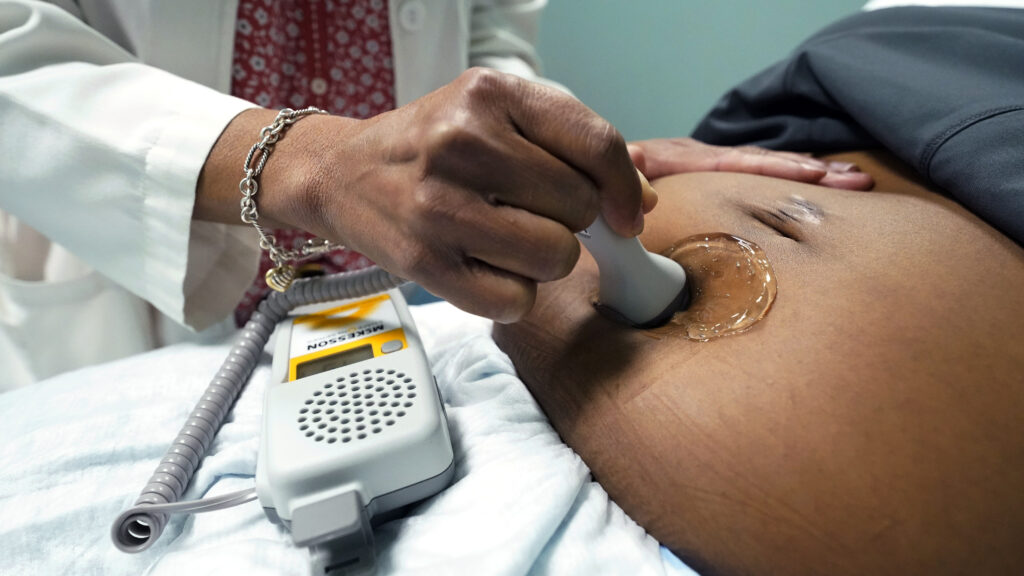
Every new data point or report appears to confirm it: The U.S. is in the midst of a mounting maternal mortality crisis. With more than 32 maternal deaths per 100,000 live births, the risk of dying during pregnancy or in the year after childbirth is on average 10 times higher in the U.S. than it is in comparable wealthy and democratic nations, and more than 20 times higher for Black and Native people.
A recent JAMA study lends fresh insight into the magnitude of the problem, showing that maternal mortality rates more than doubled in the U.S. during the two decades from 1999 to 2019.
The study is noteworthy not just for its findings, but because it highlights a problem that continues to hamper research into maternal health: The inconsistent data collection of maternal death counts.
Even as the analysis provides a reliable estimate of the trends over the past two decades, the study is limited to data obtained via birth and death certificates. But without a state-by-state review of individual deaths and their causes, the U.S. still lacks a comprehensive picture of the epidemic and its causes, rendering the country less effective in forming strategies to prevent maternal deaths.
A better way of measuring maternal mortality
Until recently, little attention was paid to documenting the health of America’s new mothers. Prior to 2003, for instance, U.S. standard death certificates didn’t include the so-called “pregnancy checkbox” indicating whether the person was pregnant at the time of death. Maternal mortality rates tripled as states adopted the updated death certificate. Yet it took until 2017 for the last state (West Virginia) to implement the change, making it difficult to perform historical comparisons between states and accurately track trends.
The JAMA study, led by the Institute of Health Metrics and Evaluation at the University of Washington, was able to overcome that challenge, reaching a reliable estimate of maternal deaths even for the years prior to the introduction of the pregnancy checkbox.
The researchers defined maternal deaths as those occurring in people who were either pregnant at the time of their death or had been pregnant in the past year, and identified them either through the checkbox in the death certificate or through a diagnosis code. Then the study corrected for misreporting by following a method that reclassified a small proportion of deaths that occurred during those years and had initially been attributed to an implausible cause of death (such as senility) but should have been coded as maternal deaths.
This allowed researchers to rule out the possibility that recent increases in maternal mortality could be primarily attributed to better measures.
“We saw increasing trends before most states were using a pregnancy checkbox and we saw increasing trends after the adoption in all states that strongly suggests to us that these trends are real and not simply a reflection of reporting biases,” said Greg Roth, a professor of medicine at the University of Washington who is one of the authors of the study.
The study also identified important trends by race and geography. For Black women, not only were maternal mortality rates higher to begin with, they more than doubled in the past two decades, reaching an average of 67.6 per 100,000 live births in 2019. Maternal mortality rates for Native Americans and Alaskan Natives have tripled.
The study identified geographic patterns in maternal deaths, finding that Northeastern states, often believed to provide better care for mothers, were in fact the deadliest for new Black mothers, with an estimated 89.5 deaths per 100,000 live births in 2019.
“It’s interesting to me that there’s a lot more geographic variation in certain subgroups than others. Because particularly if you look at the white folks, there’s a range, but it’s not an enormous range,” said Audrey Lyndon, a professor of health equity at New York University who was not involved in the study. “But if you look at the Black folks, that’s an enormous range.” This, she said, points to more systemic issues shaping disparities in maternal mortality, rather than medical differences. “To me, that’s structural,” she says.
What counts as a maternal death?
Despite the researchers’ progress in more accurately measuring maternal mortality, they are probably under-counting the number of new mothers who die during pregnancy or in the year after giving birth. In particular, as the researchers say, the analysis does not include violent deaths and deaths from suicide, nor does it take into account deaths from overdoses. Death certificate coding rules don’t allow any of these categories to be counted as pregnancy-related deaths — despite the fact that mental health issues are the most common complication of pregnancy, and suicide, homicide, and overdoses are the leading cause of pregnancy-associated deaths.
This is partially an issue of definition. Data from death certificates track so-called pregnancy-related deaths, or deaths occurring from causes related to the pregnancy, or aggravated by it. These are overwhelmingly obstetric causes. Suicide, overdose, or homicide are instead defined as pregnancy-associated deaths.
Some researchers believe that the latter categories should also be included in maternal mortality counts. “I’ve been arguing that we need to pay more attention to pregnancy-associated [deaths] because even if it wasn’t caused by the pregnancy, this is in all likelihood a premature death,” said Eugene Declercq, a professor of community health sciences at the Boston University School of Public Health who was not involved with the study.
Moreover, some pregnancy-associated deaths may well be directly connected with the condition. An opioid overdose may be related to the fact that the pregnant person was forced to quit cold turkey during pregnancy and relapsed after; a suicide could be attributed to postpartum depression; a homicide may be the result of a fight with a domestic partner about the pregnancy.
“Maternal mortality rates alone might fail to fully capture the magnitude of death among pregnant and postpartum people, given what we know about how homicide and suicide are also occurring in this population,” said Maeve Wallace, a reproductive and perinatal epidemiologist at Tulane University not involved with the study.
Only a review of every single potential maternal death would be able to account for all of the nuances. That is actually a feasible undertaking.
When measuring maternal deaths becomes a political issue
While U.S. maternal mortality rates are high, the number of actual deaths is relatively small: a few hundred cases every year across all states. This limited pool means that state-based maternal mortality review committees (MMRCs) can evaluate each case in which a pregnant or recently pregnant person dies and establish whether the cause of death was accurately reported, identify whether the death was preventable, and suggest interventions that may reduce deaths in the future.
Violent deaths typically aren’t included prior to the committee’s review because it was not the pregnancy, or a complication arising from it, that directly caused a person’s death, said Declercq, who sits on Massachusetts’ MMRC. But if there is enough information to reconstruct the chain of events that lead to the violent death, the committee can establish whether the death should be included in the updated maternal mortality count published in its yearly report.
“Maternal mortality review committees run by states […] are able to review far more data, including hospital records and other information to correctly adjudicate a death as a maternal death, and more importantly, understand what were the drivers so that they can appropriately recommend and deliver interventions that will make a difference,” said Roth.
Yet not all states have MMRCs, and those who have them don’t always routinely report their findings. Between 2017 and 2019, 49 states, as well as Washington, D.C., New York City, Philadelphia, and Puerto Rico had MMRCs, but only 36 of them reported their findings. “Increasingly, the reporting of those findings have become a political issue, and there have been efforts to suppress their findings,” said Roth.
Idaho lawmakers, for example, dissolved the state’s MMRC on June 30. The committee had identified a dramatic increase in maternal mortality in the state, from 18.7 deaths per 100,000 live births in 2018 to 41.8 in 2020 and 40.1 in 2021. The committee had also established that 98% of those deaths were preventable and issued recommendations on how to improve maternal outcomes, including by increasing treatment for substance abuse and expanding postpartum Medicaid coverage in the state to a year. (Postpartum Medicaid coverage in Idaho is currently set at the federal minimum of 60 days.).
The far-right group Idaho Freedom Foundation successfully lobbied for the commitee’s termination, raising concerns that future deaths may go undercounted, especially as the state’s abortion ban is expected to increase maternal mortality.
The reason MMRCs can become a political issue, experts say, lies in recommendations that often involve improving social determinants of health via interventions such as housing and food programs and increased access to health care and reproductive care. In addition, states with restrictive abortion policies are associated with a much higher risk of maternal mortality, and states that have passed abortion bans in the wake of the Dobbs decision may be hesitant to share data showing worsening maternal health.
Beyond the complications of accurately measuring maternal mortality, the growing severity of the crisis is hard to miss, said Lyndon. “We are an extremely wealthy country,” she said. “We spend an incredible amount of money on medical care, and we are failing mothers and families.”