

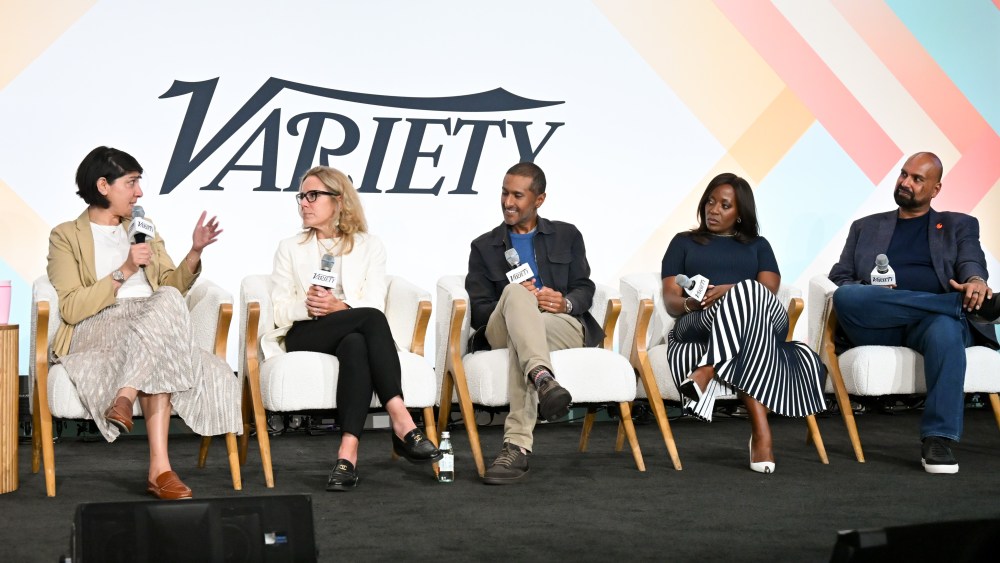
How are media and entertainment companies navigating shifting winds in Hollywood, amid an industry in constant flux and AI rapidly advancing on the scene? A panel of senior industry leaders served up insights into the biz’s burning questions, setting the table for the Variety Entertainment & Technology Summit presented by EY in L.A. Thursday.
Speaking on the kickoff panel were Clancy Collins White, president of creative affairs at Warner Bros. Television; Simran Sethi, president of scripted programming for Hulu Originals and ABC Entertainment at Disney; Liz Jenkins, chief business officer, NBCUniversal Entertainment; Abhijay Prakash, president of Blumhouse Atomic Monster; and Rahul Purini, president of Sony’s Crunchyroll anime-streaming service.
NBCU’s Jenkins said that the TV industry — during the era of “peak TV” a few years ago — was “in a place for a while where, frankly, the economics were a bit unsustainable, right? And I think that supply, frankly, probably exceeded demand.”
Now, with a portfolio at NBCU that comprises Peacock, Bravo and NBC, Jenkins said the company “has gotten very sort of surgical and being focused on who are our priority audiences and how do we ensure that we’re super-serving them, and but then grow from there.”
Sethi said that Disney discovered early on that distribution on streaming services like Hulu and Disney+ and linear TV “don’t cannibalize each other. They’re distinct audiences. People who have a habit of watching live on television are not necessarily the ones streaming streaming online. So it really did for us just make the pie bigger, and it allows people to catch up and come back.”
The panelists also said the weekly release of TV episodes, bucking Netflix’s general convention of releasing full seasons in a binge-drop, was something that resonated with viewers.
“TV has always been about a collective experience. Everyone in this room grew up watching certain shows,” Sethi said. “I think for a lot of young people, watercooler television is a new idea. But the idea that you can have this shared experience watching something weekly is, I think, an important return to what society feels like it’s gravitating towards again, which is being together and talking with each other and connecting.
WBTV’s Collins White said audiences are responding to the weekly drop of episodes of the studio’s hit series “The Pitt,” which won seven 2026 Emmys including best drama series and lead drama actor for Noah Wyle.
“At a time when when so much emphasis is being placed on IP, it’s an incredibly compelling original idea that, you know, was not a complete reinvention of the wheel,” she said about “The Pitt.” “I think audiences are really enjoying the sort of the weekly drop as opposed to sort of the binge model.”
Jenkins said some shows — like Peacock’s “Love Island USA” — need “a moment to sort of build. And sort of [ask], are you seeing green shoots? Are you seeing that it’s hitting the right audience?” For “Love Island USA,” the real tipping point was Season 6 and the addition of Ariana Madix coming off a buzzy season of “Vanderpump Rules,” with a really established fan base there, she added.
As for the threat of AI, Blumhouse’s Prakash, whose studio was behind two big summer box-office hits from YouTube creators — “Obsession” and “Backrooms” — said he thinks short-form, maybe lower-production value creator content is “the most likely to get disrupted by whatever they’re calling ‘AI slop.’”
To Prakesh, “Obsession” and “Backrooms” could not have been created from an AI prompt. “Those are not the kinds of things that could be spat out of algorithms and large language models,” he said.
And, he said, the two horror films showed that “a scary theatrical event” could compel people “to leave their homes for that experience.” And he said a takeaway for him is that Hollywood should be doing more to serve audiences natively on YouTube.
“YouTube is the probably No. 1 platform for watching filmed entertainment, so it’s not surprising that it’s penetrating the culture in many different ways,” Prakesh said. “I think what was so heartening about the experience that we had was that you had creators who were very popular on YouTube still craving the theatrical experience — and still wanting to take their storytelling to that platform and to deliver it to consumers there, which obviously is what we do.”
As an industry, “we have to figure out how to be present in front of them, not just with trailers and featurettes on YouTube, but like actually have an offering for the consumer on the platform that is increasingly dominant and so young, and where you can find and grow that audience.”
At Crunchyroll, the company is continually asking fans what makes them come back to anime over and over, say Purini. He said Crunchyroll’s research shows that outside of Japan and China, 650 million people watching anime regularly on a weekly basis, and that’s projected to continue to grow globally.
“The visual style, the art is part of it, but what really is the themes and the stories that the Japanese creators tend to tell, to to talk about, and it’s grief, it is fame, it is found family, it is all of those things,” Purini said. “But really, what our fans are telling us is there are stories that are relatable characters, but the stories that feel real, but are very different from other stories that they get in their entertainment mix.”
Jenkins said that one of the things the industry lost sight of during the peak TV bubble was that “sort of the difference between, I like to call it capital C content and lowercase C content. It’s not just about tonnage. At the end of the day, it starts and begins with great stories and great storytellers. And what works are things that audiences emotionally connect to. They make you feel something.”
Clancy Collins said that over the years, there’s become less and less of a distinction between the programming on streaming services vs. linear TV. “Our mission statement from the studio is just to be selling to as many outlets as possible,” she said. “So we obviously have a broadcast business that we’re very incredibly proud of. But you know, we’re at 30 shows across 10 platforms… and capitalizing on our independence to be able to sell everywhere and offer our creators that flexibility.”
The panel was moderated by Michael Schneider, Variety‘s executive editor for TV. The daylong event is being held at the Four Seasons in Beverly Hills.
Pictured above (l. to r.): Simran Sethi, Clancy Collins White, Abhijay Prakash, Liz Jenkins and Rahul Purini speak onstage during the Trailblazers of the Content Industry panel at the Variety Entertainment & Technology Summit presented by EY