

• Home
  • Politics
  • Health
  • World
  • Business
  • Finance
  • Tech
  • More
    • Sports
    • Entertainment
    • Lifestyle
What's Hot

Small Habits That Make A Big Difference

April 23, 2026

States Stockpile Gold Bars To Hedge Against Inflation

April 23, 2026

Hilarious Sayings for a Happy Start to Summer

April 23, 2026
Facebook Twitter Instagram
  • Contact
  • Privacy Policy
  • Terms & Conditions
Thursday, April 23
Patriot Now NewsPatriot Now News
  • Home
  • Politics

    Security video shows brazen sexual assault of California woman by homeless man

    October 24, 2023

    Woman makes disturbing discovery after her boyfriend chases away home intruder who stabbed him

    October 24, 2023

    Poll finds Americans overwhelmingly support Israel’s war on Hamas, but younger Americans defend Hamas

    October 24, 2023

    Off-duty pilot charged with 83 counts of attempted murder after allegedly trying to shut off engines midflight on Alaska Airlines

    October 23, 2023

    Leaked audio of Shelia Jackson Lee abusively cursing staffer

    October 22, 2023
  • Health

    Disparities In Cataract Care Are A Sorry Sight

    October 16, 2023

    Vaccine Stocks—Including Pfizer, Moderna, BioNTech And Novavax—Slide Amid Plummeting Demand

    October 16, 2023

    Long-term steroid use should be a last resort

    October 16, 2023

    Rite Aid Files For Bankruptcy With More ‘Underperforming Stores’ To Close

    October 16, 2023

    Who’s Still Dying From Complications Related To Covid-19?

    October 16, 2023
  • World

    New York Democrat Dan Goldman Accuses ‘Conservatives in the South’ of Holding Rallies with ‘Swastikas’

    October 13, 2023

    IDF Ret. Major General Describes Rushing to Save Son, Granddaughter During Hamas Invasion

    October 13, 2023

    Black Lives Matter Group Deletes Tweet Showing Support for Hamas 

    October 13, 2023

    AOC Denounces NYC Rally Cheering Hamas Terrorism: ‘Unacceptable’

    October 13, 2023

    L.A. Prosecutors Call Out Soros-Backed Gascón for Silence on Israel

    October 13, 2023
  • Business

    States Stockpile Gold Bars To Hedge Against Inflation

    April 23, 2026

    EXCLUSIVE: Biden-Era Rule Screws Over Top US Truck Maker As Diesel Plans Grind To A Halt

    April 22, 2026

    Panel Makes Case For Turbocharging American Innovation At Daily Caller Live Event

    April 21, 2026

    EXCLUSIVE: Florida AG Launches Antitrust Probe Into Plastic Organizations’ Costly Climate Goals

    April 21, 2026

    Tim Cook Announces Exit As Apple CEO

    April 20, 2026
  • Finance

    How Long Can Kyrgyzstan’s Economic Boom Keep Booming?

    February 18, 2026

    Ending China’s De Minimis Exception Brings 3 Benefits for Americans

    April 17, 2025

    The Trump Tariff Shock Should Push Indonesia to Reform Its Economy

    April 17, 2025

    Tariff Talks an Opportunity to Reinvigorate the Japan-US Alliance

    April 17, 2025

    How China’s Companies Are Responding to the US Trade War

    April 16, 2025
  • Tech

    Cruz Confronts Zuckerberg on Pointless Warning for Child Porn Searches

    February 2, 2024

    FTX Abandons Plans to Relaunch Crypto Exchange, Commits to Full Repayment of Customers and Creditors

    February 2, 2024

    Elon Musk Proposes Tesla Reincorporates in Texas After Delaware Judge Voids Pay Package

    February 2, 2024

    Tesla’s Elon Musk Tops Disney’s Bob Iger as Most Overrated Chief Executive

    February 2, 2024

    Mark Zuckerberg’s Wealth Grew $84 Billion in 2023 as Pedophiles Target Children on Facebook, Instagram

    February 2, 2024
  • More
    • Sports
    • Entertainment
    • Lifestyle
Patriot Now NewsPatriot Now News
Home»Health»Mobile phone data used for public health underrepresent vulnerable populations, finds new study
Health

Mobile phone data used for public health underrepresent vulnerable populations, finds new study

July 6, 2023No Comments7 Mins Read
Facebook Twitter Pinterest LinkedIn Tumblr Email
Mobile phone data used for public health underrepresent vulnerable populations, finds new study
Share
Facebook Twitter LinkedIn Pinterest Email
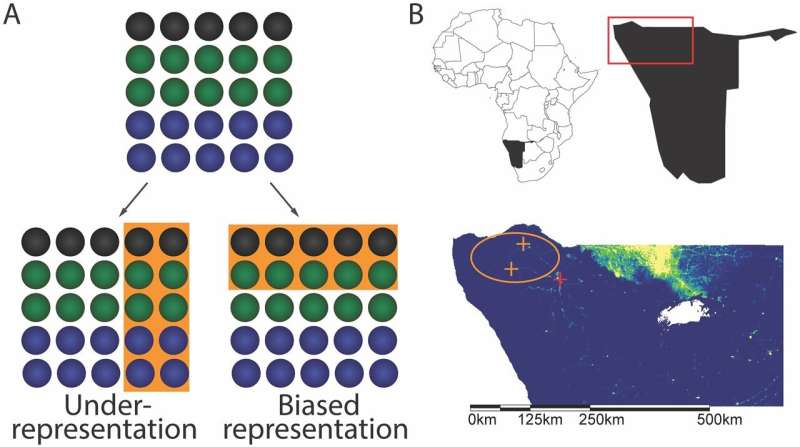
Overview of concept and location. (A) Schematic showing underrepresentation and biased representation of a population. Circles represent individuals; black, blue, and green colors each represent one of three possible values for a demographic characteristic. Orange shaded areas represent individuals selected for inclusion in each data set. (B) Above: Inset map of continent, Namibia in black, and region of interest outlined in red. Below: Detailed map of the region of interest showing population density in 2016 (yellow = high; blue = low; white = NA (Etosha National Park, no human population)). Study area circled in orange, health clinics (orange crosses), regional hospital (red cross). Map created in ArcGIS with data from GADM (https://gadm.org/). Credit: PLOS Digital Health (2023). DOI: 10.1371/journal.pdig.0000270

Mobile phone data are increasingly used in public health management and disease outbreak response, as demonstrated during the COVID-19 pandemic when location data were used as a proxy for human movement and contacts and informed exposure notification apps. However, a new study led by researchers at Penn State revealed that phone data may not accurately reflect under-resourced or particularly vulnerable populations, who are often underrepresented in other data as well.

If this bias is not acknowledged or complemented with additional data, the researchers said, a reliance on phone data in public health efforts could magnify health inequities. They published their findings today (July 6) in PLOS Digital Health.

“Populations with limited access to health care are also often overlooked in other data sources, including censuses,” said Nita Bharti, associate professor of biology in the Penn State Eberly College of Science and leader of the research team. “New, convenient data sources like mobile phones can offer important insights into these populations, but it is critical that we identify and measure their biases.”

Data gaps exist in all contexts and can be easily seen in small, rural populations, according to Bharti. In this study, the researchers investigated phone ownership, mobility and access to health care in a mobile, rural population in Namibia as a case study to measure mobile phone data representativeness in populations that regularly experience vaccine-preventable infectious diseases.

Namibia is a middle-income country in southern Africa, and Bharti said mobile phone data from the region are used to guide public health decisions around malaria and other infectious diseases. Most Namibians live in urban areas with reliable access to health care, but this is not the case for rural or remote populations. The research team conducted detailed surveys of more than 250 people at two settlements in a remote area of the Kunene province. Residents are largely nomadic, moving seasonally to herd cattle, and the distance to the nearest health clinic is substantial.

See also  US bank credit contracts, loans drop in latest week: Fed data

Mobile phone data used for public health underrepresent vulnerable populations, finds new study
Although mobile phone data are increasingly used in public health management, a new study led by researchers at Penn State reveals that phone data underrepresents vulnerable populations and that failing to account for biases in phone data could magnify health inequities. The research team studied a mobile, rural population in Namibia, pictured here, where access to health care is limited, as a case study to measure how well mobile phone data represent populations. Credit: Bharti Lab/Penn State

The researchers found that phone ownership was relatively low, with only 31% of participants owning a phone—compared to the estimated 95% in urban areas in the country in 2013—and only 59% having used a phone in their lifetime. Phone owners and users were far more likely to be men, to travel to more locations and to have better access to health care.

“We found that, within these already vulnerable populations, the most vulnerable people were underrepresented in these phone data because they didn’t own phones or have access to phones,” said Alexandre Blake, graduate student in Bharti’s lab at Penn State and first author of the paper.

“One common way to make up for missing data is to simply scale it up and assume that missing data are the same as recorded data. But we distinctly found that the people missing in phone data are less mobile with reduced access to health care. And with respect to making public health decisions, these are very important differences.”

Mobile phones also provided a skewed perception of mobility among phone owners, according to Blake. Because phone owners frequently traveled to areas with no phone reception, many of their movements would not be captured in phone data.

“Even if you own a phone, you can only be tracked in locations where you get signal,” Blake said. “So, phone data, especially from remote areas, will only capture a specific segment of the population and can record only some of their movements. If phone data were used to predict the potential spread of an infectious disease in a region like the one we studied, most movements and contacts would be missed. Without accounting for data biases, movements based on phone data would be misleading and ineffective for outbreak response efforts attempting to limit the spatial spread of a disease.”

See also  How Sunscreen Prevents Skin Cancer—Despite The Conspiracies Peddled By Social Media Influencers

Because mobile phone data may not accurately represent the populations and locations that most need public health improvements, the researchers suggested that relying on these data to inform public health decisions can actually be harmful and potentially magnify health inequalities. They stressed the importance of acknowledging and measuring bias in all types of data—not only those used for public health—as well as using multiple types of data with non-overlapping biases when drawing conclusions.

“All data have biases but are still valuable resources, and phone data are no exception,” Bharti said. “Acknowledging that data are not just under representative and showing that they are in fact biased helps our field move towards correctly interpreting data, measuring biases and looking for ways to measure what’s missing.”

According to the researchers, small, remote populations play an important but often overlooked role in the transmission and persistence of infectious disease. Limited access to health care can lead to delayed detection of outbreaks, and overlooking these groups can slow the elimination of vaccine-preventable transmissible pathogens.

“Equitable access to health care is a basic human right, and addressing health inequities in underrepresented populations is essential for public health progress,” Bharti said.

“You don’t have to look to low- or middle-income nations to find underrepresentation in vulnerable groups. We would see the same absence of vulnerable groups in widely used data if we looked, for example, at a rural part of Pennsylvania or Mississippi or in urban areas, like New York City or Los Angeles. There are gaps and biases in all data that underrepresent the segments of populations most in need of improved health services. Failing to acknowledge these biases can direct resources away from these groups and lead to public health interventions that magnify inequities.”

See also  URGENT: After Speaking with The Gateway Pundit this Afternoon - Feds Move In and Transfer Political Prisoner Stewart Rhodes from DC Gulag to SHUT HIM UP - PHONE CALL AUDIO INCLUDED! | The Gateway Pundit

In addition to Bharti and Blake, the research team includes Ashley Hazel at the University of California, San Francisco, and John Jakurama and Justy Matundu at the Kaoko Information Center in Namibia.

More information:
Alexandre Blake et al, Disparities in mobile phone ownership reflect inequities in access to healthcare, PLOS Digital Health (2023). DOI: 10.1371/journal.pdig.0000270

Provided by
Pennsylvania State University


Citation:
Mobile phone data used for public health underrepresent vulnerable populations, finds new study (2023, July 6)
retrieved 6 July 2023
from https://medicalxpress.com/news/2023-07-mobile-health-underrepresent-vulnerable-populations.html

This document is subject to copyright. Apart from any fair dealing for the purpose of private study or research, no
part may be reproduced without the written permission. The content is provided for information purposes only.

data finds health Mobile Phone Populations Public study underrepresent Vulnerable
Share. Facebook Twitter Pinterest LinkedIn Tumblr Email

Related Posts

How Your Oral Health Impacts Your Overall Wellbeing

April 22, 2026

Democratic Trifecta States Choking Out Economic Competitiveness As Red States Thrive, Analysis Finds

April 15, 2026

The Surprising Health Benefits Of Spending More Time In Your Outdoor Space

April 10, 2026

How To Protect Your Mental Health While Dating Online (And Why The Platform You Choose Matters More Than You Think)

March 24, 2026
Add A Comment

Leave A Reply Cancel Reply

Top Posts

10 Powerful Ways to Invest in Yourself and Restart Your Self Growth

September 19, 2024

Senior Google Engineer Jumped to His Death from New York HQ

May 6, 2023

Oakland A’s Fans Want Team to Sell Rather Than Move to Las Vegas

May 4, 2023

France Probes Whether Off-Duty Troops Turned Vigilante During Riots

July 8, 2023
Don't Miss

Small Habits That Make A Big Difference

Lifestyle April 23, 2026

For many people, the daily drive is treated as a functional necessity rather than an…

States Stockpile Gold Bars To Hedge Against Inflation

April 23, 2026

Hilarious Sayings for a Happy Start to Summer

April 23, 2026

EXCLUSIVE: Biden-Era Rule Screws Over Top US Truck Maker As Diesel Plans Grind To A Halt

April 22, 2026
About
About

This is your World, Tech, Health, Entertainment and Sports website. We provide the latest breaking news straight from the News industry.

We're social. Connect with us:

Facebook Twitter Instagram Pinterest
Categories
  • Business (4,342)
  • Entertainment (4,220)
  • Finance (3,203)
  • Health (1,938)
  • Lifestyle (1,871)
  • Politics (3,084)
  • Sports (4,036)
  • Tech (2,006)
  • Uncategorized (4)
  • World (3,944)
Our Picks

6 Creative And Thoughtful Mother’s Day Gifts

May 9, 2023

Mexican Cops Arrest ‘Influencer’ During Jewelry Store Robbery Investigation

June 30, 2023

Brave New World’ In Serious Trouble – Report

November 11, 2023
Popular Posts

Small Habits That Make A Big Difference

April 23, 2026

States Stockpile Gold Bars To Hedge Against Inflation

April 23, 2026

Hilarious Sayings for a Happy Start to Summer

April 23, 2026
© 2026 Patriotnownews.com - All rights reserved.
  • Contact
  • Privacy Policy
  • Terms & Conditions

Type above and press Enter to search. Press Esc to cancel.