

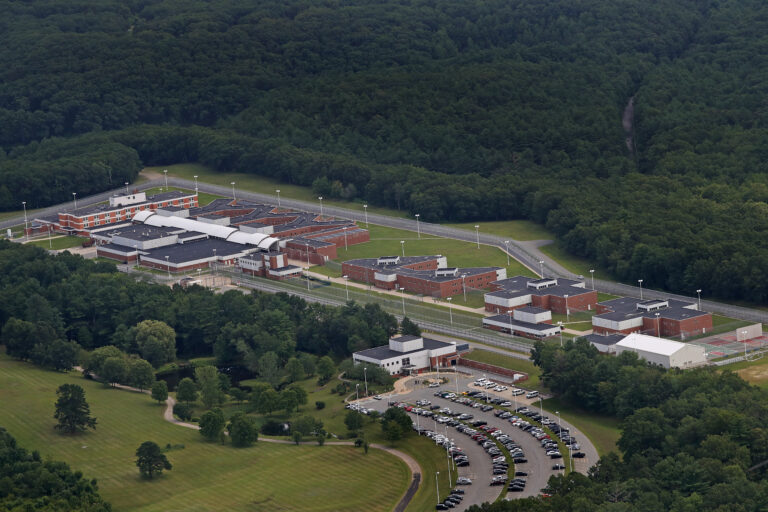
WASHINGTON — The incarcerated people at Federal Medical Center Devens should have been some of the first to receive the Covid vaccines, back when they first came out in December 2020. At the time, the country was prioritizing high-risk people in high-risk settings, like older Americans in nursing homes.
So Devens seemed a better candidate than most prisons for an early vaccine rollout: It’s one of just seven facilities in the country equipped to handle federal prisoners with complex medical conditions like end-stage renal disease — people who were also especially vulnerable to dying from the coronavirus.
But Devens wasn’t the first, or even the second, federal prison to start vaccinating its residents. It was tied for last.
FMC Devens did not vaccinate a single resident for Covid-19 until Feb. 11, 2021 — almost two months after its counterparts across the federal Bureau of Prisons got started. The Massachusetts-based facility did get shots in arms after the 11th, administering 362 doses in just a week. But by then, the six other federal medical centers had together already administered 2,340 doses.
Eight men housed at Devens died of Covid-19-related complications during the wait. And while it’s impossible to say definitively whether they would have lived if Devens began vaccinating more quickly, the facility’s slow pace of vaccination — which has not been reported before now — is the clearest example of the substandard mitigation measures taken by many federal prisons throughout the pandemic, including high-risk facilities meant to take care of the sickest incarcerated people. STAT analyzed nearly 1,500 pages of data, obtained through multiple Freedom of Information Act requests, to provide the most detailed look to date at the broader federal prison system’s Covid-19 response. They include the number of Covid-19 tests and vaccines administered daily at each federal prison from the start of the pandemic to mid-2022.
“These findings are deeply concerning, especially if FMC Devens’s negligence contributed to higher COVID-19 infection rates and deaths that could have been prevented with a comprehensive testing and vaccination strategy,” said Sen. Elizabeth Warren (D-Mass.) in a statement.
In response to STAT’s findings, the Bureau of Prisons said that residents at Devens were not vaccinated sooner because the prison’s first allotment of vaccines, 600 doses total, went entirely to staff. “This is in-line with BOP guidance and strategy at the time, prioritizing staff vaccinations due to their daily travel between the community and the institution,” a BOP spokesperson wrote in a statement.
The spokesperson also argued that Devens actually received “more than their share” of vaccines based on the prison’s population, and that the BOP stood up a committee to allocate scarce shots in the early months of the vaccination campaign.
“These findings are deeply concerning, especially if FMC Devens’s negligence contributed to higher COVID-19 infection rates and deaths.”
Sen. Elizabeth Warren (D-Mass.)
Devens is not the only so-called federal medical center that failed to contain and adequately respond to the virus. STAT’s data shows, for example, that another prison hospital was testing, on average, less than a quarter of its patients each month throughout 2021, far less than the Centers for Disease Control and Prevention recommends.
“It’s inexplicable how this could have happened,” said Corene Kendrick, the deputy director of the ACLU’s National Prison Project, which has sued the government over Covid-19 conditions at several federal prisons. “It does look like things were actually worse than what we thought.”
Below are the four most striking takeaways from STAT’s analysis of this new data on prisons’ response to Covid-19.
Prisons with high-risk patients didn’t prioritize them
While some federal prisons quickly began mass vaccination campaigns just days after the Food and Drug Administration authorized Covid-19 shots, other facilities waited nearly two months to begin protecting their residents.
The most glaring example is FMC Devens, but it’s not the only example. FCI Sandstone in Minnesota — a standard prison, not a medical center — also didn’t begin vaccinating until Feb. 11. FCI La Tuna, a federal prison in Texas with one of the highest cumulative Covid-19 cases rates, didn’t begin vaccinating until February 2021, either.
Other facilities appeared to receive shots shortly after the FDA authorized them, but only vaccinated a fraction of their residents.
FCI Elkton, a 2,000-person prison in Ohio, was hit remarkably hard during the early months of the pandemic due to overcrowded, dormitory-style housing and its leadership’s failure to contain the virus. The prison was such a tinderbox that Attorney General William Barr publicly urged prison officials to send home as many Elkton residents as possible. But when vaccines became available, the prison hardly took advantage. The facility first started vaccinating on Jan. 8 but only administered 42 shots over the course of the next month.
FMC Rochester, a federal medical center in Minnesota, started inoculating residents even earlier — on Dec. 21 — but administered just 70 shots by Feb. 1. That represents less than 12% of a population that, like Devens, houses people with long-term, high-risk medical conditions.
It’s unclear if the low vaccination rates at these prisons were due to lack of resources, leadership failures, prisoners’ refusals to be vaccinated, some combination of all three, or even other factors. But “no matter what, it’s on the BOP,” said Alison Guernsey, a clinical professor of law at the University of Iowa. “If they got the vaccinations and they didn’t distribute them in a timely manner, they knew better … and if they got the vaccinations and it was just a matter of reticence of people in their custody not wanting to take it because they didn’t feel they had enough information, that’s on the BOP, too.”
Available records suggest that the BOP did not mount a large vaccine education campaign for incarcerated people. One court-ordered inspection of a federal prison in California, for example, found that prison officials refused to answer residents’ questions about the vaccine.
Federal prisons weren’t proactively testing residents to prevent outbreaks
Widespread testing for Covid-19 infections among asymptomatic people was strikingly effective in reducing death and suffering from Covid-19 in state prison systems around the country. States that did widespread regular testing in their prisons had substantially lower death rates compared to prisons that did not do widespread testing. But STAT’s data shows that federal prisons weren’t doing that type of so-called screening testing, despite public health recommendations.
In 2021, when tests were abundant, federal prisons weren’t even coming close to the CDC’s March 2021 recommendations that prisons should consider, at minimum, testing a random sampling of 25% of their incarcerated population each week to get a proactive handle on the virus — effectively testing 100% of their population in a month.
STAT estimates that in 2021, the BOP’s roughly 100 facilities were typically testing less than 40% of their population per month, and some were testing far fewer. FCI Beaumont, for example, a sprawling prison complex in Texas housing nearly 5,000 people, typically tested less than 20% of its residents per month that year.
“I do not believe this testing was adequate for these facilities which were highly vulnerable to widespread transmission,” said Michael Mina, an epidemiologist, chief science officer of rapid testing company eMed, and vocal advocate for widespread Covid testing. “There is a duty to keep locations, where people do not enjoy the same freedoms to avoid a virus on their own terms, safe. I’d argue that that did not happen.”
The testing numbers at some of the highest-risk facilities were low, too, despite pleas from legal advocates and lawmakers to do more testing. MCFP Springfield, a prison hospital that cares for hundreds of dialysis patients, ran an average of 145 tests per month that year, enough to cover less than 20% of its population.
STAT’s data appears to corroborate reports from legal advocates who wrote to the BOP in February 2021 complaining that “the vast majority of facilities, including Springfield, appear to only test symptomatic incarcerated individuals.”
Katie Kronick, an assistant professor of law at the University of Baltimore who led the letter, told STAT that the prison had shown a “complete lack of care.”
The lack of widespread testing is all the more surprising because the BOP’s own “COVID-19 Pandemic Response Plan” recommended since at least August 2021 that prisons create a plan for regularly testing prisoners at increased risk of Covid-19, even when they didn’t have symptoms.
When asked why prisons did not do the sort of testing recommended by both the CDC and BOP itself, the BOP spokesperson reiterated that “institutions were recommended to develop individual COVID-19 routine surveillance testing plans as outlined within the BOP COVID-19 Guidance, based on risk exposure factors, staffing resources, and available testing supplies.”

The BOP’s own accounting of its early Covid response is incomplete
STAT’s data analysis reveals that the Bureau of Prisons doesn’t even know how many tests it ran earlier in the pandemic.
The records obtained by STAT show, for example, that at least one high-risk prison, MCFP Springfield, did not test any incarcerated people for Covid until June 2020. But a BOP spokesperson disputed that data, saying the BOP “administered Covid-19 tests to the inmate population as early as March 2020.” The spokesperson could not say how many tests were administered, or when.
It’s unclear why the BOP’s own accounting isn’t accurate, or whether those reporting issues were fully resolved by June, when the records begin to show that Springfield was testing incarcerated people for Covid.
Even much later in the year, testing rates there remained low. The facility ran just 281 tests in December 2020, enough to cover less than 35% of its population.
The lack of reliable data calls into question claims by the federal prison system that it had Covid-19 under control from the earliest days of the pandemic.
During the early months of the pandemic, prisoners flooded courts with lawsuits requesting to be let out early due to their increased risk of dying from Covid-19. But the federal government opposed a number of these requests, arguing that the BOP had stood up a massive Covid-19 mitigation effort, and as a result, incarcerated people were at no higher risk of dying than if they were on the street.
In a May 12, 2020, filing, for example, officials at the Department of Justice argued that a 57-year-old man at Springfield with a slew of medical conditions, including renal disease, type 2 diabetes, and congestive heart failure should not be released because he had “not established that he would be less vulnerable to Covid-19 if he were released” and because “he is currently housed at a federal medical facility with no reported cases of the virus.” The BOP “began planning for potential coronavirus transmissions in January” and “has taken significant measures to protect the health of the inmates in its charge,” the lawyers insisted.
The attorneys failed to note, however, that the prison did not have a clear account of how many tests it had even administered to residents at that point in the pandemic.
The man, who was serving 20 years for a drug charge, died in December of that year after contracting Covid.
A slow booster rollout, too
People housed in prisons were some of the first eligible for Covid-19 boosters because of their outsized risk of catching the virus. While several BOP prisons did exceptionally well mounting quick large booster campaigns — FCI Bastrop, a 900-person prison in Texas administered nearly 550 shots in just two months, for example — booster rates at several prisons were shockingly low, months after additional shots were authorized.
STAT’s analysis of booster rates is likely an overcount because the BOP vaccination data is not detailed enough to differentiate between the types of shots given. STAT counted all shots administered after Sept. 31, 2021, as booster shots. Boosters were first authorized by the FDA days earlier, on Sept. 22.
Even so, booster rates at six facilities appeared to be below 25% as of the end of March 2022 — a time when 78% of Americans in government-certified nursing homes had been boosted. FCI Three Rivers, a 1,300-person prison in Texas, for example, administered just 219 doses by the end of March, putting its booster rate at less than 20%.
Those rates left prisons particularly vulnerable to the Omicron wave. FCI Oakdale, a federal prison complex that typically houses between 1,500 and 2,000 in Louisiana, administered less than 200 shots between October and December. The complex was then hit with 688 cases of Covid-19 in January, according to data compiled by researchers at the University of Iowa.
A BOP spokesperson pointed to vaccine hesitancy as a major reason for the BOP’s booster problems, arguing that patients living in prisons with a “history of less severe COVID-19 outbreaks were less likely to accept additional vaccinations.”
That reasoning fails to explain, however, why some facilities that experienced serious Covid outbreaks have shockingly low booster rates. Big Spring, a nearly 1,200-person prison in Texas, was hit with several hundred cases of Covid-19 in mid-2020, for example, but it administered just 139 shots in the last three months of 2021.