

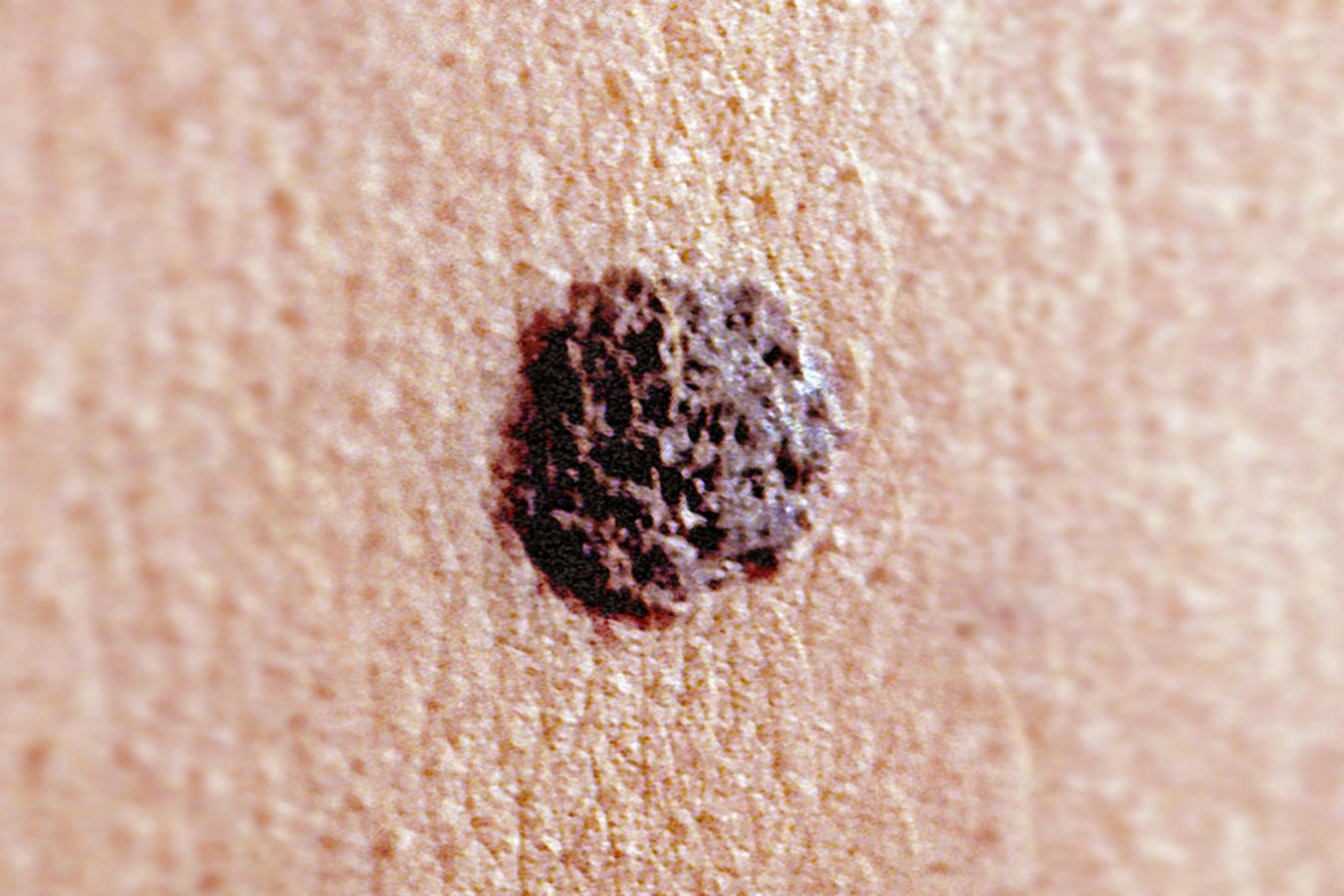
Malignant melanoma (cancer of the skin or mucous membranes), developed at the expense of melanocytes (melanocytic tumor). (Photo by: CAVALLINI JAMES/BSIP/Universal Images Group via Getty Images)
BSIP/Universal Images Group via Getty Images
Nearly 70% of patients who received a mRNA vaccine in addition to immunotherapy were cancer free after five years from melanoma, compared to 49% of patients that just received immunotherapy, according to a new study published in the Journal of Clinical Oncology. Furthermore, 92% of patients who received the combination therapy were alive at five years, compared to just 71% who used immunotherapy alone.
Melanoma is a deadly skin cancer that is difficult to treat if not detected early, and it usually recurs in about half of patients that have been treated within the first five years.
How It Works?
mRNA vaccines are the same technology that was used in Operation Warp Speed to develop the COVID-19 vaccines responsible for saving millions of lives in America. The mRNA vaccine used in the trial is designed to teach the immune system to recognize a patient’s unique tumor. Scientists sequence a patient’s tumor and identify mutations that are specific to that cancer. Researchers then select abnormal proteins found only in tumor cells, and encode them into an mRNA vaccine. When the vaccine is injected into the body, the body’s cells temporarily produce these proteins, allowing the immune system to learn what the cancer looks like and mount a targeted attack.
In this way, the approach is personalized and every patient receives a different mRNA vaccine tailored to their specific tumor. In the case of the COVID-19 vaccine, every individual received the same mRNA vaccine because the antigen used for the vaccine was a weakened form of the COVID-19 vaccine itself, not a unique tumor.
Why mRNA Vaccines Can Be Developed Quickly?
Traditional vaccines often require researchers to grow weakened viruses in a laboratory, which can take months to years. With mRNA vaccines, researchers can identify the genetic sequence of a target protein or virus, and then create a strand of messenger RNA that instructs the body’s cells to make that protein. This usually takes weeks as opposed to months or years in the case of traditional vaccines. Large amounts of virus do not to be grown in the case of mRNA vaccines.
Safety Concerns
For any new cancer therapy, safety remains a critical concern. The most commonly reported side effects from the personalized mRNA vaccines for melanoma include fatigue, chills and injection-site reactions like pain. Still, important questions remain, such as which patients would benefit most, how long protection from the vaccine would last and whether these vaccines can improve survival across multiple cancer types. Larger Phase 3 trials may shed light on these questions.
Future Potential
For decades, cancer treatment has relied on surgery, chemotherapy, radiation therapy and also immunotherapy in the case of melanoma. Personalized mRNA vaccines offer something completely different—the ability to tailor treatment specific to the biology of one’s tumor itself. Researchers are already studying how personalized mRNA vaccines could be effective in other cancers such as lung cancer and kidney cancer.
If further research confirms results of this melanoma trial, mRNA vaccines may represent one of the most transformational advances in treating different cancers. Cancer therapy will no longer be a one-size-fits-all, but rather a personalized approach to each individual.