

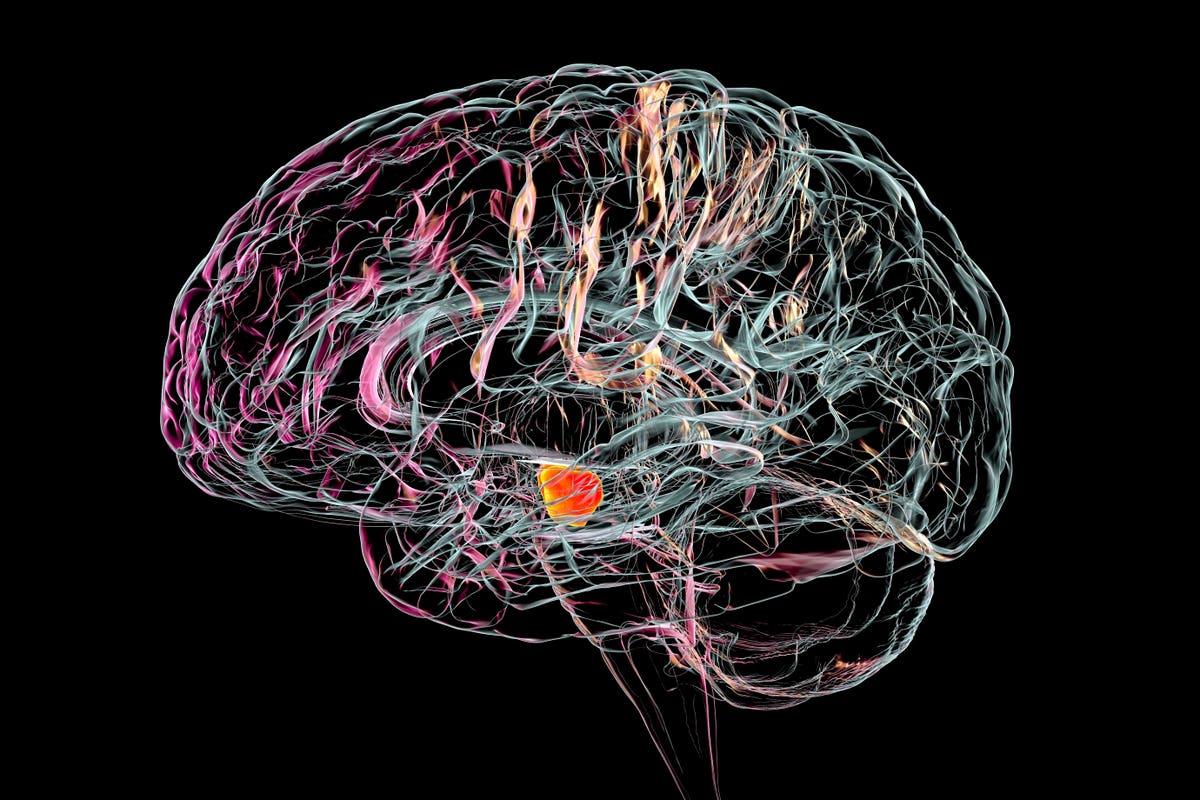
Substantia nigra. Illustration showing a healthy substantia nigra in a human brain. The substantia … [+]
In late 2018, Japanese neurosurgeons at Kyoto University Hospital implanted reprogrammed stem cells into the brain of a patient with Parkinson’s disease for the first time, a then ground-breaking moment for researchers in the field.
Merely administering the treatment was no small feat. Surgeons were required to drill two small holes in the patient’s skull and use a specialized tool to inject approximately five million cells into the putamen, a round structure at the base of the forebrain where the neural degeneration associated with the disease is known to occur. All in all, seven patients received the treatment along with an immunosuppressant.
While the results of this trial are yet to emerge, its initiation has spurred interest around the world in the potential of stem cell therapy to tackle Parkinson’s disease, a neurodegenerative condition which causes the progressive loss of dopaminergic neurons in the brain. This leads to a whole spectrum of worsening symptoms including tremors, rigidity, movement issues and cognitive problems.
Today, at the International Congress of Parkinson’s Disease and Movement Disorders, BlueRock Therapeutics presented the results of their own Phase I trial, in which dopamine-producing neurons derived from pluripotent stem cells were administered to patients as a way of attempting to replace their lost cells. Results suggest that the implanted neurons have survived transplantation and engrafted in the brain.
BlueRock Therapeutics was founded in 2016 as a joint venture of Leaps, and later became a wholly owned, independently operated subsidiary of Bayer. According to Seth Ettenberg, president and CEO of BlueRock, the full benefits of the therapy will hopefully play out over the course of many years as the cells assimilate within the patient’s brain and restore lost connections. “I don’t want you to think of the cells as a pump of dopamine,” he says. “We’ll demonstrate with data, we hope, that the cells integrate into the neural network.”
Such research is still at a relatively early stage. Larger trials still need to be done, demonstrating both safety and clinical efficacy but there is hope that stem cells will offer a new therapeutic option for a growing patient population in desperate need of better treatments. Rates of Parkinson’s disease are rising for reasons which remain unclear, yet it remains an incurable illness.
Right now, the main treatment available to patients is levodopa, a therapy which attempts to relieve tremors and other motor symptoms by boosting dopamine levels in the brain. But this cannot compensate for the missing neurons, and as such it only offers temporary respite and comes with an array of problematic side effects that can include confusion and dyskinesias, or abnormal movements.
“There’s a honeymoon period on levodopa where the patients have control, they feel better,” says Ettenberg. “But the doctor and the patient know that over the coming years, they’ll be taking more and more drug, and they’ll get less and less benefit from it. They get what’s called off-time, so times during the day, sometimes at night, where they can’t control their rigidity or their tremors.”
By the time patients are diagnosed with Parkinson’s, most have already lost an estimated 60 to 80 percent of the dopamine-producing cells in a part of their midbrain called the substantia nigra, which is responsible for motor control. As a result, David Dexter, professor of neuropharmacology at Imperial College London and director of research for the charity Parkinson’s UK, describes drugs like levodopa as ‘papering over the cracks.’
Other regenerative medicine approaches are also being investigated. Parkinson’s UK, the largest European charitable funder of Parkinson’s research, previously funded a trial using a protein called glial cell line-derived neurotrophic factor (GDNF) as a novel therapeutic. This protein is naturally produced inside the brain where it supports the survival of various cells. While the trial results were not entirely successful, there were suggestions that it could offer some clinical benefit.
“In the trial, GDNF was infused directly into the striatum in the brains of patients, which is where the dopamine-producing nerve cells have their endings,” says Dexter. “It was shown to double the number of nerve endings in the brain. We’re currently exploring the possibility of running another trial.”
AskBio, another wholly owned, independent subsidiary of Bayer, is currently investigating a gene therapy for Parkinson’s that would use a viral vector to deliver a GDNF gene to the neurons within the putamen, with the aim of expressing and secreting GDNF proteins in brain regions impacted by the disease. When scientists trialed this therapy in rodent and non-human primate models of Parkinson’s, the results suggested that such sustained expression of GDNF could induce neural regeneration and the recovery of motor function.
Modifying the Disease Process
While such approaches could help repair some of the damage caused to the brain by Parkinson’s, they are not altering the underlying disease process, which remains one of the major goals for researchers around the world.
“The holy grail is to develop therapies capable of slowing down or halting the loss of brain cells,” says Dexter.
Excitingly, there are a variety of treatments on the horizon which appear to be offering glimmers of potential. The major mechanism behind Parkinson’s disease is well established – a toxic form of a protein called alpha-synuclein that accumulates inside neurons in clusters, eventually driving cell death – and scientists are exploring various means of either protecting neurons or ridding it from the body.
A Phase III trial in the UK is currently examining whether exenatide, a repurposed drug for type 2 diabetes, can stabilize patients for longer and slow down the course of the disease. Preclinical studies have indicated that exenatide is capable of reducing neuroinflammation, supporting the function of dopaminergic neurons, and switching on neuron survival signals. And Annovis Bio, a Pennsylvania-based drug platform company addressing neurodegeneration, is conducting a Phase III trial to see whether a small molecule known as buntanetap can inhibit the formation of toxic alpha-synuclein clumps in the brains of early-stage Parkinson’s patients.
According to the Parkinson’s Foundation, genetic factors are thought to drive between 10 and 15 percent of patients, and Dexter is intrigued to see whether a drug called Ambroxol, which is a component of an existing cough medicine, can benefit patients with a mutation on a gene called GBA1.
“This mutation alters an important enzyme called GCase which is important for getting rid of defective proteins,” he says. “Ambroxol was shown to improve GCase activity. A Phase 3 trial is now going to start in early 2024.”
Other novel treatment approaches include attempting to address some of the other symptoms of Parkinson’s disease which are not currently managed effectively by levodopa. IRLAB Therapeutics, a CNS company based in Sweden, has developed a drug called Pirepemat which is currently in a Phase IIb trial and aims to address the repeated falls and balance problems many patients experience, by strengthening nerve cell signalling in the cortex. The company is also working on a new molecule, known as IRL1117, which they believe could have the potential to replace levodopa altogether.
“We’ve tried to find a way of getting something that is better than levodopa,” says Gunnar Olsson, CEO of IRLAB Therapeutics. “You need something that treats all the standard symptoms of Parkinson’s, the tremor, the rigidity, and does so with a long duration of action and without complications over time. What we see in our animal models is that we have a very fascinating molecule with all these effects that we’re after, and now we’re looking at going into human testing.”
Detecting Parkinson’s Earlier
Dexter foresees a future where patients are treated with combination therapies, akin to the regimes used to medicate HIV, which can both address the symptoms of Parkinson’s and halt the disease in its tracks.
However, to be most effective, he believes that these medications will need to be administered at a much earlier stage — before there has been significant loss of neurons in the brain. “That’s really where you may see the biggest impact, because the earlier you can stop the bad effects of alpha-synuclein, you may be able to even prevent Parkinson’s,” says Dexter.
This would require much better ways of detecting Parkinson’s without needing to wait for the onset of symptoms, and scientists have begun to make breakthroughs in this regard. Recently, the Michael J. Fox Foundation (MJFF) for Parkinson’s Research announced the development of a tool called the alpha-synuclein seeding amplification assay (αSyn-SAA), which can detect signs of the disease in the spinal fluid of high-risk individuals who have yet to be diagnosed.
In April, a paper in the Lancet Neurology journal found that in people with smell loss, a known early warning sign of the disease, the assay was 99 percent accurate at detecting signs of Parkinson’s. “I think what’s most exciting about this scientific achievement is that it allows us for the first time to measure the biology that is occurring in Parkinson’s disease,” says Mark Frasier, chief scientific officer of the MJFF. “The Foundation is urgently driving the next stages of development of αSyn-SAA toward widespread and standard use. Optimized assays would also detect abnormal synuclein through blood draw or nasal swab – a simple test that could be done in any doctor’s office.”
More effective diagnostics are also being developed to monitor the progression of Parkinson’s disease in patients. The pharmaceutical company Merck has developed an alpha-synuclein PET ligand which enables doctors to effectively look inside the brains of patients and examine the levels of alpha-synuclein and how it is contributing to the disease pathology.
“The use of the PET ligand for better understanding the disease process itself will be very valuable,” says Jason Uslaner, VP, Research Science at Merck. “What levels of alpha-synuclein and in which brain regions, are different Parkinson’s disease symptoms associated with? It could significantly help with the development of disease-modifying therapies, through confirming or not the hypothesis that a particular treatment is modifying an important biology associated with the disease.”
While there is much still to be done to improve the outlook for Parkinson’s patients, researchers are more optimistic than ever that we are reaching a turning point in the battle against the disease.
“It’s an exciting time,” says Dexter. “There’s lots of imaginative approaches being taken because we know so much more about what’s causing Parkinson’s.”
Thank you to David Cox for additional research and reporting on this article. I’m the head of Leaps by Bayer, the impact investment arm of Bayer AG. We invest in teams pursuing fundamental breakthroughs in life science, targeting ten huge challenges or “leaps” facing humanity, including to provide organ and tissue replacement and to protect brain and mind.