

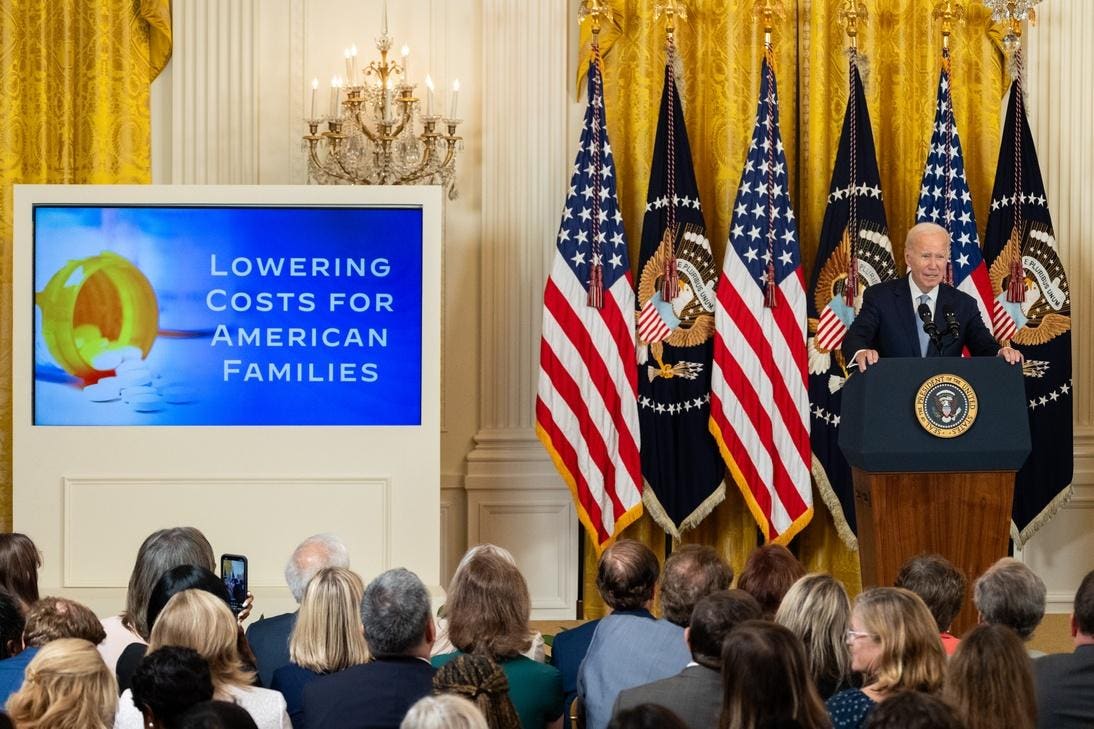
WASHINGTON DC, UNITED STATES – AUGUST 29: US President Joe Biden speaks during an event celebrating … [+]
The pharmaceutical industry has long anticipated the dreaded day that finally arrived last week. The Department of Health and Human Services (HHS) released a list of the first 10 drugs selected for price negotiation by the Centers for Medicare & Medicaid Services (CMS). By invoking the “nuclear option,” Congress and the Biden Administration achieved through the Inflation Reduction Act (IRA) what they have long been after politically: to rein in the pharmaceutical industry as a means to try and reduce the high cost of prescription drugs and lower healthcare costs.
On finally “beating” big pharma, President Biden triumphantly said “well, we did it.”
We did not arrive at this ill-conceived legislative outcome overnight, and the government’s regulatory war against big pharma is far from over. Like many open conflicts, this battle is likely to be protracted, counterproductive and result in significant collateral damage for the foreseeable future. And unfortunately, patient-consumers will be caught in the crossfire.
It’s astonishing that the pharmaceutical industry–once the crown jewel of American business–now finds itself at such a perilous juncture. It is especially puzzling and unfortunate considering that we are on the verge of introducing more life-saving medicines and therapeutics to treat a wider range of diseases than ever before. Operation Warp Speed (OWS) serves as a shining example of why big pharma remains unrivaled in leveraging technology and innovation to bring safe and cost-effective therapies to the market on a global scale. It also shows the tremendous good that can come when the government works in concert with industry.
Against all odds, the industry produced Covid-19 vaccines in just under a year, a historic achievement that saved millions of lives and facilitated a rapid economic recovery in the United States. Regrettably, despite the initial goodwill and impact of OWS, its memory faded from the public’s consciousness as quickly as fizz from a soda can. To understand why, we need to look back at the industry’s self-inflicted wounds accumulated over many years.
When it comes to the public’s perception of American industries, the pharmaceutical sector continues to rank poorly. Any value that the industry’s medicines provide to patient populations is currently eclipsed by public attention focused on egregious pricing practices.
Who can forget the infamous “Pharma Bro” Martin Shkreli and his company’s $750 Daraprim drug, the $608 EpiPen price gouging scandal, the $84,000 Sovaldi uproar and the recent Aduhelm pricing and efficacy controversy? As I explained here, these egregious instances, while not representative of industry practices at large, underscore why consumers rightly harbor suspicions about the fairness of drug prices and the profitability of drug companies.
In addition, a new Kaiser Family Foundation (KFF) survey revealed that more than 80% of Americans consider the cost of prescription drugs “unreasonable,” with an equal percentage believing that pharmaceutical company profits significantly contribute to these high costs. Clearly, the industry has failed to address these concerns effectively, allowing opaque pricing practices to dominate the market. Moreover, the industry’s argument that pharmaceuticals represent only a small fraction (11-18%) of U.S. healthcare costs has not resonated with the public.
When patient-consumers see the price of a drug at the pharmacy, they often experience sticker shock. A clinician or pharmacist may recommend a generic alternative at a fraction of the cost, reinforcing the belief that branded drugs are excessively expensive due to “greedy” pharmaceutical companies. Patient-consumers lack insight into how generics are priced, the variation in generic drug costs across regions (such as Europe), or the intricacies of insurance companies’ price negotiations for specific plans. All they know is that drugs are expensive. Until recently, with the introduction of hospital price transparency rules, they had little opportunity to understand the costs of other aspects of healthcare, specifically healthcare delivery. Despite the ruling of the Supreme Court, they still don’t have much visibility into the costs they will be forced to bear.
As I discussed in my book, Bringing Value to Healthcare, every stakeholder in the system, including manufacturers, providers, payers and consumers, bears responsibility for its current failures. Under a perverse fee-for-service (FFS) payment model, consumers are incentivized to demand drugs and services at will, thanks to generous employer-sponsored health plans. Taking advantage of this lack of accountability, drug and device manufacturers have flooded the airwaves with television ads promoting drugs for every condition under the sun, urging viewers to “ask your doctor if so-and-so drug is right for you.”
Transitioning to a new market-based, patient-centered model that accounts for cost and quality of outcomes across the continuum has been slow, but necessary. But direct government intervention in our healthcare system has often exacerbated old troubles, resulting in unintended consequences for all stakeholders.
As I’ve written about before, CMS has been trying for decades, with limited success, to control rising healthcare costs through reform. In the face of an aging population, driven in large part by the baby boomer silver tsunami that is living longer—in part because of the advances of the pharmaceutical industry—Medicare is really worried about running out of money. And, as healthcare costs continued to skyrocket, the Obama Administration’s passage of the Affordable Care Act (ACA) was intended to bring these costs under control.
Billed as insurance legislation, ACA promised to lower premiums, provide more competition in markets with few insurance coverage choices and enable Americans to ‘keep their doctor.’ ACA was meant to move healthcare delivery organizations to a better place, defined by ‘value’ and greater accountability. In reality, it has had the opposite effect: raising costs, dramatically increasing consolidation (which eliminates competition), constraining choices and achieving precious little to increase transparency. All the while, its bureaucracy has done nothing to improve health outcomes. The IRA portends similar outcomes today.
Since the IRA’s passage last year, a number of pharmaceutical companies have scaled back their R&D portfolios, which means fewer life-saving drugs coming to market. Lower Wall Street profit expectations could also lead to reduced capital investment in R&D. As this damage unfolds, stories of patient-consumers needlessly suffering and even losing their lives because of inability to access life-saving cures will become increasingly common.
As the repercussions of the IRA begin to reverberate, we must keep two perspectives in mind. Yes, the pharmaceutical industry bears much of the blame for getting in the government’s crosshairs. However, it has also been unfairly maligned due to legislators and regulators’ limited understanding of the complexities involved in bringing new drugs to market–both from an economics and efficacy and safety standpoint.
The pharmaceutical industry, like the rest of healthcare delivery, is undergoing massive, gut-wrenching change in terms of the regulatory environment, technology, competitive landscape and market expectations. Taken together, this has all necessitated a fundamental reevaluation of old assumptions about its business model, which I outlined both in my most recent column and extensively in my book. Without a focused effort to clearly make the case for the true value of medicines and drug innovation, patient-consumers’ negative perceptions about the industry will persist. The argument that the industry’s primary imperative is to become more effective at public diplomacy is a fool’s errand in this climate of seismic transition.
Conversely, failure to fundamentally change the business model to one that is less product-centric, and instead focuses on the patient-consumer, will only further fuel legislators’ appetite for greater regulatory control. And given Congress’ history of not fully grasping healthcare’s intricacies and their inability to fix the serious, underlying issues that need to be addressed, further regulatory “fixes” could result in further unanticipated consequences.
Failure to pivot means consumers stand to lose in this ongoing battle being waged between Washington politicians and big pharma. To make matters worse, all early indications suggest that a truce between government and industry is not on the horizon–and that is a frightening scenario to fathom.