

Protests in America are older than America itself. Three years before the U.S. declared independence, fed-up settlers in Massachusetts spent three hours dumping tea in the harbor — a rebellion Americans now fondly know as the Boston Tea Party.
“Protest is the heartbeat of a functioning democracy. America was born not only from a rejection of monarchy, but from the vision of a democracy of, by, and for the people,” Ezra Levin, co-founder and co-executive director of Indivisible, an organization involved with No Kings demonstrations, told JS. Those protests, most recently on March 28, have assembled millions of demonstrators across the country to denounce President Donald Trump’s second term.
Giorgio Viera/Getty Images
Trump signed an executive order in March 2025 aimed at removing information from national parks, monuments, museums and memorials that portrayed the U.S. as “inherently racist, sexist, oppressive, or otherwise irredeemably flawed” to remind the country of “our extraordinary heritage, consistent progress toward becoming a more perfect Union, and unmatched record of advancing liberty, prosperity, and human flourishing.”
But the order is just one component of a yearslong effort from conservatives to downplay and rewrite the country’s problematic and dark past by attacking and stifling “woke” policies and critical race theory.
Trump’s two administrations have also actively targeted marginalized groups, including women, immigrants, people of color, the LGBTQIA+ community and more, actively rolling back hard-fought protections for these groups over time.

Jessica Kourkounis/Getty Images

Oli Scarff/Getty; Xinhua/Wang Ying/Getty
Trump has repeatedly derided people who demonstrate against him and his causes, at one point in 2016 saying he wanted to punch a protester at a Nevada rally in the face. The president, who is known for his tendency to call his opponents names, has also referred to protesters in Los Angeles who opposed his immigration enforcement raids as “animals,” “insurrectionists” and “a foreign enemy.”
All of this is in direct opposition to Americans’ First Amendment right to free speech and protest, and effectively disregards the importance of protest in the country over the past 250 years. The irony in the country’s Freedom 250 celebrations is that not everyone in this country has been free for 250 years, and that conservatives and the Trump administration are continuing to work toward restricting freedoms that would not have been possible without protest.
“Any moment where we have advanced as a country, where we’ve deepened democracy, where we have unwound white supremacy and advanced equality, there have been massive protest movements that were grassroots, coming from the public and pushing politicians forward to push America to live up to its full promises,” Nicole Carty, executive director of Get Free, told JS. “It really is through fully reckoning with our history and undoing the legacies that made us unequal in the beginning of this country, and when we have done that — like an abolitionist movement, civil rights movement — we’ve seen democracy, equality, and economic prosperity grow for everyone. There is still work to be done.”
More than 100 demonstrations across the nation are set to take place on Saturday with Get Free, an organization sponsoring the “All of US” protests.
“There’s really a concerted effort coming from the federal government to make this anniversary tell a very specific story about American history that sets up a future where really only wealthy white men have civil rights,” Carty said.
Anthony Vidal Torres, communications director of Get Free, called it “an opportunity for the public to channel their defiance and their desires for reckoning, repair, and equality over erasure.”
Torres added: “We’re taking up the baton from our ancestors and really stepping into the legacy of the abolitionist movement, the civil rights movement, with our effort here.”

William Lovelace/Getty Images
Of course, protests are not strictly American. But American protests are absolutely inseparable from U.S. history. When taking a glimpse at American protests over the years, the divisions and contentions of the country become crystal clear.
Here’s a JS roundup of some of the significant protests in America’s 250-year history.
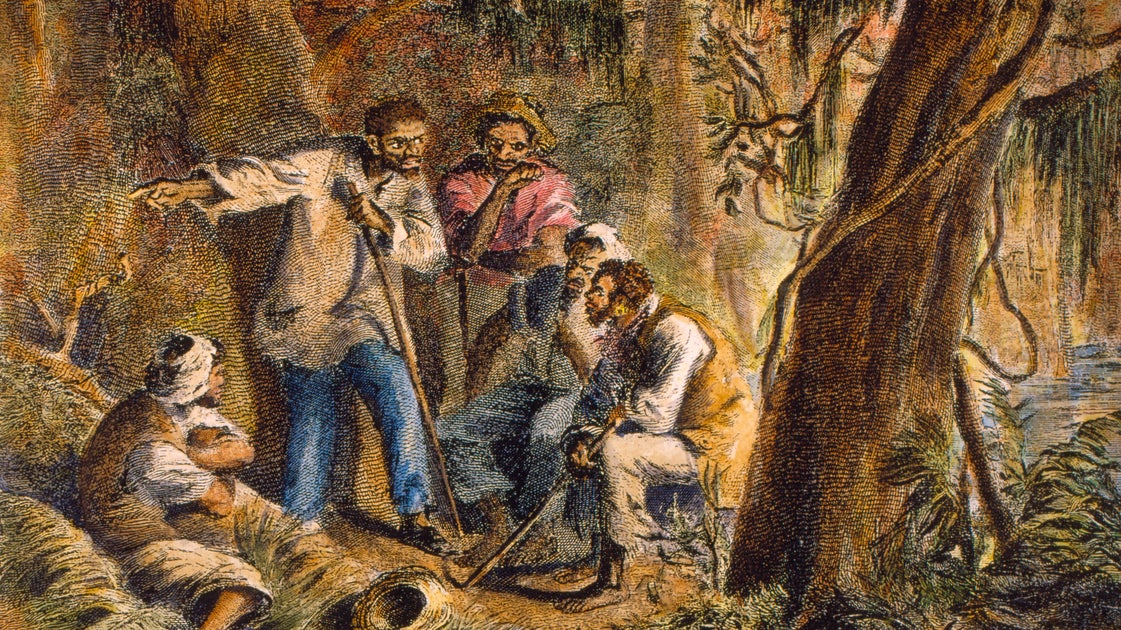
The enslavement of Africans began in the British colonies, soon to be the United States, in 1619, more than 150 years before the Declaration of Independence was signed. From that came numerous rebellions and raids against slavery, including Nat Turner’s Rebellion in Virginia in 1831, the Harpers Ferry Raid in Virginia (now West Virginia) in 1859 and the raid at Combahee River in South Carolina that freed 700 enslaved people in 1863.


Universal History Archive/Getty
A century later, the Civil Rights Movement in the ’50s and ’60s inspired countless demonstrations advocating for desegregation and the end to discrimination against Black people in the U.S.

Bettmann via Getty Images
Indigenous activism is also crucial to understanding the history of America, which sits upon land stolen from Indigenous peoples. In 1969, 89 members of the Indians of All Tribes (IOAT) began a 19-month occupation of Alcatraz Island in California in an effort to reclaim the land.
“We, the native Americans, re-claim the land known as Alcatraz Island in the name of all American Indians by right of discovery,” their proclamation read. “This tiny island would be a symbol of the great lands once ruled by free and noble Indians.”

The fight for LGBTQ+ rights is also ingrained in U.S. history. The famed dayslong Stonewall uprising in New York City began on June 28, 1969, in response to police violence against the LGBTQ+ community.

New York Daily News Archive/NY Daily News/Getty Images
The country has also historically restricted women’s freedoms, including women’s right to vote, which was not codified until 1920 with the 19th Amendment (though some women would have to wait longer). This followed decades of (notably exclusionary) feminist struggle in the country, including the historic 1913 Woman Suffrage Procession in Washington, D.C.

Young people at colleges and universities have been at the heart of many of these revolutionary moments, including students protesting the Vietnam War in 1970 at Kent State University in Ohio in May 1970. The National Guard killed four people and injured several others by firing their guns at the crowd. Days later, police killed two students and injured multiple other students at Jackson State University, an HBCU in Mississippi. There had been protests on the campus, but not the night that police fired at the dormitory.

Over America’s 250-year history, we’ve seen protests in various forms, not just rallies and marches. People have put their bodies on the line in more ways than one, including in extreme and harrowing ways. There have been hunger strikes — like this one by advocates fighting against climate change and this one by people in the Alabama prison system calling attention to poor conditions — and multiple instances of self-immolation — like when peace activist Alice Herz set herself on fire in Detroit in March 1965 to protest the U.S. war in Vietnam, or when Aaron Bushnell did the same in 2024 in front of the Israeli Embassy in Washington, D.C., to protest Israel’s war on Gaza.

Samuel Corum/Getty Images
America’s far right has also found power in protests, which Trump has treated with far more forbearance than other public demonstrations. Notable examples include the 2017 ”Unite the Right″ rally in Charlottesville, Virginia, in which white supremacist demonstrators shouted racist and antisemitic slogans to protest the removal of a statue of Confederate Gen. Robert E. Lee, and the Jan. 6, 2021, Capitol insurrection, which Trump later referred to as a “day of love,” when election deniers stormed the Capitol during the election certification process.
The Charlottesville protest, which sparked counterprotests and turned deadly when a driver fatally struck a woman and injured 19 others, featured “fine people on both sides,” according to Trump, who has since doubled down on the sentiment.
At a rally months after the Capitol riot, Trump called his insurrectionist supporters “peaceful” and “great” people. He even went so far as to pardon Jan. 6 rioters convicted of crimes when he returned to office last year.

Zach D Roberts/NurPhoto/Getty Images
Trump’s administration wants to make it harder to stage protests in Lafayette Square in front of the White House. The park, a historic landmark, has been the site of countless demonstrations, including the White House Peace Vigil on June 3, 1981.

The Trump administration’s heavy-handed anti-immigration agenda sparked a chorus of protest across the country — notably in Minneapolis, where immigration agents killed Alex Pretti and Renee Good earlier this year.

Octavio Jones/Getty Images
“Now, at a moment when basic constitutional rights are increasingly under attack, protecting and exercising those freedoms is as important as it was in 1776,” Levin from Indivisible told JS. “The spirit behind the No Kings movement isn’t new. It’s woven into the DNA of this country. It lives in every generation of Americans who have refused to accept unchecked power and instead organized to make our democracy stronger.”
“Democracy is a verb,” Levin continued, “and 250 years later, it still requires all of us to participate.”
Christy Havranek and Kelly Caminero contributed to this piece.