

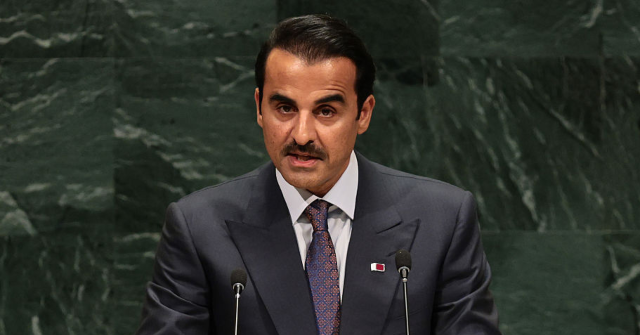
Qatar’s Emir Sheikh Tamim bin Hamad al-Thani said on Tuesday that government revenue is down 42 percent for the first half of 2026 due largely to the impact of the Iran war.
“The crisis naturally had an adverse impact on public finances, with total revenues falling by 42 per cent during the first half of the year, while public expenditures decreased by 14 per cent — all without compromising essential services or development priorities,” the emir told the Shura Council, a nominal legislature appointed by the emir that mostly fills an advisory capacity.
“The closure of the Strait of Hormuz, along with direct damage to some energy facilities in Ras Laffan Industrial City, has disrupted a significant portion of the country’s exports,” he explained.
“We decided against curtailing essential services and chose not to alter development priorities, aiming to sustain the economic momentum Qatar is experiencing,” he said, crediting financial reforms such as reduced public debt, and developing revenue streams other than oil, for cushioning the blow from the war.
Ras Laffan is the site of Qatar’s main complex for processing liquified natural gas (LNG). Qatar is the second-largest producer of LNG in the world, behind only the United States, and supplies about a fifth of the world’s total LNG consumption.
An especially destructive Iranian missile strike on Ras Laffan Industrial City in March caused extensive damage to the LNG facility, sparking several major fires that had to be controlled by emergency personnel. Qatar had already halted most LNG production at Ras Laffan and another industrial city, Mesaieed, due to the threat of Iranian missile and drone attacks.
Qatar denounced the Ras Laffan attack as a “dangerous escalation, flagrant violation of state sovereignty, and direct threat to national security” — but like the other Middle Eastern nations attacked by Iran, Qatar took no overt retaliatory action.
QatarEnergy, the national energy company of the emirate, has said it could restart full LNG production within a matter of weeks after the Strait of Hormuz is officially reopened, but Reuters on Monday quoted industry experts who were skeptical of that claim.
The International Monetary Fund (IMF) and World Bank have estimated Qatar suffered more proportional economic damage from the war than any country except Iran itself. Qatar was expecting 6.1 percent GDP growth this year, but instead will lose about 8.6 percent, if current trends hold.
Qatar seems more hesitant about daring the Strait of Hormuz after U.S. forces dramatically reduced Tehran’s terrorist grip on the vital passage. QatarEnergy is still citing force majeure to cancel major LNG shipments to Asia and Europe.
Industry sources pointed out that LNG production is much more difficult to restart than oil exports, because the LNG production chain is more intricate and fragile, and Qatar does not have enough storage space to handle major backlogs if there are hang-ups along the chain. LNG is much harder to store in great volumes than oil because it requires temperature-controlled storage facilities.
The specialized LNG tanker fleet is smaller than the oil fleet and therefore more vulnerable to Iranian sabotage, so insurance costs are sky-high. Qatar seems unwilling to risk its tankers until the safety of the strait has been guaranteed.
Another complication is that Qatar had just embarked upon a huge production increase when the Iran war started, and the stalled upgrade process means big construction projects are halted and investments are stalled. The logistics of both restarting the existing LNG production chain and completing the expansion are formidable — and the financial logic of the expansion may have changed, with increased U.S. production of LNG and shifting supply chains due to the war.
Sheikh Tamim was relatively optimistic in his remarks to the Shura Council, predicting the war will have strengthened Qatar’s infrastructure and increased its resilience when all is said and done. He touted a $60.7 billion “portfolio of projects and investment opportunities” that will generate more revenue, and provide more public services, over the next five years.
The emir said Qatar’s objective should be “not merely to return to the pre-crisis status quo, but to use recovery as a springboard to accelerate economic diversification and strengthen national capabilities.”
QatarEnergy said on Monday that a major new LNG project will begin in November, and will start producing gas during the first quarter of 2027, suggesting the company believes exports will start returning to normal levels soon. Ship tracking firms have noted a dozen empty tankers owned or chartered by QatarEnergy gathering in the waters near its LNG export terminals.