

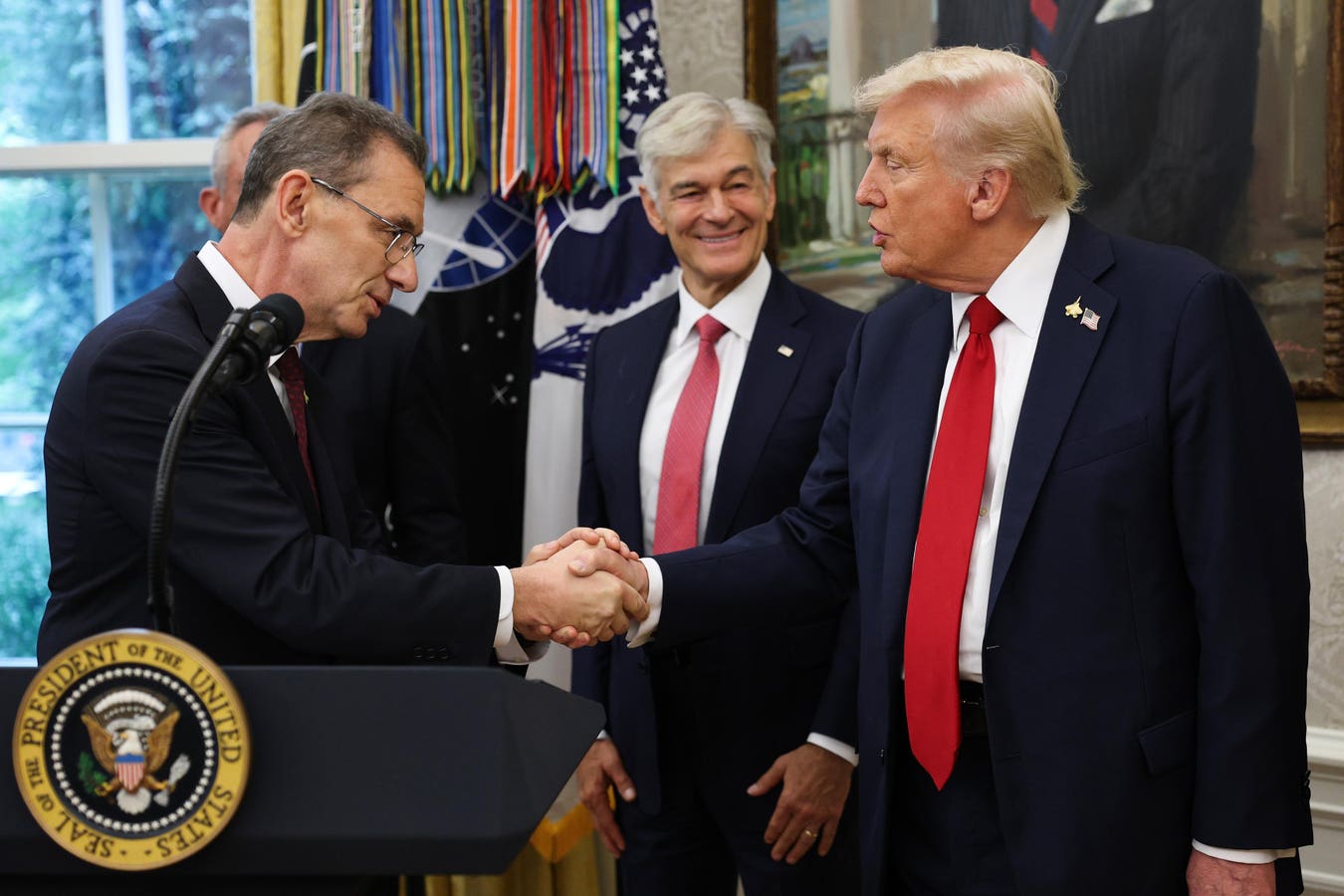
WASHINGTON, DC – SEPT. 30, 2025: President Trump shakes hands with Pfizer CEO Albert Bourla as he announces a deal with the company to lower Medicaid drug prices. The Trump administration has reportedly reached confidential agreements with 17 pharmaceutical companies to voluntarily sell some of their medications through Medicaid at lower prices that align with those paid in peer nations. And now the White House has issued a report claiming the potential for massive cost savings from MFN deals. (Photo by Win McNamee/Getty Images)
Getty Images
The White House issued a report this week touting massive projected cost savings — more than $500 billion over a ten-year period — from so-called most favored nation deals in which U.S. net prices for prescription drugs are pegged to those in comparably wealthy countries. The estimates are largely speculative and based on implausible modeling assumptions.
All presidential administrations want to put themselves in the best possible light. The Trump administration is no different in this regard. But when it comes to hyperbole and the tendency to exaggerate positive outcomes, it seems that no administration in modern times has ever done it quite like President Trump’s.
In relation to MFN drug pricing, for example, when Trump declares, “now you have the lowest drug prices anywhere in the world,” it doesn’t stand up to scrutiny. Specifically, research reveals the falsity of the administration’s claims when it touts its online platform TrumpRx as offering Americans the world’s lowest prices on certain prescription drugs.
The administration’s document released Tuesday notes that its MFN “provisions” differ between those pertaining to future drug launches or what it calls prospective MFN, and ones related to drugs that existed on the market before MFN began. It’s the latter we turn to first, and this includes TrumpRx.
MFN Framework for Existing Drugs
The voluntary MFN framework requires manufacturers to make existing drugs available to state Medicaid programs at MFN prices, which will yield more than $64 billion in “federal and state savings” in the next ten years, according to the White House. And the administration says that “discounted prices offered in the direct-to-consumer channel, TrumpRx.gov, will generate large patient savings for prescription drugs commonly purchased outside of insurance.”
The strictly confidential and temporary (three years in duration) agreements between the Trump administration and drug manufacturers are presumably based on MFN prices or the “second-lowest” offered among a basket of nine other similarly wealthy nations. However, without knowing details of the agreements it’s unknown whether the prices are in fact lower than what Medicaid already achieves using its existing system of supplemental rebates.
And logistically, any MFN calculation relies heavily on having access to international net prices. But most of these aren’t publicly available. Additionally, European countries included in the group of comparators, including France, have drafted regulations that explicitly forbid public release of net prices.
Supposing the administration can overcome the operational hurdles, to achieve broad sustained manufacturer participation over time the administration seeks potential legislative action to codify the deals. However, based on current sentiment in Congress this is unlikely to happen.
Separately, President Trump announced last autumn a new direct-to-consumer website called TrumpRx, operated by the federal government. The portal has been operational since February and offers several dozen prescription drugs at discounted prices.
Thus far, TrumpRx has had little impact on the prices consumers pay. Critics have noted that most of the pharmaceuticals currently available on TrumpRx are in the latter stages of the product life cycle, which means that they already face lower-priced generic or biosimilar competitors. And often savings offered on websites such as Mark Cuban’s Cost Plus Drug Company are considerably more for generic products than what TrumpRx delivers. Similarly, companies such as BlinkRx and GoodRx offer channels for patients to access more affordable prescription medications.
A platform like TrumpRx that primarily focuses on branded products is also mostly irrelevant for patients who are insured for the medications. Co-payments tend to much lower than the discounts offered by TrumpRx.
And cash-pay purchases generally do not count toward insurance deductibles (amount patients must spend before insurance kicks in) or out-of-pocket maximums. This implies that should patients need other prescription medicines in a given year, which many people do, they’ll be on the hook in the deductible phase of their pharmacy benefit. This may cause patients to lose the safety net of their insurance, leaving them financially exposed.
The administration supports proposed legislation that would ensure health insurers count direct-to-consumer purchases of drugs at MFN prices towards patients’ deductibles and out-of-pocket maximums. While this would be a positive development, it’s expected that insurers would raise premiums to offset the added financial liability they face.
Prospective MFN
Under the voluntary MFN framework outlined by the White House, it’s asserted that manufacturers will offer all new drugs launched in the U.S. at prices comparable to those in other high‑income countries. These arrangements are expected to generate $529 billion in savings in the next ten years across the public and commercial sectors, according to the administration.
The model assumes a 30% reduction in U.S. drug prices over time, while overseas prices would rise by an unknown percentage. The projections suggest global price convergence.
As the Trump administration sees it, the MFN framework aims to “equalize” drug prices by decreasing them in the U.S. and increasing other developed countries’ prices. Here, use of the word “equalize” is conspicuous, as there’s no law of one price when it comes to goods and services in different countries. For a variety of reasons, prices of most commodities differ, sometimes substantially, even among comparably wealthy nations.
Furthermore, the administration’s projection begs the question whether other developed countries will indeed raise prescription drug prices. If anything, most comparator nations are moving in the opposite direction because of severe budget constraints.
Another implied modeling assumption is that future drugs will be approved in the jurisdictions that make up the basket of comparator nations at or near the same time that they are granted marketing authorization in the U.S. The White House states that pharmaceutical manufacturers “will offer all new drugs launched in the U.S. at prices comparable to those in other high‑income countries,” Well, with more than 70% of drugs today getting approved in the U.S. first, this raises quite a few questions. To derive an MFN price, there needs to be at least two comparators. With different regulatory agencies — there are five such entities among the comparator nations — substantial differences in timing of regulatory approval are a common feature as well as sometimes lengthy delays in pricing and reimbursement as pharmaceuticals go through evaluations by national health authorities.
And in the current context, what happens if pharmaceutical manufacturers decide not to launch drugs at all in certain jurisdictions to avoid MFN pricing? This is a legitimate concern, given the public comments issued by CEOs in recent months about sequencing of launches and possible avoidance altogether of a number of countries.
It’s notable that none of the posted estimates on cost savings have been independently verified. Frankly, they can’t be assessed properly without disclosure of the terms of the agreements signed by pharmaceutical companies. The White House said it has not shared the text of the agreements because they include highly sensitive data that could “move financial markets.”
An emerging critique of the deals struck by Trump and drug company CEOs is that firms don’t appear too bothered by the possible implications. Public Citizen writes, “when talking to shareholders, under legal obligations to provide truthful information, drug corporations have not indicated anticipating any major impacts from the White House deals.”
If this is the case, it makes one wonder about just how substantive the cuts in net prices are or will be. Perhaps pharmaceutical companies do anticipate significant reductions in price, at least for some medicines, but they expect there to be an increase in patient utilization due to lower prices? Or maybe there are hidden details contained in the agreements that offer material offsets?
In April, staff working for Sen. Bernie Sanders (I-Vt.) released an analysis that looked at 15 of the companies who had agreed to MFN deals and found that their combined profits rose 66% over the past year. There seems to be an inference that whatever is included in the deals isn’t hurting business. The report also noted that the tax cuts Trump signed into law in 2025 “exempted or delayed many of the most expensive drugs” from being selected for price negotiations with Medicare. This includes medications such as the cancer therapy Keytruda, which got at least a one-year reprieve from being chosen by Medicare to have its price negotiated by the federal government.
The Trump administration countered by asserting that the analysis Sanders had commissioned was flawed, in part because it relied on list and not net prices, which then overstated the profit estimates.
As it stands currently, model estimates issued by the White House on cost savings from MFN prices are highly speculative and depend on a set of unrealistic assumptions. It remains to be seen how the MFN framework will play out, both in terms of verified savings over time and the impact on drug makers’ bottom line.