

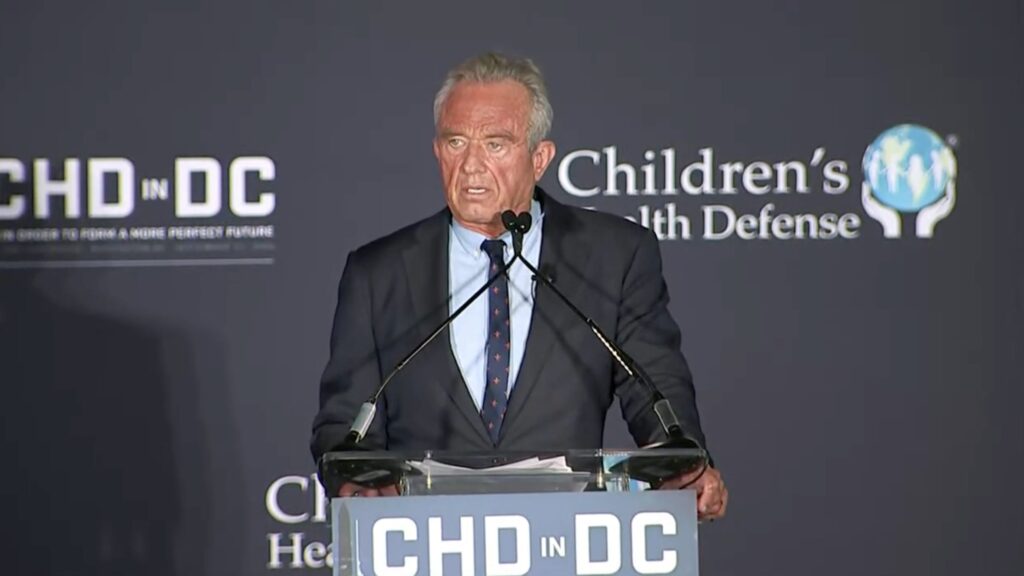
WASHINGTON — Health secretary Robert F. Kennedy Jr. returned to his roots on Thursday during a keynote address at a conference hosted by the Children’s Health Defense, an anti-vaccine nonprofit he helped start.
The CHD speech served as a victory lap for Kennedy at a key moment for the MAHA movement — just before midterm elections that could determine the viability of his agenda, and serve as a referendum on the GOP’s approach to health care reform. Kennedy, who previously downplayed his work sowing doubt about vaccine safety, has now made it central to his legacy as health secretary.
His remarks appeared at first to be a recap of Kennedy’s agenda over the past year — flipping the food pyramid, scrutinizing chemical additives, and changing hospital meals. About halfway through, however, after mentioning work his agency is doing on electromagnetic frequency and “chemtrails,” he delivered for his fervently vaccine-distrusting base.
“The question is: Should we be looking at the potential that some of these chronic illnesses are associated with vaccines?” Kennedy said as an image of a hepatitis B vaccine package insert appeared on screens inside the conference center ballroom.
“ADVERSE REACTIONS,” the insert read, above text describing how researchers collected adverse reaction information from 147 healthy infants and children enrolled in three clinical trials.
“They were monitored for only five days, and there was no placebo,” Kennedy said. “There’s no way any other product would get FDA approval with that few people.”
At the time, the Food and Drug Administration accepted the trial of 147 participants alongside data from thousands of babies vaccinated with an older version of the hepatitis B shot. Trials including thousands of children that were conducted after the hep B vaccine entered the market have provided further evidence of efficacy and low risk.
Universal newborn vaccination led to a 99% drop in chronic hepatitis B infections among children and teens. The Trump administration ended the policy last year.
Kennedy spent more than 20 minutes casting doubt on the safety of vaccines at the CHD gathering, saying the public has “no idea” about the risk profile of shots that have been administered tens of millions of times. While saying serious harm from vaccines was probably “very rare,” the secretary at various points suggested — without evidence — that vaccines were underpinning an epidemic of chronic illness in the United States. He used the package insert as proof.
In order to market their product, vaccine makers are required to disclose conditions that people (adults and children) reported after getting vaccinated, but which are not necessarily correlated with vaccination. “It is not possible to reliably estimate their frequency or establish a causal relationship to a vaccine exposure,” the hep B insert says.
Nevertheless, Kennedy drew a link between chronic disease and the 18 vaccines previously recommended for American children.
“There are 454 adverse events listed in total, and they include almost all of the injuries, like diabetes, death, sudden infant death syndrome, anorexia, allergic reactions, allergies, asthma, autoimmune diseases,” he said. (The Trump administration’s changes to the childhood immunization schedule are the subject of an ongoing lawsuit.)
The Department of Health and Human Services is now conducting research on more than 150 of the most serious adverse events that have been reported after vaccination to determine whether they could be linked to certain vaccines, he said. Kennedy also noted a litany of other vaccine-related initiatives happening across agencies, including a task force review of the safety, timing, and sequence of childhood vaccinations, and an expansive project involving health data from Medicare and Medicaid, states, and private health insurers.
Kennedy blamed the nation’s poor system for reporting adverse events for letting issues fly under the radar. HHS is working to make the Vaccine Adverse Event Reporting System more user friendly, and planning to compensate doctors for their time when they submit information about possible vaccine side effects and injuries, he said, without offering additional details.
The secretary previously said he wanted to automate the VAERS system in order to boost data collection.
Even if vaccine-related injuries are rare, he said, “in our country, we care about rare illnesses and deaths. We care about every child who dies from measles. They get headlines.” That was the only time the secretary mentioned measles, which has been rapidly spreading in the U.S. and has contributed to at least four deaths in Pennsylvania.
Despite uproar among physicians, biotech companies, and others in public health over the Trump administration’s vaccine policy, Kennedy has gotten the president to embrace his ideology.
On Thursday, he emphasized that he had Trump’s support. “Let me be clear: You have a strong and steadfast friend at the White House,” he told the crowd.
As Kennedy ended his speech, walking offstage to hearty applause, a voice overhead announced the next speaker: Andrew Wakefield, the discredited British physician whose work in the late 1990s helped kickstart the anti-vaccine movement.
Nicholas Florko and Matthew Herper contributed reporting.