

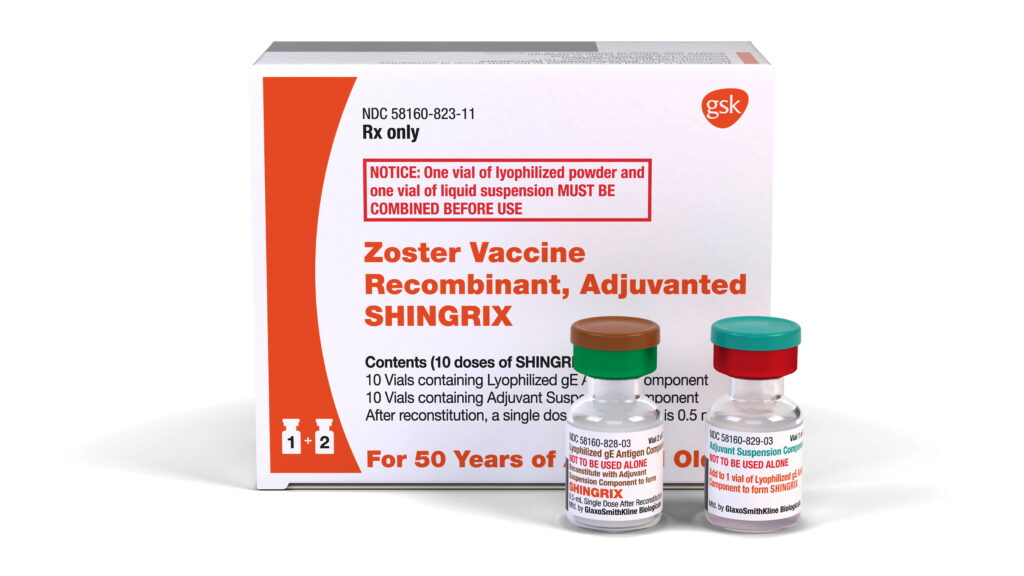
The newer shingles vaccine has been turning heads since its link to lower dementia rates was reported two years ago. Now the same research team behind that observation has found an association between receiving the Shingrix shot and a reduced risk of heart disease.
There have been signals before of cardiovascular benefits in people who got the newer, recombinant vaccine to prevent shingles, a painful, often serious flare-up in older people of the chickenpox virus from childhood. Those who got Shingrix were less likely than unvaccinated people to have heart attacks, strokes, or heart failure.
The Oxford researchers wanted to answer the “what else could it be?” question arising from earlier observational studies that, by definition, can’t prove cause and effect. Were people getting vaccinated against shingles healthier to begin with than those who weren’t vaccinated? Did their better access to health care, as evidenced by their inoculations, better protect them from the disease?
Beyond eliminating the possibility of “healthy vaccine bias,” was there a way to show important differences between the two vaccines?
The researchers found their solution in a natural experiment, taking the opportunity to compare similar groups of vaccinated people on either side of the date in October 2017 when Shingrix was approved in the U.S., displacing Zostavax, the live vaccine administered before then. The study, published Wednesday in Nature Medicine, looked at the TriNetX network’s electronic health records of 72,000 vaccinated people 60 and older, splitting them into two matched groups who got their shots six months before or six months after the new approval. TriNetX holds data from 60 health systems but does not include people with public health insurance.
After seven years, receiving Shingrix versus the older Zostavax was associated with a 9% lower overall cardiovascular burden, defined as a bucket of coronary heart disease, heart failure, and stroke. Coronary heart disease was reduced by 10% and heart failure by 12% in the Shingrix cohort. Strokes were down 12% in men but not significantly lower in women; atrial fibrillation was 7% lower in all. The relative risk numbers translate in absolute terms to 1% fewer cardiovascular events after seven years.
“Although the benefits are relatively small on an individual basis, millions of people receive shingles vaccination, meaning that even a small cardiovascular benefit could translate into a substantial number of cardiovascular events prevented at a population level,” Mark Russell, clinical senior lecturer and consultant rheumatologist of King’s College London, said in a statement shared by the Science Media Centre.
The authors, while acknowledging limits of the study, said the results were encouraging. “This study remains observational, even though it’s a natural experiment, and so we are keen to see results from randomized controlled trials. And one of them is underway,” co-author Maxime Taquet, associate professor of psychiatry at the University of Oxford, said at a media briefing. He was referring to the DAN ZOSTER study of about 162,000 people in Denmark, whose first results are anticipated in 2027.
“If confirmed, Shingrix could prevent hundreds of thousands of cardiovascular events in the USA alone, and may be the first vaccine that protects the heart and the brain,” Taquet said.
Kaleen Hayes, associate director of pharmacoepidemiology at Brown University School of Public Health, said she was excited to see the results. Her research focuses on using real-world data sources to understand the effects of medications and vaccines in older adults, including dementia risk after Shingrix vaccination.
“This was really the next question everyone was wondering about,” she told STAT in an interview. She was not involved in the Nature Medicine study. “There’s been some evidence, but very conflicting evidence on whether this vaccine has cardioprotective effects as well as potential neuroprotective effects.”
What’s different about Shingrix? The study authors said they can only speculate on how Shingrix exerts this protection, because they don’t know the exact mechanism. The herpes virus that causes chickenpox and shingles also heightens the risk of cardiovascular disease, research has shown, so better protection from Shingrix than Zostavax could help.
But the chemical composition of Shingrix might explain its salutary effects on dementia and heart disease, if borne out by randomized clinical trials designed to generate stronger evidence of cause and effect.
“The recombinant vaccine may induce trained immunity,” said study co-author Fabiana Corsi-Zuelli, a research fellow in Psychiatry at Oxford. “That means changes in cells of our immune system.”
Those changes could affect cytokines, proteins that can induce changes in the endothelial cells lining blood vessel walls.
“Ischemic heart disease and vascular diseases tend to be linked to an inflammatory response,” said study co-author Betty Raman, associate professor of cardiovascular medicine at Oxford. “So the cytokines essentially activate cells within the tissue that can promote atherosclerosis, which is basically deposition of fat in the wall, and that in turn can lead to vascular events like a blockage in the arteries.”
Taquet pointed to the adjuvant AS01, a chemical added to Shingrix but not to Zostavax, and the epigenetic changes that might alter immune response.
“For cardiovascular disease in particular, we’ve got a bit more stronger hypothesis that this has to do with the adjuvant, because we haven’t seen any protection of Zostavax vaccines for cardiovascular disease, and the natural experiments have not found any effect on cardiovascular outcome,” he said.
Brown’s Hayes suggested that the vaccine might help moderate inflammation risk through its robust immune response to shingles. “Whether it’s the actual AS01 versus just in general, it’s an effective vaccine and our immune system gets keyed up is, I think, very much still on the table as to what’s the potentially right answer here,” she said. “Being able to harness what we can learn from the benefits to understand our options for new therapeutics in this area — I think that will be a really exciting field that’s to come.”
While shingles vaccines are offered only to middle-age or older people now, others could possibly benefit, too, Oxford’s Raman said. She called for more research and randomized control trials to define the right population to treat.
Taquet thinks more people should be vaccinated against shingles.
“If these findings and the findings we provided for dementia help sort of nudge that, then that’s great. And if they are then confirmed in randomized controlled trials, the benefit might be enormous, for the people and for the economy and the health services,” he said. “If this helps people get the vaccine, then that’s great. But they should get it for the shingles protection in the first instance.”
STAT’s coverage of chronic health issues is supported by a grant from Bloomberg Philanthropies. Our financial supporters are not involved in any decisions about our journalism.