

The Diplomat author Mercy Kuo regularly engages subject-matter experts, policy practitioners, and strategic thinkers across the globe for their diverse insights into U.S. Asia policy. This conversation with Dorota Maczuga – co-founder of Polylocal, a Taiwan-EU B2B platform based in Kraków, Poland – is the 516th in “The Trans-Pacific View Insight Series.”
Identify the factors for cooperation between Polish and Taiwanese drone companies.
The main reason is the growing convergence of Poland’s and Taiwan’s national security strategies, driven largely by one factor: Ukraine. Ukraine’s role as a key driver in the development of drone-powered military technology is inseparable from Poland’s position as NATO’s eastern flank and main logistical hub for military aid to its fighting neighbor. In Taiwan, it has become a common narrative to compare Ukraine’s situation vis-à-vis Russia with Taiwan’s own security challenges posed by China.
China’s support for Russia’s invasion of Ukraine has changed how Poland views Taiwan, while Poland’s support for Ukraine has also changed how Taiwan perceives Poland. From being a blind spot on the map, Poland has emerged as an unexpected ally for Taiwan within the EU, while Taiwan has become an increasingly important partner for Poland in the Pacific.
Both Poland and Taiwan have large and increasing defense spending. Poland’s defense expenditure has reached 4.8 percent of GDP, giving it the highest relative defense budget in NATO. In Taiwan, defense spending reached 3.3 percent of GDP in 2026, and President Lai Ching-te has committed to raising it further to 5 percent by 2030.
The current geopolitical situation has raised concerns about overreliance on Chinese supplies in the defense sector, increasing demand for non-Chinese components. These concerns are based on real examples. In 2024 and 2025, Beijing restricted exports of critical drone components to Ukraine. At the same time, Chinese exports of components to Russia – including fiber-optic cables and lithium-ion batteries – increased sharply from mid-2025.
This is why Ukraine has fundamentally changed how Taiwan views its own military doctrine. President Tsai Ing-wen (2016–2024) initiated the elevation of unmanned aerial vehicles (UAVs) as a core element of national defense. Taiwan has banned the use of Chinese drones by government agencies and promoted exports of “non-red” UAVs to scale up its domestic industry.
Poland is pursuing a similar ambition, aiming to become a regional power in the drone industry. The Subcarpathian region in southeastern Poland, centered around Rzeszów, is set to establish Drone Valley, a national center for the certification and development of UAVs, at a cost of approximately 135 million Polish złoty (32 million euro). It was announced in early 2026.
Among other challenges, Poland’s small but growing drone industry faces one critical dependency: foreign imports of electronics. Taiwan’s excellence in ICT makes it an ideal partner for sourcing core components such as flight control systems. Last year, Poland became the world’s biggest buyer of Taiwanese drones, accounting for almost 60 percent of Taiwan’s total drone exports. The convergence between Poland and Taiwan on drones is therefore political and practical.
Explain the concept of “compliance-as-a-product” in the context of EU-U.S.-Taiwan defense and dual-use technology stack.
In simple words, it means buying a ready solution that already meets security standards, instead of having to go through compliance process by yourself.
In both U.S. and EU, the process is directed by ulterior regulations. The U.S. Department of Defense’s NDAA Section 848 bars procurement of drones containing components sourced from China, Russia, Iran, North Korea, or other designated states. The EU’s European Defense Industrial Strategy (EDIS, March 2024) pushes member states toward autonomy and reducing dependence on non-allied suppliers.
The U.S., EU, and Taiwan already function as a complementary ecosystem in this regard. While U.S.–Taiwan military ties run deep, Taiwan’s defense partnerships within the EU are newer. Poland has so far been the most active in it, alongside the Czech Republic.
How does this concept help European defense companies avoid Chinese supply chains?
Compliance has traditionally meant expensive audits and supply chain checks. “Non-red” products cut through that – certified clean of Chinese, Russian, or Iranian components from the start. For instance, Dronehub, a Polish-based company founded by a Ukrainian entrepreneur near Rzeszów, does exactly this: meeting both U.S. federal (NDAA 848) and EU defense (EDIS) requirements simultaneously.
As European nations are pivoting toward autonomous warfare, “compliance-as-a-product” becomes a necessity in the defense industry. Poland is becoming one of the most active countries in this type of companies. This year Poland’s drone company FlyFocus has raised $5.3 million for “Made in Europe” drone manufacturing. The company ensures that all its systems are built using NATO-compliant components and that it retains full ownership of its software.
What is the role of Ukraine’s drone industry in Poland-Taiwan drone industry cooperation?
Ukraine’s drone industry has rewritten how modern war is fought, and it is visible even to those with little military background. Ukraine’s active battlefield, Poland’s eastern NATO flank, and Taiwan’s ICT excellence – meaning especially non-red electronics – combine into a shared security logic. Taiwan provides the technology, Poland the NATO backing and strategic positioning, Ukraine the battlefield experience and a living revolution in modern warfare.
Ukraine has shown that the drone-dominated battlefield runs on three things: precision, visibility, and speed. AI-enhanced unmanned aircraft systems (UASs) have made persistent surveillance the norm and large formations a liability. The Ukrainian Navy’s decimation of Russia’s Black Sea Fleet using drones alone is a case in point – and a preview of how China might use UASs to challenge U.S. naval dominance in the Taiwan Strait.
There is yet another aspect, rarely mentioned in public discourse. Ukraine’s war effort makes it a perfect testing ground for Taiwanese solutions. As mundane as it sounds, Taiwanese drone companies find it harder to test their products at home: permits are more difficult to obtain, and Taiwan’s mountainous landscape complicates flight operations. Here too, Ukraine and Poland offer a solution.
All of this has created a situation where two countries on opposite sides of the globe are developing a surprisingly deep and consequential cooperation.
Assess the future trajectory of Taiwanese-Polish drone convergence.
The trajectory is only going upward, as what we are seeing right now is just the beginning. In June, for the first time, Taiwan Expo was held in Warsaw – and alongside smart energy and urban development, it featured a dedicated zone for unmanned systems and drone technology.
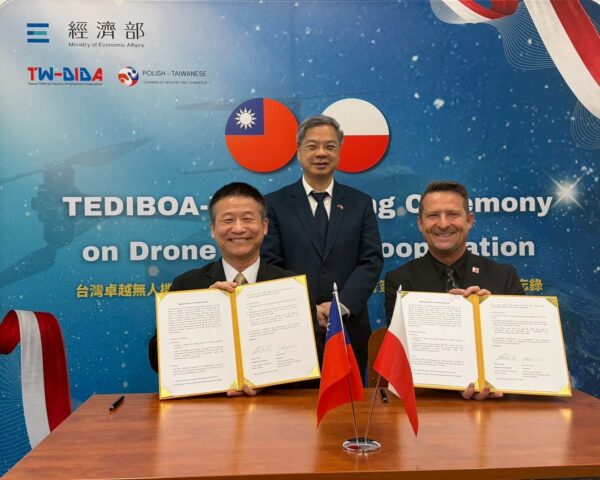
As another example, in December last year, the Taiwan Excellence Drone International Business Opportunities Alliance (TEDIBOA) and the Polish Chamber of Unmanned Systems signed a memorandum of understanding.
Poland is preparing for the war of the future, and it looks like Taiwan’s active hand will remain in the picture.