

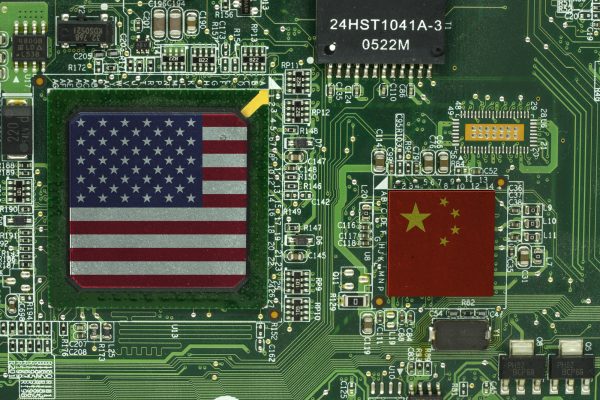
Last year, the United States stepped up its competition with China in the semiconductor industry. In August, the Biden administration signed the CHIPS and Science Act, an $52.7 billion industrial policy that aims to bolster research, enhance supply chain resiliency, and revitalize semiconductor production in the United States.
In October, the administration rolled out the most extensive restrictions to date on China’s chip manufacturing industry. This new set of restrictions curbs the sale of advanced chips to China, depriving China of the computing power it needs to train artificial intelligence at scale. It also extends restrictions on chip-making tools even further to industries that support the semiconductor supply chain, cutting off both U.S. talent and the components used in the tools that make the chips.
The Biden administration has not offered Beijing a viable “exit strategy” to end the technology war; the White House neither demanded Beijing to improve its trade behaviors nor provided a roadmap for the lifting of sanctions. Thus, in the eyes of the Chinese leadership, the new semiconductor sanctions illustrate that the U.S. government is actively weaponizing its control over core technologies in order to contain China. As a result, China’s government elevated supply chain security to its highest priority.
The 20th Party Congress report, which was released days after the announcement of the United States’ latest semiconductor export controls, identified the current trade conflict with the U.S. as the “economic main battlefield” and vowed to “realize high-level technology self-strength and self-independence.” To achieve this goal, the state will mobilize and concentrate all forces to “attack technological bottlenecks” and “win the war of conquering core technologies.” Thus, the Chinese Communist Party will buttress its leadership role in science and technology affairs, construct a new “national system” (举国体制) for scientific research, and strengthen the “national strategic technological force.”
In the eyes of leader Xi Jinping, China has no alternative option but to move away from a market-based innovation system to security-based national innovation planning. However, economic planning based on security concerns rather than economic viability might lead to long-term economic distortions.
China’s experience during the Third Front construction campaign highlights this challenge. China launched the Third Front campaign in the mid-1960s in response to the complicated security situation. Mao Zedong was worried about a war with Moscow following the Sino-Soviet Split, in which China’s industrial base in Manchuria would likely be the first target. The Vietnam War also heightened China’s fear of a U.S. attack on its industrial coastal region. In response, the Third Front construction aimed to move China’s industrial base to the mountainous southwest. It cost over 200 billion RMB and involved the relocation of more than 4 million people.
After the Maoist era, the Third Front construction became a massive economic liability that left long-lasting economic distortions. While mountains were natural shields against airstrikes, they became heavy burdens for firms’ development due to prohibitive transportation costs. Thus, these state-owned enterprises (SOEs) could not keep up with their competitors and faced severe debt problems in the reform era. For example, China Second Heavy Machinery Group in Deyang, Sichuan, had accumulated over $2 billion in losses by 2015. Meanwhile, local governments prevented these SOEs from defaulting since their collapse would cause tremendous unemployment problems.
As a result, many Third Front era SOEs become “zombie” firms: They survive through handouts from local budgets and policy loans from banks. The soft budget constraints and local subsidies also incentivize them to remain as “zombies” rather than taking painful reform measures to adapt to market conditions.
The semiconductor drive in China will also leave long-lasting economic distortions. For local officials, innovation promotions allow them to prolong China’s investment-led economic model, which has led to various problems, including corruption, local debt, and the real estate crisis. Since the beginning of his reign, Xi has rolled out measures to tamp down on China’s overheated infrastructure investment, such as the deleveraging campaign, real estate regulations, and land use rules. The push to build innovation parks allows local officials to bypass these policies and double down on infrastructure construction.
In China, the central government sets a national construction land quota and distributes it to all provinces. The provincial governments distribute the quota to cities, and cities divide it further to counties. In addition, provincial governments retain some construction quotas for projects with significant economic value. When local governments receive these special quotas, they can make additional construction outside the regular quota. Therefore, local governments establish innovation parks to receive a special land quota from provincial governments, allowing them to undertake more construction.
Beside building scientific labs, local governments need to construct “complementary infrastructures” in the innovation park, such as roads, transportation, and other public facilities. This process is called “making raw [newly expropriated] land ripe.” Once lands become “ripe,” the local government can sell the property at much higher prices and keep all the revenue. Even if local governments cannot attract high-tech companies, they can redevelop the supposed innovation zone into commercial areas and apartment buildings. In this process, local officials find opportunities to enrich themselves and reward cronies.
Chinese companies also take advantage of the lack of accountability and capitalize on innovation subsidies. In a prominent fraud case, a businessman named Cao Shan established a joint venture company, Wuhan Hongxin Semiconductor, with Dongxihu district government holding 10 percent of the share. His promise to manufacture 10 nanometer and 7nm chips and his rumored princeling status gained the trust of local officials. Hongxin even hired TSMC’s former vice president Chiang Shang-Yi and purchased ASML’s 7nm photolithography machine to show progress and attract more investments.
However, an investigation revealed that Cao never followed up on his investment share. Hongxin never started real production; it even mortgaged the photolithography machine to the bank immediately after securing additional subsidies from the government. In total, the Dongxihu district wasted over 15.3 billion RMB before journalists finally exposed the fraud. Hongxin is not the only case; even after this scandal broke out, Cao started another semiconductor company, Quanxin, and attracted massive investments from the Jinan government.
There are many reasons behind the prevalence of fraud. Semiconductor regulators are generalist bureaucrats with very limited technological backgrounds. Thus, they cannot discern technical concerns, leading to fraud and waste. In addition, the national innovation drive incentivizes local officials to attract high-tech investments because fostering high-tech companies becomes a great political achievement, which helps officials in the cadre evaluation and promotion system. Therefore, companies like Hongxin take advantage of regulators’ urgency to foster high-tech companies by making lofty promises.
Furthermore, local officials award subsidies based on cronyism. For example, Dong Huaichen, an official in Huaian, Jiangsu, was arrested for corruption because he exchanged chip subsidies for personal bribes. As a result, companies with princelings’ backing and other official connections receive the most state investments.
Fostering national champions also reduces Chinese firms’ global competitiveness. Entrepreneurs will shift their focus away from innovation and research to maintaining their relations with the government and securing backing from the state. Subsidies and policy loans lure high-tech firms into soft-budget constraints, which leads to a decline in productivity and market competitiveness.
In addition, in general the secret to Chinese firms’ success is producing quality products at lower prices. Chinese goods often outcompete others in the price-performance ratio. The key to this business model is adapting and improving cutting-edge foreign technologies and accessing the global value chain. Forcing Chinese companies to source locally will undermine product quality, leading to a declining price-performance ratio. In the worst-case scenario, the innovation drive will turn China into an import-substitution system that produces low-quality goods that cannot compete in the global market.
Many observers of the Chinese economy believe that China has enough resources to bear the enormous trial-and-error costs until it achieves success. However, China’s security-oriented industrial policy will lead to isolated breakthroughs in a short period, but not an economic-wide productivity boom in the long term. Massive corruption and fraud will exacerbate China’s structural economic problems. The attempt to foster domestic national champions will also reduce Chinese firms’ efficiency and competitiveness. The disregard of market incentives would lead to long-term economic distortions. China might be stuck in a Soviet-style scientific development model, where an “occasional Sputnik illuminates galaxies of mediocrity.”
In the United States, the CHIPS and Science Act and the semiconductor ban are copying China’s failed formula. First, it is ineffective in shutting China out of the global semiconductor value chain completely due to China’s role as a critical market. To cite just one example, entity list companies can use foreign shell companies with no apparent link to sell products to Huawei’s shell companies.
Second, the industrial policy will harm U.S. competitiveness by encouraging global semiconductor giants to “de-Americanize” the semiconductor production chain. Many U.S. chip manufacturers are considering building cutting-edge fabs in Asia using U.S. equipment produced overseas and ASML’s lithography equipment. These fabs can supply Chinese customers and bypass U.S. regulatory control.
Third, China’s case demonstrates that economic planning cannot foster global technological leaders. Identifying emerging industries and handpicking industrial winners cause tremendous waste. Fund distribution also attracts corruption and cronyism. None of the top U.S. high-tech companies succeed due to economic planning; all are fairy tales of the free market and open competition.
The United States should not be intimidated by Beijing’s grandiose investment plans and blindly copy China’s approach. As George Kennan suggested in the Long Telegram, the United States must have “courage and self-confidence to cling to our own methods.”