

The recent release of a new United Nations report has only fueled the world’s growing interest in artificial intelligence (AI). Most of this global AI attention has focused on the United States and China, home to many of the world’s leading foundation model developers. Other parts of the planet have also received notable attention – from Europe’s AI Act to Saudi and Emirati efforts to woo new startups to the Gulf.
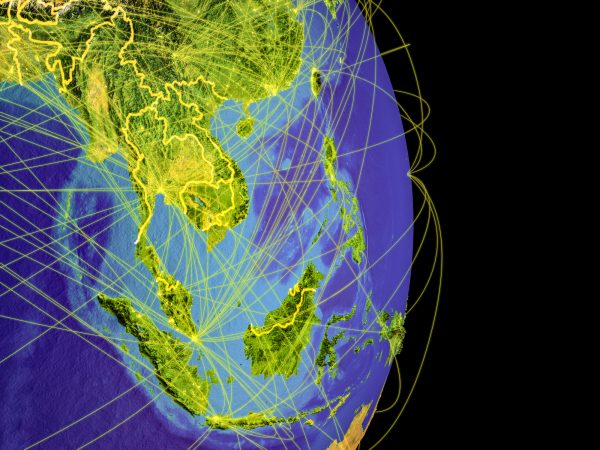
However, there is one region that has not received as much global interest: Southeast Asia. Encompassing the 10 diverse member-states of the Association of Southeast Asian Nations (ASEAN) – Brunei, Cambodia, Indonesia, Laos, Malaysia, Myanmar, the Philippines, Singapore, Thailand, and Vietnam – Southeast Asia is quietly becoming an emerging hotspot on AI. Indeed, through its homegrown firms, delicate geopolitics, and the entry of foreign players, the ongoing AI race in Southeast Asia offers unique lessons that global policymakers, investors, and technologists should watch closely.
Southeast Asia is already one of the world’s most economically important regions. If aggregated together, the GDP of the ASEAN states would be the world’s fifth-largest economy. The region’s middle class is composed of some 200 million people – roughly two-thirds of the United States’ total population. This importance, in turn, will only continue to grow. By 2050, Indonesia is projected to be the world’s fourth-largest economy, while the individual GDPs of the Philippines, Thailand, and Malaysia may exceed $1 trillion.
The region’s economic weight makes it a lucrative market for global technology firms. However, Southeast Asia has unique regional dynamics that make AI use more difficult. The region has nine official state languages, including Thai, Malay, and Bahasa Indonesia, meaning AI models intended for the region must have strong multilingual capabilities. Despite the need, Southeast Asian contextual knowledge and languages are underrepresented in the datasets on which many Western AI models are trained.
For example, only 0.5 percent of the training dataset for Meta’s Llama 2 large language model (LLM) includes Southeast Asian languages, despite the region representing 8.45 percent of the global population. Because of these limitations, Southeast Asian users have found that when they input Thai or Bahasa Indonesia text into large language models, many LLMs give back unhelpful responses, often in English.
The result has been an opening for homegrown players to build LLMs for the region. Leading the pack is AI Singapore, a national partnership of leading AI research centers in the country. Their debut model, SEA-LION LLM, has 13 percent of its training dataset in Southeast Asian languages, which AI Singapore claims makes SEA-LION more culturally attuned. Separately, Thailand’s Jasmine Group, a major communications technology firm, is also reportedly working to build a Thai LLM. Indonesian startup Yellow.ai, meanwhile, built a regional LLM for 11 languages in the country, building off Meta’s open-source Llama-2 model.
These homegrown players in Southeast Asia are worth watching for several reasons. First, unlike most firms in the United States and China, some of Southeast Asia’s leading AI players are not purely private firms. For example, AI Singapore is a public-private partnership of AI startups and public research institutions. If these players succeed in building state-of-the-art regional LLMs that gain significant traction, they might offer unique lessons for other global policymakers and executives on how to launch beneficial public-private collaborations building advanced AI systems.
Second, if these homegrown LLMs gain more traction in the region than U.S. or Chinese LLMs, the result might also encourage the development of similar, culturally-specific models in other parts of the world.
However, players from China and the United States are not sitting idly in the region, either. In fact, Southeast Asia is seeing significant firm-level competition between U.S. and Chinese companies to cater to the region’s demand. For example, Alibaba’s DAMO Academy – the Chinese firm’s research institute – recently launched SeaLLM, a new model focused on Southeast Asian languages. Meanwhile, Microsoft CEO Satya Nadella and Apple CEO Tim Cook recently visited Southeast Asia, while Amazon Web Services plans to add Malaysia as one of its new regions this year.
Ultimately, this competition matters. Generative AI is a notoriously capital-intensive industry, so the firms that manage to produce greater revenue in the region will be better equipped to cover the expensive costs of model development and finance powerful advancements in AI capabilities.
Beyond firms, both the U.S. and Chinese governments are also increasingly becoming involved in Southeast Asia’s AI landscape. China recently began hosting an annual forum on China-ASEAN Artificial Intelligence Cooperation, featuring government officials and other key leaders. It also set up a China-ASEAN AI Innovation Center in Guangxi Province, which has started over 119 projects on AI. The United States, meanwhile, has launched its digital strategy efforts, such as a new partnership between the U.S. Agency for International Development (USAID) and Google to use AI and other digital tools to map the effects of climate change in the Mekong Delta.
In turn, watching how China-U.S. competition on AI plays out in Southeast Asia might offer several valuable lessons. For U.S. and Chinese policymakers, the overlapping relationships might fuel concerns that the region enables the flow of sensitive technology to the other side. The United States is already reportedly trying to find ways to prevent the sale of sensitive AI chips from Singapore and Malaysia to China.
In the long run, these concerns may lead Washington and Beijing to encourage nations and firms in Southeast Asia to limit their exposure to the other side. Many in Southeast Asia, however, are opting for neutrality, wishing to reap the benefits of linkages with the world’s two largest AI ecosystems. How Southeast Asian nations attempt to assuage both sides and navigate these risks may influence how other nations respond to these geopolitical tensions as well.
Beyond the United States and China, one other country is making AI inroads into Southeast Asia: Japan. Tokyo has long maintained significant trade ties in Southeast Asia, with Japanese firms being significant investors in Southeast Asian markets. More recently, Japan is poised to expand into AI. In July, Japanese Prime Minister Kishida Fumio launched a public-private partnership to support Japanese companies in developing LLMs for Southeast Asia, including potentially subsidizing firms like Japan’s Elyza, which is making a Thai LLM. The Japanese government is considering donating computational resources, like graphics processing units (GPUs), to help beef up the region’s compute capacity. Japanese companies like Sakura Internet are also aiming to become major cloud service providers for the region.
Global technologists, investors, and policymakers should watch Japan’s moves in the region closely. Numerous nations outside the United States and China, including France, Saudi Arabia, and more, are trying to carve out a niche in the AI race by providing support to homegrown AI development, launching new investment funds, and more. If Japan’s efforts make its firms major players in Southeast Asia’s LLM and cloud markets, then other governments and companies worldwide might try to mimic Japanese efforts to support the foreign expansion of their homegrown firms as well. However, if Japan’s effort peters out, it might reinforce the belief that AI development remains a two-horse race between the United States and China, disincentivizing other nations and firms from taking a similar path.
In many ways, Southeast Asia’s AI race is one to watch. The region provides a unique case for global policymakers, technologists, and investors to observe how homegrown startups attempt to compete with global giants, how nations can hedge geopolitical risk in the age of AI, and how countries outside of the United States and China can find their place in the AI ecosystem. How generative AI adoption plays out in the region will have significant ramifications for our future.