

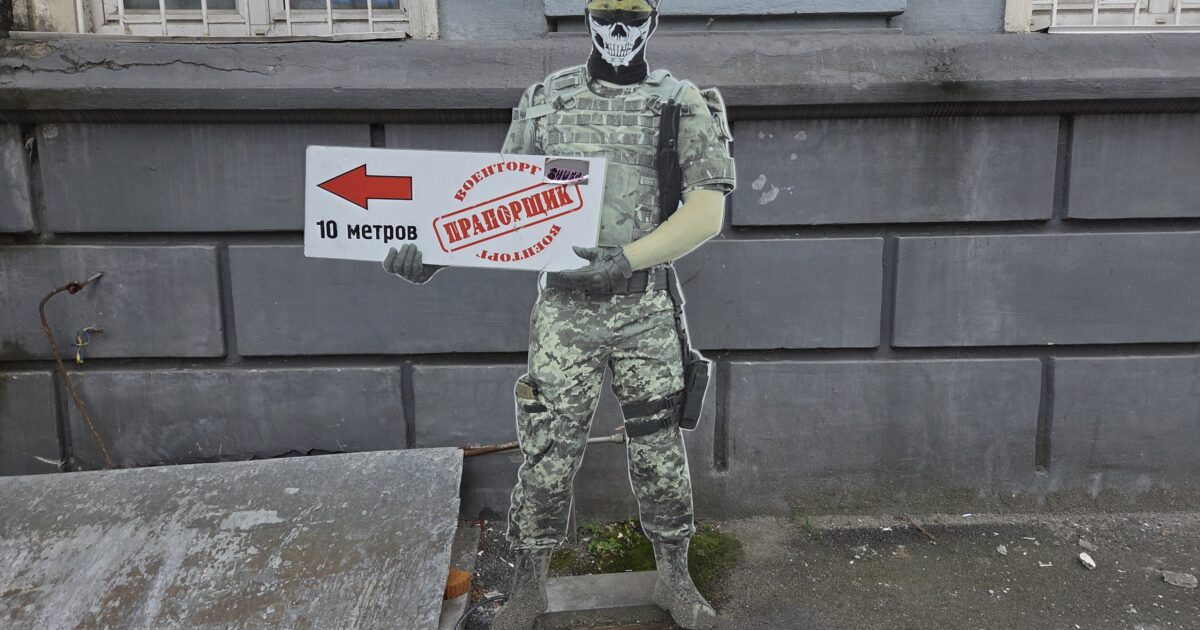
The journey to Kyiv had to be made by train because there have been no commercial flights since Russia’s full-scale invasion began in 2022. A Ukrainian friend, Tymoteusz, picked me up at the station and took me to McDonald’s for breakfast, which shocked me because when you think of a war zone, you don’t think of Big Macs and Happy Meals. On the way there, the air raid alerts went off twice, and explosions could be heard somewhere in the city. Tymoteusz, however, didn’t seem very put out.
“It’s always like this,” he said. “It’s been like this for years already, and everyone is used to it.”
When we arrived, McDonald’s was locked, but the café next door was open. Tymoteusz explained that some corporations have policies requiring them to shut down during missile and drone attacks, but private businesses are permitted to make their own decisions. Apparently, the coffee shop, the neighboring bakery, and the ice cream parlor had all decided to remain open.
Kyiv has a long history as a cultural center. Neither 70 years of communism nor the past four years of war has been able to undo that. Everyone you see on the streets is dressed stylishly, and people sat in outdoor cafés, drinking coffee and raising their voices to be heard over the explosions. The weather in Kyiv during the summer is a perfect 77°F (25°C), warm but not too hot. The sunlight is wonderful, and there are trees lining the boulevards. If it weren’t for the war, this would be one of the gems of Europe.
“It all looks normal during the day,” Tymoteusz said, “but at night we have to go into the shelters. The attacks usually come after 1:00 in the morning.” He shook his head at the absurdity of the situation. “Every night is like this.”
Outside the bank, I saw a long line of people, which for a second reminded me of the old USSR days when people queued up for everything because of shortages. But then I remembered there was no bank crisis here. Tymoteusz explained that the banks also had a policy of closing during air raids. The policy was intended to promote safety, but the customers remained outside the bank waiting for it to reopen. So, if the bank was hit, the people would still be killed. And if a bomb fell outside the bank, they were more likely to be killed than if they were inside.
It was similar to the nonsensical social distancing measures taken during COVID, except that the bombs were real, and bomb shelters have been proven to save lives. By closing, these businesses gave their staff the option of going to a bomb shelter, which seemed fairer than forcing them to remain in harm’s way to keep their jobs.
So, in the coffee shop beside the McDonald’s that was closed for safety, amid the sounds of air raid sirens and explosions, we met up with a friend of Tymoteusz named Vladim. I had come to Ukraine to report on the war, but meeting Vladim, who was two years older than me, I realized there were additional dimensions to this story that I hadn’t anticipated.
He and I had both been Cold War soldiers, serving in the 1980s, but on opposite sides. He told me that he had believed in the USSR and had grown up in the Young Pioneers, a Soviet version of the Boy Scouts. But unlike the American Boy Scouts, which now allow girls and Pride flags, the Pioneers remained true to the original Boy Scout mission of building patriotism and preparing young people for military service.
After the Pioneers, he joined the army “because I wanted to be strong for my country,” he said. I am so glad we didn’t meet at that time because we would have shot each other.
However, when the Berlin Wall fell in 1989, he said he felt “very happy and hopeful.” By then, the spell of communism had been broken, and “I hated communism.”
In many ways, it is ironic how certain we each were of our positions during the Cold War. Now that the USSR has collapsed, Americans and Ukrainians are friends, and Vladim’s life story parallels my own. We also agreed on how much we hated communism and laughed about how we had experienced it firsthand while the younger generation of Ukrainians had not.
Unlike many young people in America, however, Ukrainian youth are taught how destructive communism was and would never vote to bring it back. Vladim predicted, “Even in the next generations, young people will know that their ancestors were killed by the communists, and they will not want it.”
The remarkable thing about Vlad’s story is that he had known his entire life that his grandfather had been killed by the Russian communists, yet he still supported the Soviet system. Tymoteusz, by contrast, was born after the collapse of communism and grew up knowing that his grandfather’s execution by the Russian communists was a reason to hate them.
The talk turned to the current war. Earlier that morning, there had been attacks in another city, and Vlad told me that about six members of the same family had been killed. The two Ukrainians then discussed other recent attacks and the people who had died. It hit me that, under Soviet rule, Ukrainians had suffered at the hands of Moscow, and this war was simply the latest iteration of Ukrainians being killed by Moscow.
The Ukrainian famine, the Holodomor, was one of the deadliest single-year episodes of mass killing in modern history, claiming an estimated 3.5 to 5 million Ukrainian lives in 1932–1933. The famine was deliberately imposed by the Soviet government under Joseph Stalin through the confiscation of grain and other food, impossible procurement quotas, restrictions on travel to prevent starving peasants from seeking food elsewhere, and the continued export of grain while millions starved. Today, 33 UN member states and the European Parliament recognize the Holodomor as a genocide against the Ukrainian people.
Beyond the famine, Ukrainians endured decades of political repression under communist rule. More than 123,421 people were executed during the Great Terror in Soviet Ukraine alone, while hundreds of thousands more were imprisoned, sent to the Gulag, or deported from their homes. Because Soviet records are incomplete and many victims disappeared into the prison and labor camp system, no definitive total exists, but historians agree that Soviet repression affected millions of Ukrainians over the roughly seven decades of communist rule.
Since the full-scale invasion began on 24 February 2022, OHCHR has verified at least 16,431 civilians killed and 48,613 injured, with the real toll likely higher, as the UN cannot confirm casualties in areas of active hostilities or occupied territory. Bombs, missiles, and drones fall on Ukrainian cities multiple times per day. Casualties would be far higher were it not for Patriot and other air defense systems supplied by the United States and its European partners intercepting incoming missiles and drones.
Ukraine intercepted roughly 91 percent of Russian drones in May 2026, but a far lower share of ballistic missiles, the deadliest category of Russian strike weapon. Patriot batteries remain the primary system capable of stopping Iskander and Kinzhal missiles, and those stocks are running critically low. In one attack on Kyiv in July 2026, Ukraine’s air force confirmed it intercepted zero of 29 incoming ballistic missiles due to interceptor shortages.
Ukraine’s Defense Ministry has already written to nearly 40 partner countries requesting interceptors from existing stocks, and Ukrainian crews have shifted Patriot batteries to manual operation to ration remaining missiles.
In just the first 48 hours after my arrival, at least nine people were killed and 28 injured, including four children, when Russia launched its second major attack on Kyiv in 48 hours, The Kyiv Independent reported. Rescuers pulled 105 people from damaged buildings across five districts of the capital. Zhanna Maidanska, whose relatives survived in a partially destroyed building in the Solomianskyi district, told the outlet, “He [Putin] is a monstrous person, and the society that supports him is deeply sick… They choose to spread death.”
The attack came less than two days after a previous large-scale strike on July 30 that killed at least eight civilians, including six members of one family, when a Russian Iskander missile struck a home near Kryvyi Rih, underscoring the near-daily tempo of Russian strikes on Ukrainian cities.

Ad block users: Some site features may not work correctly while an ad blocker is enabled, because they break scripts and content this website depends on. If you can’t see comments below, for example, please disable your ad blocker.