

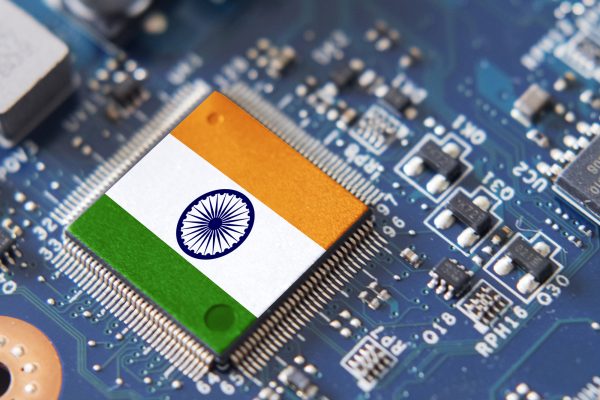
India’s Prime Minister Narendra Modi and U.S. President Joe Biden met at the fourth Quad Leaders’ Summit in Delaware in late September. Among various decisions, they announced a plan for the two countries to establish India’s first national security semiconductor fabrication plant (a “fab” or “foundry”) which will be dedicated to manufacturing chips deployed in military hardware, critical telecommunication networks, and electronics.
Established under the aegis of the India Semiconductor Mission, the fab will produce infrared, gallium nitride, and silicon carbide semiconductors. Under the strategic technology partnership between Bharat Semi, 3rdiTech, and the U.S. Space Force, India will get 100 percent technology transfer for making compound semiconductors.
The fab, named Shakti, is expected to be established in 2025. Within three years, 3rdiTech hopes to start with phase one production of 50,000 semiconductors a year. The start-up founders have stated that the primary objective is to plug the gaps in the supply of semiconductors for the Indian Armed Forces while in subsequent phases they will look toward exports.
This agreement between India and the U.S. on a strategic technology like semiconductors explicitly to be used for national security purposes is a seminal moment in the bilateral relationship. The decision signals India’s arrival into an elite group of nations capable of domestically producing advanced chips. Before considering the different strategic significance of this decision, it is worth highlighting the geopolitical backdrop that has allowed this technological breakthrough for India.
The geostrategic rivalry between the United States and China has provided New Delhi with greater opportunities for technological partnerships by leveraging its geopolitical position as an important strategic partner for Washington. The U.S. is interested in diversifying global semiconductor supply chains away from flashpoints in East Asia, which has allowed India to position itself as a technological haven providing economic and security-related benefits.
This has led to the U.S. military collaborating with an Indian start-up to share the technical know-how to help produce chips that will be incorporated into the security infrastructure of the United States and its allies such as the United Kingdom. For the last few years, 3rdiTech has been collaborating with General Atomics, a major U.S. defense firm, on important projects to improve the defense technology capacity in India.
The roots of the collaboration can be traced back to the U.S.-India initiative on Critical and Emerging Technologies (iCET), announced in January 2023, and Modi’s state visit to the U.S. in June 2023. The joint statement issued by Modi and Biden during the former’s state visit stated that the U.S. Space Force had signed its first International Cooperative Research and Development Agreement with Indian start-ups 114 AI and 3rdiTech to work with General Atomics to co-develop components using cutting-edge technologies in artificial intelligence and semiconductors, respectively.
The formation of iCET was underpinned by the desire to unlock the private sector and start-ups in the two countries and cement partnerships in critical technologies. The latest agreement is a major step in such collaborative endeavors.
Countries worldwide acknowledge the importance of access to a steady supply of semiconductors, which are necessary to run virtually any modern digital device. Semiconductors are also foundational for any technological advancement including advanced military hardware and next-generation communication technology. The paucity of a dependable supply of chips can have downstream effects on several other technologies of the future. Considering India imports all its semiconductors and has no manufacturing capabilities, it is vulnerable to geopolitically induced factors such as export controls and sanctions. The India Semiconductor Mission, which seeks to create a domestic chip-making ecosystem, was born from the government’s awareness of this vulnerability.
With that context in mind, the watershed India-U.S. arrangement on semiconductor manufacturing brings three significant achievements.
First, the India-U.S. fab arrangement could be a game-changing moment in switching India’s strategic dependencies into a historic opportunity for strategic autonomy. India imports 95 percent of its semiconductors and is excessively reliant on countries like China, Taiwan, and South Korea. Currently, the entire Indian defense ecosystem relies on imports, purchasing semiconductors worth $1 billion annually for national security purposes.
The Shakti fab will look to reduce this dependency, which will not just trim the import bill, but more importantly serve as a step in enhancing India’s strategic autonomy by improving its military self-sufficiency. This fab will assist the Indian Army’s capabilities in critical facets of modern warfighting, such as advanced sensing, communications, and power electronics. As per reports, the advanced infrared sensing chips will be utilized for night vision systems, missile guidance, space sensors, weapon sights, handheld soldier sights, and drones. The advanced power electronics chips will find applications in satellites, drones, fighter jets, high-altitude pseudo-satellites, electric vehicles, renewable energy systems, data centers, and railway engines.
The advanced radio frequency communication chips will also be employed in military communications, satellite communications, electronic warfare jammers, radar systems, and 5G/6G telecommunications. The Shakti Fab is a step in the right direction to achieve greater military self-sufficiency in critical technologies and reduce India’s strategic vulnerability.
Second, the agreement fortifies India’s position in global supply chains by nurturing the domestic capacity to produce these high-value technologies. The involvement of start-ups and the private sector is a rarity in India’s defense history. As semiconductor technology becomes a lynchpin in developing advanced military systems, building up in-house semiconductor manufacturers will benefit the defense industry – but domestic manufacturing of chips will also benefit India’s economy as a whole.
The project aligns with India’s broader semiconductor aspirations to rise in the value chain and build intellectual property over time. Apart from fulfilling its internal needs, the growth of domestic fabrication capabilities will also contribute to global supply chains, particularly in areas requiring secure and resilient semiconductor supplies.
Shakti will be a compound semiconductor fab, making chips involving two or more elements from the periodic table. Such semiconductors are anticipated to be in high demand as they notably produce high efficiency. They are conducive for applications requiring high-power electronics, which are rapidly being utilized not only in defense technology but also in sectors like the renewable energy industry.
Third, India hopes that the success of the collaboration will help chart new paths of cooperation with the United States. The burgeoning strategic partnership between New Delhi and Washington on critical technology like semiconductors elevates the relationship between the countries. U.S. cooperation on these vital and restricted technologies will make India one of the few countries globally to enjoy the privilege of manufacturing these complex compound semiconductors.
India is also reaping the harvest of being a Quad member. The United States has prioritized Quad partners in developing semiconductor technology while identifying vulnerabilities and bolstering supply chain security for allies and partners. The Shakti fab is not just the first technology partnership between Indian businesses and the U.S. Space Force but also the earliest such initiative in the Quad. The geopolitical convergence between the United States and India is underpinned by the common desire to reduce excessive economic dependence on China and will further incentivize the two countries to build technological cooperation. The access to hitherto elusive technology will thus embolden India to transition from a consumer to a producer of technology.
India wishes to join the community of nations working to achieve a degree of industrial and technological self-sufficiency. As the 2023-2024 economic survey stated, “For better and worse, technology is emerging as the biggest strategic differentiator determining the economic prosperity of nations.” Compound semiconductors are integral for advanced civilian and military applications, and the new fab will contribute to India’s techno-industrial modernization.
India is expected to become the largest consumer of semiconductors by 2030 – 10 percent of the global semiconductor consumption, worth about $110 billion, will be in India. Establishing semiconductor manufacturing plants on Indian soil is imperative to India’s long-term interests. There are many reforms that the Indian government must make in order for India’s semiconductor ambitions to come true. Notwithstanding the challenges ahead, at a time when microchips find themselves at the core of almost every techno-nationalist competition, the birth of the Shakti fab should be a celebration of India’s tech diplomacy and strategic foresight.