

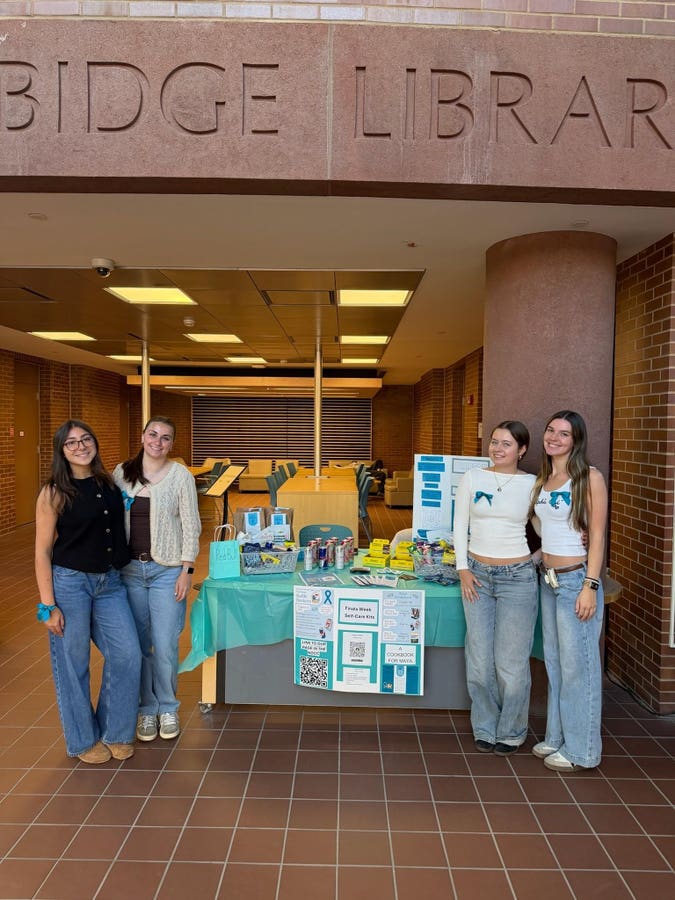
Ovarian Cancer Awareness Leadership Team (L to R): Lauren Feffer, Tiara Lamont, Avery McMahan, Maisie Bowler
Lauren Feffer
When Lauren Feffer arrived at the University of Connecticut as a freshman, she knew she wanted to get involved. She joined business organizations, dove into her finance program, and scanned the club catalog looking for something that spoke to her on a personal level. Her mind kept returning to her best friend Maya Ortiz, who was also a college freshman fighting a stage III ovarian cancer diagnosis. She noticed UConn had plenty of health organizations — but nothing specifically focused on ovarian cancer awareness.
“I asked Maya, are you okay if I start something like this to honor you?” Feffer recalls.
That conversation was the beginning of Ovarian Cancer Awareness at UConn.
To understand why Feffer and her co-founder Tiara Lamont built what they did, you first have to know Maya. At 18, Maya was a high school senior when she began experiencing sharp stomach pain that her doctors repeatedly dismissed. It took multiple visits, persistent advocacy from her mother, and an ER trip before a CT scan revealed stage III ovarian cancer. Maya documented her journey publicly — her story resonated with thousands who recognized the pattern of a young woman’s pain being minimized. She went on to become an EMT, started an ovarian cancer awareness chapter at UMass, and dreamed of becoming a doctor. Maya unfortunately died before she could see how far her friends would take the organization — but the movement she inspired has only grown in her absence.
Maya Ortiz and Lauren Feffer with Feffer’s sisters at a ovarian cancer fundraising event, Trotting in Teal
UCONN OCA Instagram
Over the past two years, I have interviewed patients with cancer and noticed that the word “legacy” often arrives into the conversation. Patients, or their loved ones, wonder what impact they are leaving behind and how they will be remembered. Research supports this – a survey of hospice and palliative nurses found legacy among the most common end-of-life reflections among terminally ill patients. The legacy being built for Maya is a powerful reminder that grief, when channeled with purpose and the right people by your side, can become something that outlasts loss itself.
Finding Your Core Team
Feffer and Lamont both grew up in the same hometown as Maya. Lamont rode the same school bus, played the same sports. When Feffer came to her with the idea for the club, Lamont didn’t hesitate. “This was the most important cause of them all,” she says. They gathered seven members, submitted the form, and by spring of Feffer’s freshman year, OCA at UConn was official.
For Lamont, joining wasn’t just about honoring Maya — it was about the power of community. Already embedded in campus life through her sorority, first-year experience programs, and the psychology club, she understood what a well-run organization could mean to students searching for belonging. When her sorority’s philanthropy focus turned out to include ovarian cancer awareness, two separate corners of her college life collapsed into one. “It’s crazy seeing two things you’re so passionate about just come together,” Lamont says.
Building out a Support System
They have continued to find support from the most surprising sources.
Professor Steve Wilson, from Feffer’s finance program, became one of their most dedicated champions, inspired purely by Maya’s story. As they are creating a fundraising cookbook, A Cookbook for Maya, the UConn Dean of the Business School submitted a recipe to be included. They’re currently in talks to receive one from the President of UConn. At fundraising tables across campus, strangers walked up and shared their own stories of loss. “Since we’ve created the club, the amount of people who have come up to our events and shared a story of someone affected by ovarian cancer is just truly eye-opening,” Lamont says.
Their first major event, a panel, drew a crowd neither of them had anticipated. Maya’s parents were there. “We had big shoes to fill as Maya had already started a Chapter at her campus,” Lamont recalls. “We wanted to make sure Maya’s parents were proud. We were just trying to do the best we could.” The weight of that moment, she says, only sharpened their drive.
Photo from first UConn OCA inperson event
UCONN OCA Instagram
Facing Grief While Being Productive
None of it has been easy. Grief, as Feffer puts it, is not linear.
“It could be a year from the death and I smell something that smells like Maya, and then I get emotional,” Feffer says. In the early days, working on the club was painful as it was a constant reminder of everything she had lost. Over time, that shifted. “Now OCA is more of a reminder of everything I had.”
Lamont carried much of the operational weight during the moments Feffer couldn’t. “I would be honest with Tiara and say, it’s really hard for me to work on this right now, can you take this?” Feffer recalls. “I was very lucky that I had people around me supporting me.” It’s advice she now offers to anyone considering a similar path: don’t do it alone.
How To Start Building a Project To Honor a Loved One
Tiara Lamont and Lauren Feffer speaking at an OCA event
Tiara Lamont
For readers who have lost someone and wondered what to do with that grief, both women have a clear answer. Lamont states that, “you don’t need a grand plan — or even a large group.” Starting with a small core was helpful for them to really determine their miss and direction. They also return back to the values of their friend Maya. “Ask yourself what they would do,” Feffer says. “I know Maya well enough that I know for the rest of my life what she would tell me in any situation.”
The work, Lamont says, has shaped her in ways she never anticipated — teaching her how to negotiate PR sponsorships, write professional emails, built a website, and lead a team from scratch. But beyond the skills, both agree on something simpler: if it helps even one person, the mission is achieved.
“Spreading awareness of whatever you’re passionate about not only honors your loved ones,” Feffer says, “but also offers comfort to other people who can relate.”
Maya wanted to help people. It is remarkable to see how her friends are making sure that mission lives on. Maya would be proud.