

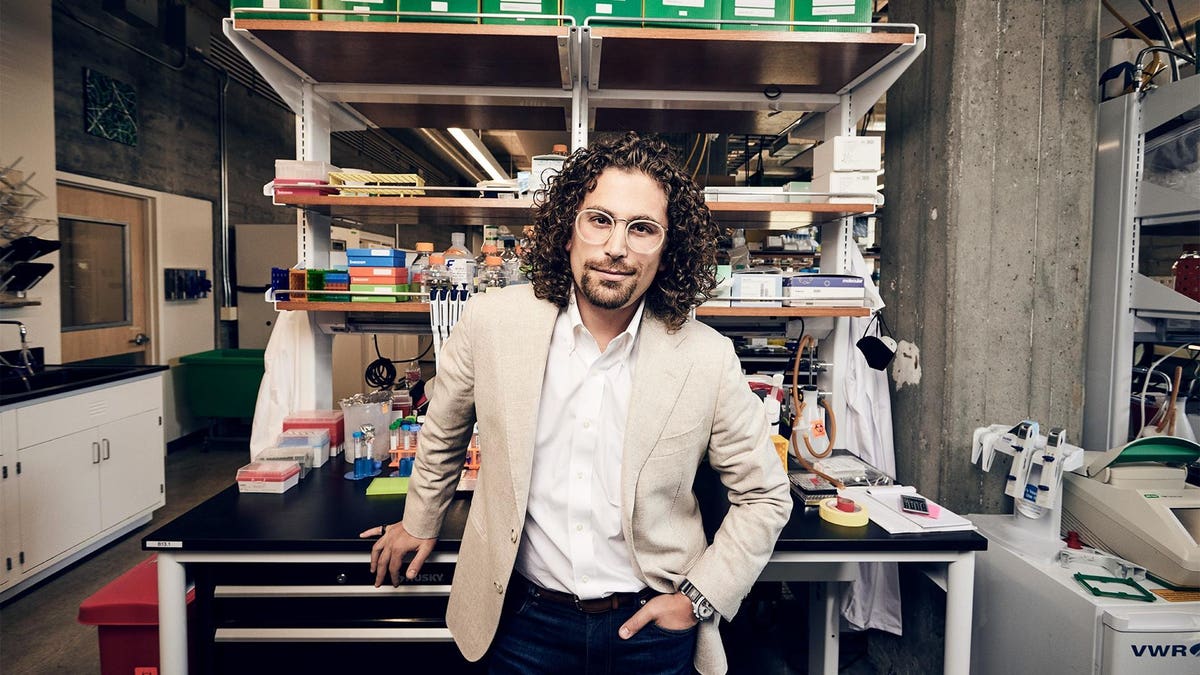
Benjamin Oakes’ Scribe Therapeutics is developing specialized Crispr proteins to tackle a wide range of diseases–and it’s garnered deals with Big Pharma potentially worth over $4 billion.
Alex Knapp, Forbes Staff
In 2013, Benjamin Oakes was hellbent on getting his PhD while working on the bleeding edge of molecular engineering: refining a gene editing tool, Crispr, that promised to some day cut DNA as precisely as a pair of scissors. There were two leading research groups at the time — one at the University of California, Berkeley, led by future Nobel Prize winner Jennifer Doudna, the other at the Broad Institute jointly run by Harvard and MIT — and Oakes was vacillating endlessly between them. Which is how he found himself one day in Doudna’s house, part of a gathering of promising students being considered to work in her lab.
There, he met David Savage, then a professor at Berkeley who had just started his own lab focused on engineering proteins like ones used in Crispr systems. Oakes had interviewed to join Savage’s lab, too, but in the more relaxed setting they geeked out over the potential of new tools in the space accurate enough to essentially cut a function from one protein and paste it into another. Not long after, Oakes solved his career conundrum: he joined both labs, where his research focused on improving the gene-editing potential of Crispr by making protein engineering tools more customizable and controllable.
Ten years later, he’s applying that work in a company he cofounded with Doudna and Savage, Scribe Therapeutics. The company is building a biological platform of customized gene-editing tools to tackle a wide range of hard-to-treat diseases from ALS to cancer to sickle cell anemia. It’s backed by over $120 million in venture investments from major firms like Andreessen Horowitz and OrbiMed — and it already has partnerships with major pharmaceutical companies potentially worth over $4 billion dollars.
The story of Crispr starts with bacteria, whose immune systems evolved to attack invading viruses by cutting up crucial parts of their DNA. This discovery was first applied to gene editing in combination with a special class of bacterial proteins called Cas9. The potential for this technology is enormous: it makes it possible to consider curing genetic disorders with a one-and-done treatment. But it’s not without complications. Because viruses mutate, Crispr systems aren’t completely precise, creating a risk that the wrong part of someone’s DNA might be cut by a gene-editing system.
A little over a decade since its discovery, the promise of Crispr has already begun to be realized with viable applications in agriculture as well as diagnostic testing. Last April, a collaboration of Vertex Pharmaceuticals and Crispr Therapeutics filed the first full FDA application for approval of a Crispr/Cas-9 gene editing treatment for patients with sickle cell anemia. The treatment showed strong results in clinical trials with a stunning 94% of patients treated hitting the desired outcomes. The FDA is expected to make a decision on approval before the end of the year. Other Crispr-derived therapeutics for type one diabetes and multiple types of cancer are in the pipeline.
LAB WORK: One of Scribe’s goals, says Oakes, is to turn naturally discovered gene-editors into “scalpels” for more precise work.
Scribe Therapeutics
Oakes, 34, is already working on the next generation of the technology. His company uses a different set of proteins for Crispr systems, called “CasX”, that were discovered by Doudna’s research group. Scribe has developed a platform with CasX it calls “Crispr-by-design” that enables the company to tackle multiple types of disease. Its primary focus is enabling gene editing therapies to be delivered directly to a patient (“in vivo”) instead of removing cells from the body, editing the genes, and returning them. For example, the Vertex treatment for sickle cell involves removing stem cells from patients’ bone marrow, editing them, and returning them to the patient after they’ve undergone chemotherapy to eliminate the non-edited stem cells.
CasX proteins offer a lot of advantages to developing medicines compared to Cas9 systems, says Dr. Joshua Modell, an assistant professor at Johns Hopkins School of Medicine who researches Crispr systems in nature. “They’re smaller, which makes it easier to do certain kinds of applications,” says Modell. Additionally, CasX proteins may be more selective, meaning that they’re more likely to only impact the part of the DNA that’s desired.
There’s a lot of activity in the Crispr startup market. According to Pitchbook, some $3.3 billion in venture capital has flowed into the space since 2019. That’s a figure that doesn’t even account for the over half-dozen Crispr companies that have exited to public markets in the past few years, or the hundreds of millions flowing in from big pharma.
One major hitch for companies in this space isn’t technical, but legal. The Crispr/Cas9 system is foundational for many of these therapies, but multiple research groups, most particularly Jennifer Doudna’s group at U.C. Berkeley and another group at the Broad Institute at MIT and Harvard, described breakthroughs with this system within a short span of each other. This has resulted in massive, ongoing international intellectual property disputes that have been resolved differently in the United States and Europe, which can make it confusing for companies seeking to license the technology to know who they’re supposed to be signing contracts with. (The internet is replete with guides aiming to help perplexed biotech companies.)
Despite the relatively crowded Crispr marketplace, Oakes’ Scribe has believers. Its investors include major venture capital firms like Andreessen Horowitz, Avoro Ventures, OrbiMed and Menlo Ventures. Kazi Helal, an analyst for Pitchbook who covers the biotech sector, also notes that Scribe’s new class of CasX proteins keeps it clear of the ongoing litigation around Cas9 systems, which makes it more attractive for investment and partnerships. Doudna and Savage both remain scientific advisors for the company, which has hired veteran researchers from both of their labs.
“The group that has gone and built Scribe is really the next-generation team out of the Doudna Lab,” says Greg Yap, a partner at Menlo Ventures. He acknowledges the company has a long way to go before it brings products to market but says its partnerships with big pharma are an early validation of the tech’s promise.
Oakes says his PhD research was a synthesis of Doudna and Savage’s labs. Using the bioengineering focus of Savage’s lab, he focused on turbocharging the Crispr process being applied to gene-editing in Doudna’s lab. For example, one of his projects involved building a chemical “lock” for Cas9, so that it couldn’t start working without the right chemical “key.” This process used a specialized set of Crispr tools that had been developed in Doudna’s lab, combined with a protein engineering technique created in Savage’s.
After getting his PhD in 2017, Oakes was awarded an Entrepreneurial Fellowship at Berkeley, a program the university used to help lab discoveries make a smoother transition to commercial application by providing funding, mentorship and business training. In October 2018, Oakes, Savage and Doudna cofounded Scribe Therapeutics along with Brett Staahl, a researcher in Doudna’s lab, and shortly thereafter raised a $20 million series A round led by Andreessen Horowitz.
The company emerged from stealth in October 2020, simultaneously announcing it had signed a drug development agreement with Biogen with a $15 million upfront payment and potentially worth up to $400 million if certain development milestones were met. The agreement also entitles Scribe to royalties from any approved drug that results.
A few days after Scribe emerged from stealth, Doudna was co-awarded the Nobel Prize in Chemistry. A few months later in March 2021, the company raised a $100 million series B round led by Avoro Ventures that valued the company at $300 million. “Scribe’s platform is quite unique compared to Cas9 systems,” says Avoro partner Behzad Aghazadeh, who joined Scribe’s board when the round closed. Oakes, he says, “has really thought out and engineered his way to really addressing the challenges that other gene-editing companies still face.”
MANUFACTURING SHIFT: The site of Scribe’s offices were once used to build ships—now they’re home to dozens of bioengineers.
Scribe Therapeutics
Over the past year and a half, Scribe has seen an acceleration of partnerships with other pharmaceutical companies. Its collaboration with Biogen was extended to a second potential ALS drug in May 2022. In September, the company landed a deal with Sanofi to work on cells that could be used to fight cancer. That deal provided the company with a $25 million upfront payment and is potentially worth over $1 billion, plus royalties. In May of 2023, the company started a collaboration with Lilly subsidiary Prevail to work on gene-editing therapy approaches to neurological diseases in a deal with an upfront payment of $75 million to Scribe that is potentially worth up to $1.5 billion, plus royalties.
Despite the big dollars it’s potentially seeing with these deals, the company is being selective in its partnerships, says chief business officer Svetlana Lucas.“I’ve seen companies that partnered a ton,” she says. “Which looks amazing at the time but then very impossible to execute on in the long-term.” The risk, she says, is losing focus and stretching resources too thin to execute on multiple programs at once.
Last week, Scribe announced that it was entering into a second deal with Sanofi. This time, the two companies will be working on a cure for sickle cell disease, which affects millions around the globe and contributes to over 300,000 deaths per year but still has very few treatments. That deal comes with a $40 million upfront payment and is worth up to $1.2 billion.
Unlike the solution being pioneered by Crispr Therapeutics and Vertex, this therapy would work similarly to the Covid vaccines developed by Pfizer and Moderna: Sanofi and Scribe will design a CasX protein and then encode it in messenger RNA, which serves as an instruction manual for the body’s own protein manufacturing systems. Those blueprints will be packaged inside a microscopic nanoparticle that’s been engineered to hit the right target using the same mechanisms the immune system uses to home in on viruses.
This approach, says Oakes, is easier to scale without running into manufacturing bottlenecks that can plague other biological therapies — see how quickly the Covid vaccines were scaled up. That’s in part because the nanoparticles are much simpler to build than other gene therapy methods, which often rely on building complicated molecules like custom viruses to get medicines to the right place in the body.
Scribe has developed a second platform that’s focused on using Crispr tools not to edit genes but to control epigenetics — the conditions that decide whether a gene is turned on or off. This would have the potential to be a valuable tool, Oakes says, because it could treat genetic diseases without making permanent changes to DNA. Which means that if problems arise, the treatment could even be reversed. “Basically we can give you the one and done and, if necessary, we can reactivate you away from it,” he explains.
An epigenetic platform is intriguing, because there’s less chance of causing damage to DNA. “The risks would be lower,” says Johns Hopkins’ Modell. He thinks that could be useful for genetic disorders where, for example, the body is just making too much of something. In that case, you wouldn’t want to cut out or edit the gene — you’d just want to slow it down. Meanwhile, the smaller size of the CasX proteins means it’s easier to add more engineered features and still be able to pack them into their microscopic delivery vehicles.
The epigenetic’s platform’s potential likely won’t be realized for years, and both Oakes and his team are mindful of the fact that whenever a new biotechnology emerges, a lot of companies are born only to flame out without making an impact. “I am an avid student of history, in the sense of ‘let’s learn from the mistakes others have made.’ So I’m trying to be careful here,” Oakes says later adding, “Where we’re going to be focused is in areas where having highly engineered systems that are best in class are going to make a big difference.”
MORE FROM FORBES