

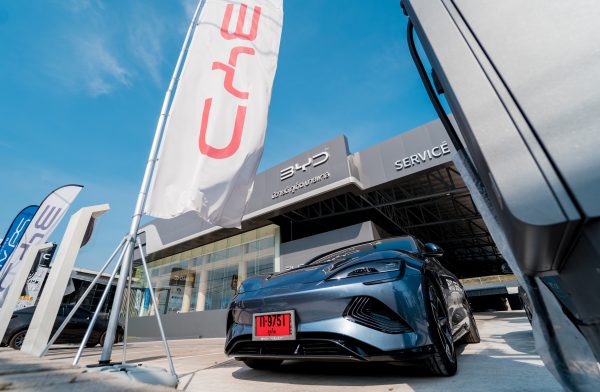
China’s rapidly evolving electric vehicle (EV) market is plagued by intense price competition amid rising overcapacity. Seeking new markets to diversify from vulnerable domestic positions, Chinese brands are increasingly venturing into international markets, and Southeast Asia has emerged as a particularly promising destination.
The expansion of Chinese EV companies into Southeast Asia signifies a strategic symbiosis between the region’s emerging markets and the technological prowess of Chinese auto companies. Southeast Asia has a projected need for $2.8 trillion in infrastructure investments by 2030 to fuel economic growth, making it a top destination for Chinese EVs.
At a time of heightened geopolitical competition, Southeast Asia has become a battleground for strategic EV expansion between China and traditional auto companies, particularly Japanese brands. Southeast Asia consumer demand to buy electric cars have risen significantly, while the region’s reliance on imported crude oil underscores how electrification could alleviate energy concerns and financial burdens in the long term.
According to OPEC data, Thailand imports about 70 percent of its annual oil consumption. While Indonesia is a net exporter of petroleum products, Jakarta had to hike fuel prices after recording a 464.3 trillion rupiah ($29.77 billion) fiscal deficit in 2022, fueling mass protests.
Amid the woes caused by jumping fuel costs, there was a remarkable increase in demand for EVs in the second quarter of 2023. Total EV sales in Southeast Asia experienced a year-on-year growth of 894 percent, the highest globally. This surge was propelled by consumers in Thailand, Vietnam, Indonesia, and Malaysia, as reported by Counterpoint Research.
Much of this extra demand is being filled by Chinese companies. China’s established EV technology has found an increasingly ready market in Southeast Asia. Counterpoint’s data reported a significant uptick in market share for Chinese auto companies in Southeast Asia last year, jumping from 38 percent in 2022 to nearly 75 percent in 2023.
For example, China’s share in Thailand’s new-auto market more than doubled to 11 percent in 2023, driven by EV leader BYD. Thailand’s EV imports tripled in the first half of 2023 to 33,000 units; BYD accounted for approximately 30,000 units, surpassing competitors such as Nissan and Mazda. Chinese automakers collectively controlled about 80 percent of the Thai EV market share, while Japanese brands lagged behind with less than 1 percent market share.
The Success and Resilience of China’s Domestic EV Industry
Chinese EV companies’ domestic success – supported by production subsidies from 2009 to 2022 – powers its burgeoning success in Southeast Asia. China’s “Plan for the Development of the New Energy Vehicle Industry (2021-2035),” the policy blueprint that positioned EVs as a central component of China’s economic transformation, aims to secure China’s leadership in the global EV market.
The pillars of the plan include market-led development, innovation-driven development, coordinated promotion, and open development. It established a technology innovation system with businesses at the forefront. Incentives and protections for innovation have paved the way for diverse technological pathways and collaborations among various entities to tackle core technologies such as lithium-ion batteries, energy management systems, charging infrastructure, vehicle-to-grid (V2G) technology, and fuel cell technology.
The industry’s resilience stems from robust support on both the supply and demand fronts, evident in data from China Association of Automobile Manufacturers (CAAM). EV exports showcased remarkable performance, demonstrating year-on-year growth of 77 percent, and reaching a total of 1.2 million units in 2023.
In addition to policy support, market drivers have played a crucial role in China’s EV growth story. Consumer demand, bolstered by purchase tax exemptions, has been a major catalyst. EVs’ improved affordability and performance have made them more competitive with traditional vehicles, attracting consumers due to lower operating costs and long-term savings on fuel and maintenance. Advancements have led to improved battery efficiency, longer driving ranges, and enhanced features, making EVs increasingly appealing.
China’s continued EV growth is the outcome of both supportive central policies and market drivers. Government policies have provided the necessary incentives and regulatory frameworks to encourage EV adoption, while market drivers, led by burgeoning consumer demand and technological innovation, have been instrumental in propelling the industry forward.
Southeast Asia Expansion: A Win-Win
A significant deterrent to the full adoption of green mobility is the existing infrastructure gap, which China’s Belt and Road Initiative may be able to address. The Southeast Asia market is witnessing a paradigm shift toward substantial investments in infrastructure; the Asian Development Bank projects Southeast Asia will require a total infrastructure investment of $2.8 trillion by 2030 to support continued economic growth. To fulfill this need, countries in the region must allocate over 5 percent of their GDP to infrastructure investment over the next decade.
As China’s automotive brands continue their multi-faceted approach, combining product, factory, and capital expansion, Southeast Asia governments actively contribute by offering policy support, tax incentives, and subsidies, fostering a conducive environment.
Collaborations between Chinese automakers such as BYD, Great Wall, SAIC-GM Wuling, and Geely and local partners have laid a robust foundation for localized production, part procurement, and sales tailored to the specific needs of each region. For example, the partnership between China’s Geely Auto and Malaysia’s Proton revitalized Proton’s brand reputation, doubling its sales and market share over five years. It exemplified successful internationalization beyond capital deployment to encompass cultural integration and brand elevation.
Thailand, alongside other Southeast Asia nations like Vietnam, the Philippines, and Indonesia, is setting ambitious targets and policies to position itself as a manufacturing hub for EVs in the next decade. In alignment with its 30@30 policy, Thailand aims to have zero-emission vehicle production constitute at least 30 percent of the country’s total automobile output by 2030.
This policy not only underscores Thailand’s commitment to a green future but also envisions the country becoming a global hub for electric vehicles and their components. Similarly, Indonesia has been actively allocating budgets and courting investments through subsidies and tax reductions for EV and battery manufacturing. It aims to become a leading producer of EV batteries by 2027.
While these Southeast Asia economies are currently dependent on collaborations and technology exchange, the long-term goal is clear: They want EV self-sufficiency. The timeline is crucial; these economies understand the necessity of strategic partnerships and knowledge transfer, recognizing that the EV industry cannot presently stand alone. The trend is made evident by their willingness to trade market access for technology with established players like Chinese automotive companies.
Southeast Asian nations are actively courting Chinese EV companies in a collaboration that not only strengthens the imperative transition away from fossil fuel vehicles, but also fuels economic growth through technological exchange. However, the long-term sustainability of the arrangement will hinge on how governments manage the current dependency on foreign technology transfer and potential geopolitical influence.
Transparency, equitable partnerships, and robust regulatory frameworks are essential to ensure the trade yields mutual benefits while safeguarding the interests and sovereignty of Southeast Asian nations. Ultimately, the equity and net benefits of the arrangement depend on how effectively these considerations are addressed and balanced by all parties.
So far, China has made inroads that will be difficult to compete with. Other EV companies interested in the Southeast Asia market should understand its rapidly evolving dynamics, address local infrastructure challenges, and embrace localization by tailoring products and services to suit the needs and preferences of each Southeast Asian country.