

In 2019, Wendell Pierce was walking through London’s Piccadilly Circus to make it to that night’s performance of “Death of a Salesman,” when he stumbled upon a massive billboard. The ad was for the latest season of “Jack Ryan,” the Prime Video series in which he also stars. As he looked at himself on the Technicolor screen, it struck him that the London Film Festival was also screening his latest film, “Burning Cane,” for which he’d won best actor at Tribeca.
In this moment, Pierce developed his personal mantra: “I want to do the trifecta every year,” the Juilliard grad remembers thinking, meaning he would star in a theater production, a TV series and a film annually. “This is what I trained for.”
But, this month, he raises the stakes to a quadfecta.
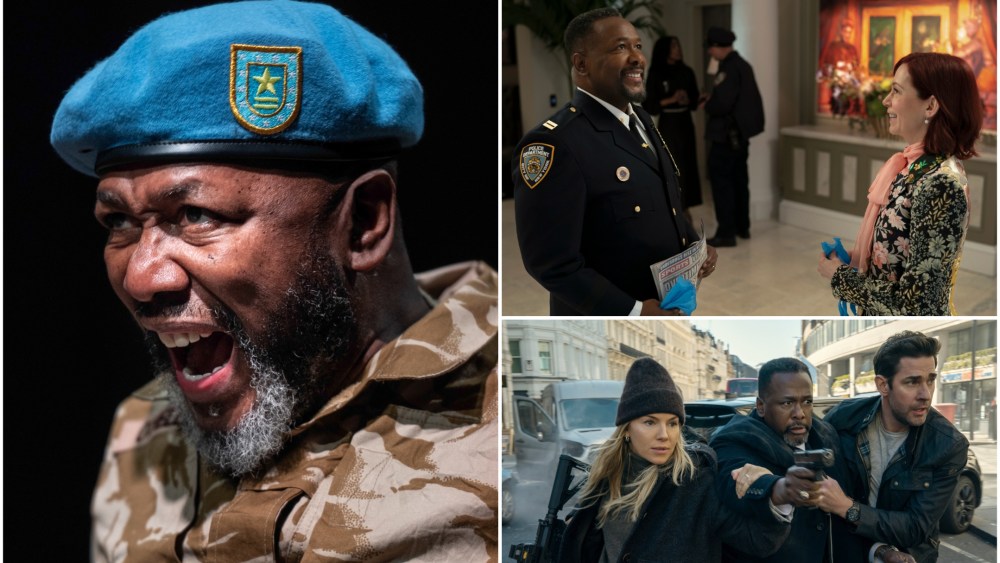
This weekend, lucky ticket holders can watch him onstage in the Shakespeare Theater Company’s production of “Othello,” then head home to catch the Season 3 finale of “Elsbeth” on CBS, and finally — after refueling by popping a bag of popcorn — stream the new “Jack Ryan” movie, subtitled “Ghost War,” on Prime Video. Or, if they wait a couple of weeks, they can sign up for the quadruple feature of Shakespeare, the “Columbo”-like comedy, the military action movie and the modern-day drama of the “Power” universe, in “Power Book III: Raising Kanan,” where Pierce plays a rare robber to his usual cop roles. The Starz series premieres on June 12, a few days after his next film, “They Fight,” starring André Holland and Samira Wiley, debuts at Tribeca.
“I wear that with a badge of honor, and I’m humbled,” Pierce says about the diversity of his IMDb. “This is a dream. This is the actor’s life that I’ve always wanted and hope to continue. That’s what I love, and hopefully people can see the range and the dexterity.”
When he logged on to Zoom with Variety from Washington, D.C., Pierce had just finished telling the London story to his young co-stars during rehearsal for “Othello,” a bucket list role since his school days. His advice to them: “Focus on the accumulation of events that get you to this point. Don’t think of all the things that are taken away from you, but think of the events as they accumulate; it drives the momentum of the story.”
“That’s why I always proudly say ‘I am a journeyman actor,’” Pierce explains. “Sometimes people say, ‘Oh, Wendell, you shouldn’t say that,’ and I go, ‘No, a journeyman actor can be seen on the stage, on television, and in cinema.” Doing all at the same time speaks to that goal as an artist.’”
Since Pierce’s first appearance in Variety — a post-grad role as an ensemble player in the traveling stage production of “Duke Ellington’s Queenie Pie,” — on Oct. 1, 1986, he’s built a resume as eclectic as the jazz that’s the soundtrack to his New Orleans hometown: from Detective “Bunk” Moreland in HBO’s “The Wire” and trombonist Antoine Batiste in “Treme” to that Tony and Olivier-nominated turn in “Death of a Salesman,” as well as roles in popcorn films like Marvel Studios’ “Thunderbolts*” and DC Studios’ “Superman” (which also debuted simultaneously last year).
Wendell Pierce’s first mention in Variety came in a review of “Duke Ellington’s Queenie Pie,” published on Oct. 1, 1986.
Read on as Pierce looks back on his four-decade journey.
What do you remember about performing in “Duke Ellington’s Queenie Pie”?
I had just gotten out of school. That was one of my first jobs, and we went on tour — first in Philadelphia, and then here in Washington, D.C., at the Kennedy Center.
We were with some of the most talented people around — Marion Caffey, Larry Marshall, Denise Morgan, Tina Fabrique, Lillias White, Terry Burrell, Ken Prymus — they were Broadway stalwarts, and then in the pit was the Duke Ellington Orchestra. Every night to hear that music, Duke Ellington’s final piece, being played by orchestra, I saw a level of excellence, proficiency and commitment that I’d never seen before, and I saw how it manifests itself in performance. It was a great lesson to learn right at the beginning of my career. It’s still one of my fondest memories.
What is it like to be back on stage in D.C. with “Othello”? Have you ever played this role before?
No, this was on my bucket list. It’s one of the great roles that I’ve wanted to pursue; there’s always been anxiety around it. You always put it off and then you say, “Hey, man, one day you have to face your fears and accept the challenge.” That’s one of the main reasons I did it. One of the young actors asked me that the other day, “Why do you still do theater?” I said, “This is a great challenge, and especially Shakespeare, takes it up to even another level.” I still have fear, but now I have courage, and courage is acting in the face of fear to accept your challenges. The experience is teaching me so much about myself and the work and preparation. You’re never too old to learn more about the craft.
What have you learned about yourself?
You can never prepare enough. Every day, there’s more and more and more to learn.
I also have learned why we do Shakespeare 400 years after the fact. He was masterful with the language to put into the verse and prose exactly what you need as an actor to play it: letting you know exactly what’s happening in the minds and in the emotions of the characters, and at the same time, instructing you how to play it without direction. He uses the melody of the words, the structure of the verse in its meters, and the image of the poetry that he puts together. It’s all there for you. When in doubt, just go back to the text. It’s like peeling an onion; the complexities are all in there. I know that I’m going to be discovering things on the last day of doing it. That’s the great thing about it, and that’s a level of artistry when it comes to writing that is seldom seen. And what makes it classic is that it spoke to people then, hundreds of years ago, it’s speaking to us now, and it will speak to us long after we’re gone. That’s what makes it classical theater.
What does this production say about our time?
How easily we could be manipulated. How dangerous it is to let inference, propaganda and rumor be exaggerated to the point that it changes people’s lives, and to the point where it can take people’s lives. We go to war on rumor. We go to war on inference. We go to war on manipulation, and people die. And how, even on a personal level, people allow betrayal and jealousy and envy to whip them up to a level of violence and depravity. It’s not just a good story; it actually happens. This is a cautionary tale, and that’s why it should speak to people, even today, on a personal level and in the community.

Wendell Pierce, with Daniel Velez and Jon Beal, in rehearsal for “Othello.”
Jeffrey Ray / Shakespeare Theatre Company
Every year you like to do theater, TV and film. What is it like to have “Othello,” “Elsbeth” and “Jack Ryan: Ghost War” debut on the same day?
It is with great pride that this is happening right now, and after this experience, I’m adding to the trifecta to make it a quartet. I need to do some Shakespeare or a classical text every year to keep those chops up, so it’ll be TV, film, theater and a classical text.
I’ve had this experience before, and that’s where my mantra came from. We were speaking about that today in rehearsal: to focus on the accumulation of events that get you to this point; don’t think of all the things that are taken away from you, but think of the events as they accumulate, and it drives the momentum of the story. It’s the same thing with career and creation. Think of the accumulation of material that gets you to the point.
“Jack Ryan” ended in 2023, but now, you’re back playing James Greer in the movie. What was it like to explore more of his backstory, especially as it factors heavily into the plot?
In the series, we got to lay the foundation for all these characters. Now you have this momentum for a film, these two hours where the audience, even those who aren’t familiar with the series, are taken on a thrill ride. It is like the series on steroids. It puts you in the action even sooner than you would during a season of a TV series. To be able to go and shoot something for three months that allows you to have that same impact and not take up as much of the year, so you get a bigger bang for your buck, and still have all of the things that you love about the series when it comes to the thrill, the espionage and the intrigue. It’s a concentrated, powerful piece. That’s the thing we love about doing the movies; the series gave you a chance to develop the entire world, and now the movies will give us a chance to make that concentrated impact. Hopefully, this will be the first of many more.
Is there a chance of getting a theatrical release for the next “Jack Ryan” movie?
There was a possibility that this one was going to be [in theaters], too. So hopefully we’ll be a part of that movement.
Was there anything you got to do in the movie that you hadn’t gotten to do in the series?
That thrill ride of a car chase through London. It was the first time in years that they allowed a film crew to go at the speeds that we were going. Having a stunt driver behind me most of the time and not having any control of the car, I felt like I was riding on the hood of a rocket ship. It’s a thrill ride. I had to act very hard not to smile all the time, because I was like a kid in a candy store on a roller coaster ride; I had to put on a very serious look. That was something I had never done before, and it’s comparable to the car chase in “The French Connection.”
We shot that over the course of a month, on the weekends, when it would be easier to get the streets. So, every weekend, we would do the car chases, and I loved it; every weekend, I knew I was going on a thrill ride.
Sienna Miller, Wendell Pierce and John Krasinski in “Tom Clancy’s Jack Ryan: Ghost War.”
Jonny Cournoyer / Amazon MGM Studios
You get to show off your funny side on “Elsbeth,” playing police Captain Wagner. In the Season 3 finale, he goes out in the field to help Elsbeth (Carrie Preston) solve the crime. What did you enjoy about that?
The story reflected what was happening in real life because Patti LuPone is in our finale. The character she plays is someone that Captain Wagner is enamored with, and that’s why he goes into the field. It was great to work with Patti LuPone. She was a blast, and Michael Urie, too. It was great because we do a lot of theater, and we all went to the same school, Juilliard.
Had you ever met before?
Very briefly. Marianne Elliott, who directed “Death of a Salesman,” directed her in “Company,” so I met her briefly on opening night in London.
And then when we worked together [on “Elsbeth”], it was a blast. We talked about teachers that we had in common, things that were helpful, things that were difficult, and we realized that we wouldn’t trade it for anything in the world. As difficult as it may have been, it helps us with the challenges that we have in the business. I actually said, “I don’t think I’ve met a challenge or had a more difficult time in my 40-year career than I had at Juilliard.” It was a really challenging time, especially when you’re incubating your talent at a very fragile moment in your life, when you’re a young person. I’ve never faced anything in the business that was as difficult as some of those challenging times when I was in conservatory. So I appreciate that, because it taught me how to persevere.
Carrie Preston, Wendell Pierce and Patti LuPone in “Elsbeth.”
Michael Parmelee/CBS
“Elsbeth” has been renewed for Season 4. What would you like to see happen next for Captain Wagner?
I just love all the guest stars that we have. I enjoy the formula of the round robin; it’s like a repertory theater company. The first thing I anticipate with every script is who our guest star is. To have people like Patti LuPone, Michael Urie, Tracey Ullman, Stephen Colbert, Alan Richter, and the list goes on and on, it’s just fun. It’s absolute fun.
Who are you trying to recruit to guest star next?
I’ve succeeded a couple of times: having Vanessa Williams on was a coup. I’m trying to get Tony Danza on, because I’ve worked with him on “Raising Kanan.” Tony does this whole Frank Sinatra thing; I really would love to have him come on and sing in the show. André De Shields [his co-star in “Death of a Salesman”] has already been on, and it was great to have him.
The final season of “Raising Kanan” begins next month. What has it meant to be part of that show?
I was pleasantly surprised when they asked me to be a part of it, because I’m always a cop. I’m always a detective. I’m the CIA officer, so it was cool to have both of those shows [“Elsbeth” and “Raising Kanan”] on television right now, where I’m literally playing cops and robbers. I really, really love that dichotomy.
What’s it like to see it come to an end?
I love the world of the show, and “Power” is a universe, so you never know when your character can pop back up on one of the other shows. It’s like reading a good novel where you know the people, you know the places, and you can’t wait for the intrigue of the story. It’s a crime noir series going on every week, and it’s totally different from the comedy of “Elsbeth,” which is like “The Mary Tyler Moore Show.”
Erika Woods and Wendell Pierce in “Power Book III: Raising Kanan.”
Cara Howe/Starz
How do you characterize the significance of the “Power” universe for Black entertainers?
The networks and the studios are the folks that need to learn the lesson that we all know as Black creators from the beginning of time: We are populated with an abundance of talented creators and artists above the line and below the line. I was just thinking about this the other day, when you see a first accomplishment of a Black person being the “first” there should be a sense of accomplishment, and then a sense of shame that we are living in a world that, in the 21st century, it’s the first time a person of color has reached a certain plateau, or done a particular job. When we, in the community, have known three, four, five generations of people who have been able to do that.
There was a Black man [Charles Frederick Page], from my home state in Louisiana, who actually discovered flight, and his invention was stolen on the way to the World’s Fair. I was thinking about that as Artemis was being flown by the first Black pilot in space. We live in a time where we have to fight erasure. We have to be vigilant and make sure that we tell our stories. I think of that accomplishment when I think of Black creators, creating shows, plays and films to make sure to fight against those elements that don’t want our stories to be told, that want to change and erase our history.
It’s also a coup to be one of the few actors who have been in both a Marvel and a DC movie. And in the same year.
There had to be some coordination around filming dates. And then one of the producers asked me, “Why didn’t you tell us you’re on that other movie?” I said, “You guys have me with a non-disclosure agreement. I couldn’t tell them about you, and I couldn’t tell you about them. I wanted to honor the contract.”
I am always so, so impressed by the passion of the fandom. When you see how special it is to them, it makes you want to be a part of something that special. I love the fact that I’m a part of something that makes people feel so good. Pleasing the people who appreciate the Marvel Cinematic Universe and the DC universe, that’s the best thing about it.
Next year marks the 25th anniversary of “The Wire.” How do you describe the legacy of that show?
David Simon said it best: “All the pieces fit. All the pieces matter.” [The show] reminds people of the dysfunction of our country that we are still dealing with. “The Wire” was the canary in the mine, letting us know these issues will be self-destructive and it has been prescient in the impact that it has in the industry. I hope that people reflect on the importance of the material, and there’s a retrospective and a reexamination of the issues that it brings up. A reexamination of why it is important to shine a light on those issues, because that’s the role that we play as artists. It’s the place where we decide to show our issues, and we as a community come together and decide what our values are and possibly act on those values. I hope there’s an affirmation to tackle some of the issues that “The Wire” brought up and still brings up.
This interview has been edited and condensed for length and clarity.