

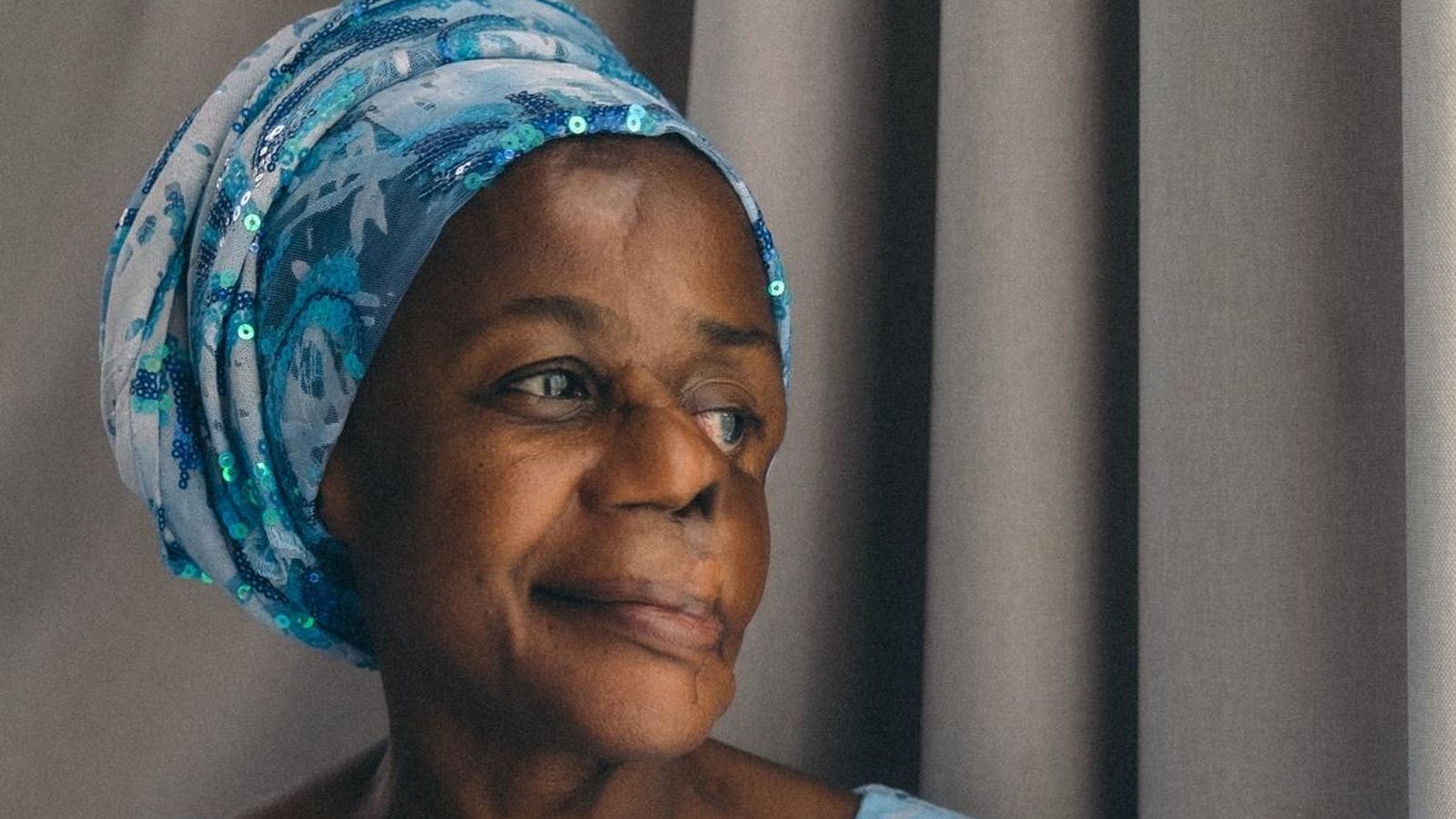
Health promotion officer and noma survivor Mulikat Okanlawon.
© Fabrice Caterini – Inediz
At the age of six, Mulikat Okanlawon was living with her grandparents in a village in Nigeria’s Ogun State. She remembers, “My living conditions at that time were so bad; life then was difficult.”
Her family noticed that something wasn’t quite right with her, but it wasn’t exactly clear what that was. Her face started to swell, and her body was hot all the time. “Nobody understood what happened, even my parents. Everybody thought it was normal malaria…my grandparents tried what they could, but they couldn’t stop it.”
The left side of her face began to look dramatically different to the right side. One day, at a bus stop, a man spotted her face and put a name to what had happened to her: noma. Okanlawon was then treated in hospitals in Lagos and eventually in a specialist noma hospital in Sokoto, in northern Nigeria.
It was in Sokoto that Okanlawon really came to understand what noma was. Seeing other people affected by noma “made me comfortable because before I thought I was the only one with it.” She had three reconstructive surgeries, but that wasn’t the end of her time at the noma hospital. For doctors there took note of Okanlawon’s English and communication skills. She became the first noma survivor to stay at the hospital after treatment and work there, helping others during their noma treatment. Okanlawon also cofounded the first association of noma survivors, Elysium, in 2022.
Noma is a gangrenous infection affecting the mouth and face. It can develop very quickly and devastatingly. “What is commonly said is that up to 90% of the people will die in just a few weeks,” explains Claire Jeantet, a filmmaker and former noma campaign manager for Médecins sans frontières (MSF, or Doctors Without Borders). Broad-spectrum antibiotics can help early on, though it can be difficult for family members to initially recognize the severity of the problem, or to amass the money to seek out treatment.
If the person with noma survives to stage 3, the damage done is irreversible and the person is disfigured. Treatment at this stage can help with aspects like wound dressing and nutrition. By stage 5, once the scars have healed, surgery is possible. This may take several rounds.
Each stage is difficult, for both people with noma and those close to them. Jeantet notes, “it affects every aspect of the life of people affected by it and their loved ones,” from relationships to work and self-confidence. And the challenges don’t end with surgery. “It’s really a lifetime journey.”
To raise the condition’s profile, noma survivors including Okanlawon, and organizations including MSF and the Nigerian Ministry of Health, started campaigning in 2020 to get noma added to the World Health Organization’s list of neglected tropical diseases (NTDs). NTDs are diseases or disease groups that affect many people in low- and middle-income countries, but receive far too little attention. Many are avoidable.
For noma, it was laborious to assemble all the components of the application to the WHO list, Jeantet remembers. “This was like a puzzle.” It took at least a year to build the dossier of evidence. Besides Nigeria, 31 other countries joined the effort, and the group submitted the formal application in January 2023.
Finally, in December 2023, the recommendation was issued to add noma to the list. Advocates were thrilled. “My joy in the WHO recognition is that noma will get more attention,” Okanlawon said at the time. Similarly, some researchers expected noma’s inclusion to help with funding and monitoring. Noma remains the most recent addition to the list.
Why was this international coalition so invested in getting this disease named to the WHO list? And what happened after it was added?
One Of The Most Significant Lists In Global Health
“The NTDs can be defeated,” emphasizes Albis Gabrielli, a senior advisor in the director’s office of WHO’s Malaria and Neglected Tropical Diseases Department. “63 countries have already eliminated at least one NTD…So we can see we have an exit strategy.”
With the addition of noma, the NTD list now encompasses 21 conditions, from leprosy to Chagas disease. What they have in common is that they: 1) disproportionately affect the poor, 2) mainly affect people in tropical and sub-tropical areas, 3) can immediately be addressed by a recognized public health approach, and 4) are neglected by research.
Heather Ferguson, a professor of infectious disease ecology at the University of Glasgow, sees the NTD list as a significant step forward. Previously, because of the limited attention, funding and coordination for these diseases, “that led almost to them competing against one another for that tiny, tiny pot of invisible money.”
Then, in 2005, WHO decided to bring together its various programs for neglected tropical diseases and create the list. In Feguson’s view, it was strategic “to unify these under the banner of NTDs and really push for this as a common issue.” This helped to draw focus to the neglected communities affected by the diseases, even beyond each individual disease.
One of the most tangible impacts has been donation of medicines for diseases on the list, which WHO advocates for and often administers. In 2025, pharmaceutical companies donated 1.5 billion tablets and vials for NTD treatment. “It’s actually one of the largest donations of medicines globally that we have today,” Gabrielli says. Still, some conditions on the NTD list have not elicited such donations.
As for research, Ferguson says, “in my career, I have seen lots of positive progress” from the creation of the list. For instance, research funders recognize that a disease on the NTD list affects the poorest of the poor, and that there are tangible ways to address it.
But she acknowledges that many people, possibly including herself, have had inflated expectations for what inclusion on the list can do. It’s no silver bullet—especially with the steep decline of global health budgets, including major restructuring of WHO, in the last couple of years. Ferguson wonders, “Yes, you have this recognition, but where is the funding going to come from that’s going to deliver the action that is needed?”
Gabrielli emphasizes that WHO is not a funding agency, and inclusion on the list does not automatically release funding. In fact, “there’s not much change, especially in terms of funding.” This is after all a set of neglected diseases, not well-resourced ones.
The Process For Joining The List
Ahmed Fahal, a surgery professor at the University of Khartoum, has played a key role in the movement to better treat and understand mycetoma, a bacterial or fungal infection that can become chronic, potentially making amputation necessary.
Fahal’s enthusiasm for treating mycetoma was not always welcomed or taken seriously. “Even in Sudan, mycetoma patients are neglected,” he reports. In common with a number of the world’s most neglected diseases, “it is not a killing disease, but it is a disabling disease.” To combat the morbidity, stigma and exclusion, Fahal has helped establish both a dedicated research center and a training institution supporting people with mycetoma.
The ongoing war in Sudan has challenged this kind of work. The headquarters of the Mycetoma Research Centre (MRC) at the University of Khartoum was destroyed, and the equipment at the training center was looted, making it impossible to continue vocational training. But Fahal and other researchers remain determined to continue their work. They’re working to rebuild the centers, and Fahal is continuing to travel in relatively safe parts of the country.
The MRC, together with the government of Sudan, submitted multiple proposals to WHO to have mycetoma added to the NTD list. “That took about three years,” Fahal recounts. It ended up being a diplomatic process as well as an administrative and scientific one: “You need to have a lot of people on your side,” says Fahal. Sudan’s health minister spoke with counterparts and other countries, and there were years of meetings to get countries with “a loud voice” onboard. These efforts eventually paid off when mycetoma was added to the NTD list in 2016.
That same year, WHO created a formal process for adding a disease to the NTD list. So in theory it should now be a less political and more clear-cut set of steps. A few submissions have not been accepted, because the disease burden was deemed too small (scorpion sting envenoming), the disease could be bundled with another one, or the applicants hadn’t gone through the proper process.
Over the years, the quality of the dossiers submitted to WHO has improved, Gabrielli reports. The noma campaign “was extremely well prepared,” with a large and varied list of supporting organizations. In general, it’s especially helpful if many countries can join forces behind a campaign, as with noma. “The more the better,” Gabrielli advises.
One point of contention in the evaluation process has long been whether a disease community should already have some funding in place before that disease is added to the list. Infectious disease researcher Ferguson is now chair of the Strategic and Technical Advisory Group (STAG) for Neglected Tropical Diseases, which makes recommendations to WHO on whether to add certain conditions to the NTD list. Ferguson is keen to make sure that this point about pre-existing funding is formally reviewed.
One argument put forward is that the current four criteria are so wide that just about any disease that affects marginalized communities in tropical communities could be added; without some funding in place, inclusion on the list won’t achieve anything, and could even drain resources. On the other hand, there’s an argument that inclusion could attract that critical funding.
There’s technically no restriction on how long the list can be, but in practice people worry about dilution of scarce resources. This question of how selective to be is so critical because of the dire shortage of funds for NTDs. Ferguson notes that this calls for tough decisions around priority setting. “It’s heartbreaking, but it’s the current reality.”
Is It Worth It?
Researcher and doctor Rella Zoleko Manego.
Christine Ro
Thus, inclusion on the WHO NTD list is a mixed picture. Sadly, mycetoma expert Fahal says, most of the steps needed to reduce the burden of mycetoma have not been achieved. “Definitely more of the international community donors, funders, they know about mycetoma, but still it is not a priority for many of these funding bodies and research bodies. And hence, really, we need more international collaboration, more effort.” Notably, according to Fahal, no pharmaceutical company is supporting medicine donations for mycetoma patients.
One telling study focused on a different condition: snakebite envenoming, which was added to the NTD list in 2010. Subsequently, multiple countries in sub-Saharan Africa appointed a point person for this condition and developed national snakebite policies. However, countries vary widely in how they’ve rolled out these policies.
The noma case also shows the nuances. WHO advisor Gabrielli says that budget cuts have meant that WHO couldn’t do as much on noma as they would have liked. “We have been advocating for noma, but unfortunately in terms of funding, there’s not much that WHO can do…and this is a bit of a source of disappointment.” But the recognition of noma on the WHO list has given a boost to people already working on the disease, for instance at health ministries.
The survivor community, like any group, has mixed feelings. Okanlawon says that the situation has much improved since noma was added in 2023. “Now, people know what noma disease can do in the life of someone affected and the damage it could do,” says Okanlawon. “The level of awareness is higher, and it makes people understand and know what to do so they can stand up and help people affected by this disease.” Her speaking engagements have increased since 2023, including at major scientific meetings and government agencies. And she now lives, in her words, “like a normal person.”
Valter Muendane, Elysium’s representative in Mozambique, believes that the NTD list inclusion “makes a difference, but it’s still not enough,” especially in Mozambique. He reports that some health professionals remain unaware of noma.
One person who believes in the power of the NTD list is Rella Zoleko Manego, a doctor and clinical researcher at the Centre de Recherches Médicales de Lambaréné, Gabon and the Bernhard Nocht Institute for Tropical Medicine in Hamburg, Germany. Zoleko Manego was shocked the first time she saw a patient with a worm wriggling across her eye. This was the parasitic loa loa worm, which she’d heard about in her medical training. But there had been little information on treatment. Doctors would just tell patients there was nothing to do. “I realized we don’t have anything, we don’t have any procedures to treat patients in endemic areas,” Zoleko Manego says.
So she set out to research how prevalent loiasis is, and what its symptoms are besides the tell-tale worm in the eye, which may not always appear to doctors. Treatment is challenging for multiple reasons, including the possibility of inducing a serious allergic reaction that rural hospitals are ill-equipped to manage. Zoleko Manego and other researchers have investigated the possibility of using drugs developed for other parasites, but the match is imperfect: the parasites may live in different places in the body, or the side effects might be too strong.
Also mismatched is the best course of treatment in endemic countries and non-endemic countries. A German hospital treating a traveller who picked up loiasis would likely have a very different level of resources and awareness to a rural facility in Gabon, for instance. The risk of re-infection would also diverge.
This is a “very, very neglected disease,” Zoleko Manego says, for a number of reasons. For one thing, the roughly 20 million people living with loiasis are mainly in scattered rural parts of Central and West Africa. And there’s a language gap between those areas, where mainly French and local languages are spoken, and the English-speaking research world. That limits the spread of information on this globally little-known condition.
So a key advocacy goal of The Loa Loa Initiative, a research collaboration of the two institutes where Zoleko Manego works, is to get loiasis added to the WHO NTD list. Collaborators are now working on compiling the dossier. This is a big task, Zoleko Manego notes.
Still, she believes, it remains important for loiasis to be an officially recognized NTD in order to unlock badly needed funding.
Reporting for this article was supported by a Maria Leptin / EMBO Science Journalism Fellowship.