

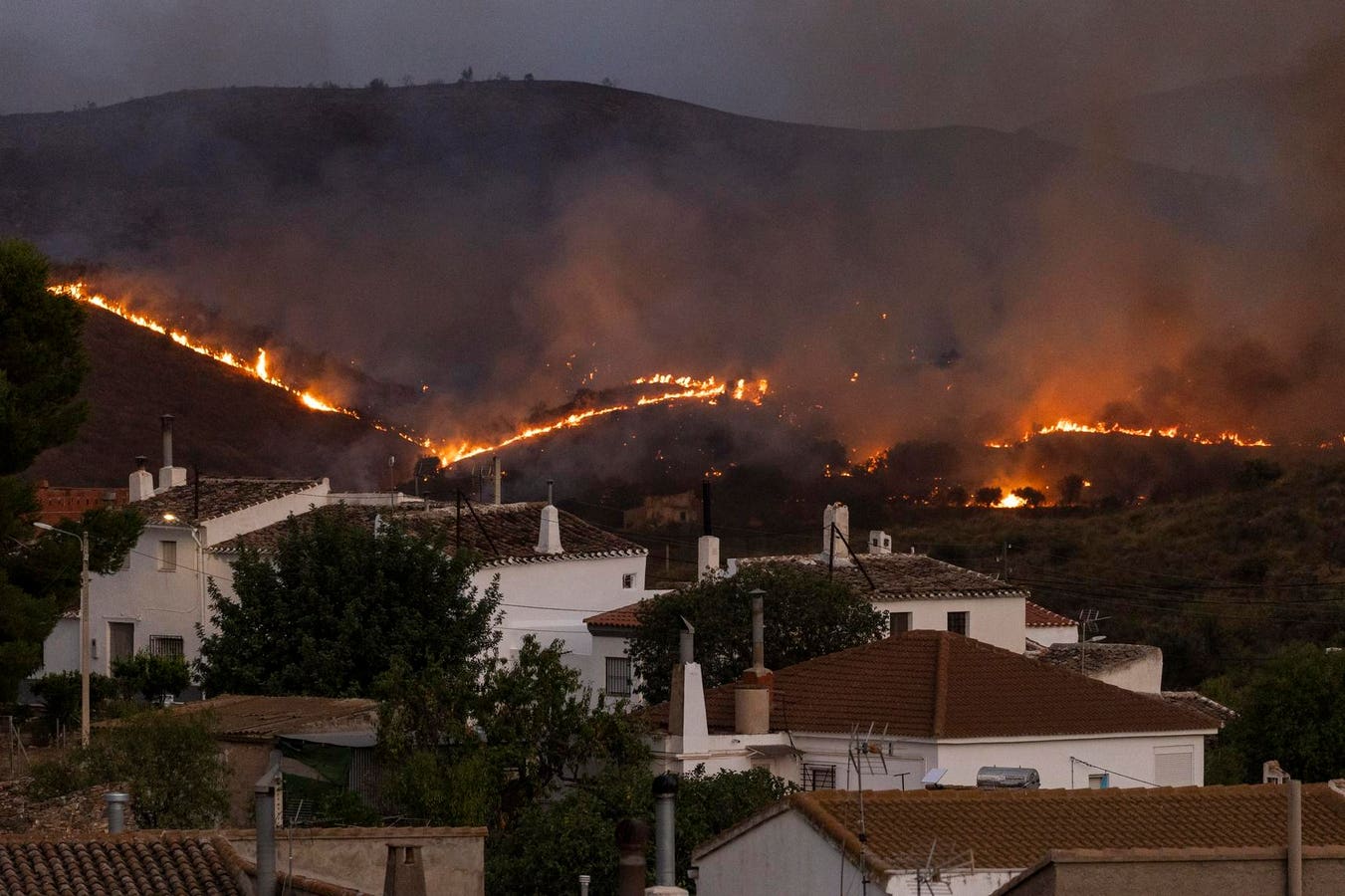
Flames and smoke rise from a wildfire as it creeps towards residential buildings near the municipality of El Pocico on July 10, 2026 in Almeria, Spain.
Getty Images
The list of vacation destinations burning this summer reads like a bucket list itinerary: Bordeaux, Crete, the Aegean coast, and Bend, Ore.
Fires across Europe have killed at least 17 civilians, six firefighters and two helicopter crew, and forced roughly 330,000 people from their homes in France and Spain. France has already passed its worst fire year on record and is running at 6.2 times its 20-year average, according to the data research firm Ranking Atlas.
If you have a trip booked, you’re probably doing arithmetic you didn’t expect. Here’s where the fires have already forced the call:
- Central Oregon. The Akawa Butte fire northeast of Sisters reached 27,491 acres before evacuation notices eased. Visit Central Oregon, the tourism marketing agency, has been promoting a hyperlocal smoke map this summer, partly to prevent unnecessary cancellations in towns that weren’t affected.
- Spokane, Wash. Three fires broke out around the city on August 1 and are now managed together as the Spokane Area Fires. Roughly 65,000 people have been evacuated, and more than 600 structures were hit. An air quality alert covering 13 eastern Washington counties warned that fine particulate levels could reach the “very unhealthy” range.
- Gironde and the Arcachon Basin, France. About 40,000 visitors at 45 campsites in Gironde and the neighboring Landes were evacuated, and the prefect publicly asked tourists to stay away. On the Cap Ferret peninsula, the summer season has been effectively cancelled.
- Crete and the area west of Athens. Authorities moved about 8,000 residents and tourists out of the coastal resort of Agia Galini, Crete, on July 29. The fire that started west of Athens on July 31 destroyed more than 100 homes and drove out over 1,000 people, more than 250 of them evacuated from the beaches by boat.
Every one of those flare-ups has travelers asking the same question: Should I cancel, and if so, when? But you won’t find the answer on the TV news. More often than not, it comes down to air quality, whether anyone has ordered an evacuation, and how your travel insurance policy defines a disaster. Get that wrong and you’ll cancel a trip that didn’t need canceling—or forfeit a deposit you can’t recover.
When should you cancel because of a fire?
Headlines aren’t always enough to prompt a cancellation, according to experts. Daniel Grainger, founder of Ranking Atlas, ran a country-level analysis of the European Union’s fire records. He says cancellation decisions are based on a specific destination’s fire trend rather than this week’s news.
He points out that in Portugal, wildfires have burned the equivalent of 23 percent of the country’s land area over 20 years, yet this year’s fire activity is running at only 0.35 percent of the seasonal average. Most Mediterranean coastlines see some fire activity every August.
Karen Clay, professor of economics and public policy at Carnegie Mellon University, says the common error is treating one number as the whole story.
“The air quality index can worsen by 100 points across a short distance as smoke plumes move,” she says.
Those index categories are built around healthy adults, she adds, so anyone with asthma, heart disease, a pregnancy or a young child needs to react sooner. She also points out that people check the forecast the week before instead of the morning of, which is when advisories and smoke shift.
The index itself is slipperier than travelers assume. Colleen Rosales, strategic partnerships director at OpenAQ, a nonprofit that publishes open air quality data, says air quality indices are calculations rather than physical readings, and countries build their own to match their own health standards.
A fine particulate concentration that reads “good” in Mongolia can read “moderate” in the U.S. Providers don’t always disclose how they got their number. Air quality indices don’t mean the same thing everywhere.
Also, a fire in one part of town doesn’t mean the entire destination is closed. My U.S. home base is in Spokane, and the fires there illustrate this point. Nearly half the city’s neighborhoods were evacuated or at risk. The images were terrible. But Visit Spokane’s latest advisory says the region remains open to visitors, with events and attractions continuing as scheduled. Hotels are taking reservations. Several are discounting rooms for evacuees and first responders.
Bottom line: A fire in the news doesn’t necessarily mean the destination has stopped functioning, or isn’t open for business.
Does travel insurance cover wildfire cancellations?
“When severe weather or a natural disaster causes an extended delay so your travel carrier can’t get you to your destination for at least 24 hours from your original scheduled arrival, that can be a covered reason for trip cancellation,” says Daniel Durazo, director of external communications at Allianz Partners USA. “To travel insurers, a heat wave, smoke, or a bad forecast alone are not covered reasons for cancellation. Yet, widespread evacuations, destroyed accommodations, or an official order preventing access can change the equation.”
Durazo says the wildfires near Bordeaux were a clear case of a destination becoming uninhabitable rather than simply unpleasant, and that people with travel insurance policies could be reimbursed for unused, prepaid, nonrefundable trip costs, subject to their policy terms.
Allianz Partners’ 2026 Global Travel Confidence Index, conducted by Ipsos, found that 68 percent of American travelers now weigh environmental risks and extreme weather when choosing where to go.
Terry Boynton, president of Yonder Travel Insurance, draws the same line.
“For heat, wildfire smoke, and other extreme weather events, the key question isn’t whether the conditions are unpleasant,” he says. “It’s whether they directly disrupt your travel plans in a way that is covered by your policy.”
If smoke cancels or badly delays your flight, trip cancellation, trip interruption or travel delay benefits may apply. If you simply decide not to go, they generally don’t.
Chrissy Valdez, senior director of operations at Squaremouth, says standard trip cancellation coverage on travel insurance policies responds to mandatory evacuation orders, uninhabitable accommodations, airport closures and supplier cancellations.
“Where it falls short is when a traveler feels uncomfortable going unless there is an evacuation order or uninhabitable lodging,” she explains. “Most standard policies don’t treat high temperatures or poor air quality as covered cancellation reasons.”
In those situations, a more expensive “cancel for any reason” or “interruption for any reason” policy provides more flexibility, she adds.
The timing can be tricky. Buy insurance after a fire is burning, and you’ve bought nothing. The UK insurer InsureandGo designated the current European wildfires a known event as of July 22. Every carrier sets its own date, and once it passes, that fire is no longer an unforeseen event on any policy sold afterward.
There’s also a category of disruption nobody’s policy addresses. Nick Cavanaugh, CEO of Sensible Weather and a climate scientist, says traditional coverage is built for low-frequency, high-severity events. Smoke and heat tend to ruin the trip without canceling it. His company’s survey of 600 U.S. leisure travelers found 78 percent have had a trip negatively affected by bad weather.
That gap between what people assume is covered and what’s listed in the policy can be frustrating, according to Joe Cronin, president of International Citizens Insurance. But some gaps are wider than others.
“Travel medical coverage generally does apply if you go anyway and end up needing treatment for heat exhaustion or respiratory issues,” he says.
Do hotels and vacation rentals offer wildfire refunds?
Here you have more leverage than you think, at least in some places.
If your hotel, campsite or rental is evacuated by local authorities, French law treats it as force majeure and the provider is generally required to refund the unused portion of the stay. Under EU package travel rules, travelers who booked a package can cancel before departure when unavoidable and extraordinary circumstances hit at or near the destination, with a full refund and no additional compensation.
The platforms moved during the Gironde fires. Airbnb told the French newspaper la Voix du Nord that it extended the scope of its policy to cover the entire Gironde region in light of local advice against traveling there. Many suppliers waived cancellation fees, even on nonrefundable rates, when access was impossible or a property had closed. SNCF, the French railway system, allowed free changes and cancellations on trips to Gironde and Landes.
Pay attention to the fine print. Airbnb’s Major Disruptive Events Policy covers unforeseeable natural disasters and severe weather, plus mandatory government evacuation orders. Weather common enough to be foreseeable in a given location is usually excluded. For example, during the January 2025 Los Angeles fires, one guest with a rental near Pacific Palisades was told her cancellation didn’t qualify.
Ask for everything in writing, too. Keep the evacuation order or prefectural notice, and enclose it with any request for a refund or rebooking. Suppliers with no legal obligation to refund will often move a booking rather than lose the customer, and Sensible Weather’s Cavanaugh says booking direct rather than through a third party usually buys you a real person to ask.
How to plan a trip during wildfire season
The season isn’t finished. Above normal significant fire potential continues this month in much of the Northwest, northeast California, the northern Great Basin and the West Slope. Washington has already seen more than 1,000 fires burn about 425,000 acres this year, the most since 2021, according to the state Department of Natural Resources.
Experienced travelers aren’t panicking, though.
“Despite another summer marked by record-breaking temperatures and increasingly severe weather events worldwide, most experienced international travelers are not overly concerned about extreme heat or weather-related health risks when planning trips abroad,” says Bill McIntyre, a director at Global Rescue. Its survey found only 12 percent are “extremely or very concerned,” with 52 percent “somewhat or slightly concerned.”
What distinguishes them is preparation.
“Experienced international travelers understand that unpredictable weather is one of many travel risks that can be managed with preparation,” says Jeff Weinstein, a paramedic and medical operations manager for Global Rescue. “They recognize that staying hydrated, adjusting itineraries and understanding local conditions will significantly reduce the likelihood of heat-related illness.”
Weinstein says their real concern isn’t avoiding every risk. It’s knowing they’ll have access to quality medical care and, if necessary, medical evacuation.
Check your destination against its own seasonal average rather than the country’s latest news headlines. Take a look at the local air quality reading the morning of your departure. Ask your lodging about air conditioning, filtration and backup power. Build in a buffer day. Book rentals or hotels with flexible refund policies, which costs less than a “cancel for any reason” rider and pays out faster.
Remember, canceling your vacation is the only decision here you can’t reverse. Smoke will eventually clear—and maybe soon—but a forfeited deposit stays forfeited. So this summer, make the call as late as your refund window allows.