

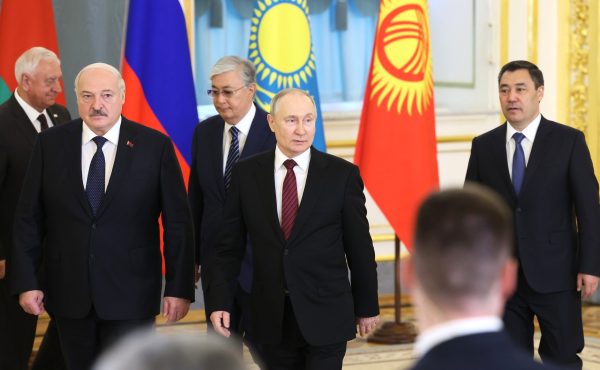
The Eurasian Economic Union (EAEU), comprising Kazakhstan, Kyrgyzstan, Armenia, Belarus, and Russia, has been a relatively successful geopolitical project for Russia, which stands as the union’s uncontested dominant player. But contrary to its multilateral agenda and aspirations, the EAEU remains to this day an ineffective instrument in terms of economic cooperation and integration, paradoxically its very reasons for being.
First of all, the EAEU suffers from enormous internal disagreements and uneven markets. Members of the union have very different goals, and there are recurrent clashes between members over the application of non-tariff regulations and accusations of protectionism. Second, in the eight years since its creation, the EAEU has failed to establish itself as a profitable economic alliance or attract new member states, although Russian President Vladimir Putin has repeatedly predicted the opposite.
Despite its heavy dependence on remittances from migrant workers in Russia and regular pressure from the Kremlin, Tajikistan has no plans to join the EAEU. The most populous state in Central Asia, Uzbekistan, has flirted with EAEU membership but so far has only become an observer.
According to Kazakhstani political scientist Dosym Satpayev, this “gives Uzbekistan time to support and strengthen the positions of its own commodity producers.”
According to the Statistics Agency of Uzbekistan, Uzbekistan’s largest trade turnover is currently still with Russia, with 18.6 percent of the total, followed by Kazakhstan (9.2 percent), and Kyrgyzstan (2.5 percent). But against the backdrop of the war in Ukraine and Russia’s current situation, Uzbekistan’s accession to the EAEU may bring more losses than benefits, as there is always a risk of Western sanctions against members in relation to re-exports to Russia.
In addition, Uzbekistan is once again actively pursuing World Trade Organization (WTO) accession, which would allow it to set foreign trade tariffs based on its own interests. Uzbekistan first applied for membership in 1994, but the main barriers to Uzbekistan’s accession to the WTO, limited currency convertibility and the high levels of state intervention in the economy, remained problems for decades. However, under the administration of current President Shavkat Mirziyoyev, Uzbekistan has begun to move away from the kind of protectionism and other economic policies that impeded its WTO ambitions.
In 2017, Mirziyoyev removed currency restrictions in the domestic market, eased barriers for exporters, and created a level playing field for both state and private importers. These reforms have led to an increase in Uzbekistan’s foreign trade turnover. Uzbekistan realizes that joining the EAEU or any other organization with a single customs duty would limit its ability to establish free trade with third countries, including high priority partners such as Turkey (6.4 percent of foreign trade turnover as of the end of 2022), South Korea (4.7 percent), and Germany (2.3 percent).
Accession to the WTO will certainly secure Uzbekistan’s global trade relations and increase the inflow of investment, which in turn will create new jobs and could serve to at least partially break the Uzbek economy’s dependence on Russian business.
Moreover, joining a Russian-controlled structure may delay negotiations with the WTO. Tashkent cannot easily pursue both tracks with equal ambition.
According to World Bank estimates, Uzbekistan’s transition to a market economy is still in its early stages, with border crossing difficulties and a substantial part of the economy still controlled by centralized state institutions. It should be taken into account that the economies of the main EAEU players are far ahead of Uzbekistan’s in terms of per capita income and degree of development, as they have long since transitioned to market economies. Uzbekistan was economically isolated under Islam Karimov and is still at an early stage of development, especially in the sphere of production. Joining the EAEU without fully adapting Uzbekistan to a market economy could have detrimental consequences and weaken the country’s industrial potential.
Thus, despite repeated calls from Russian officials, Uzbekistan has shied away from full membership in the EAEU, for now. At the same time, Russia has courted other potential new members such as fellow international pariah, Iran.
A New Friend in Iran
In February 2021, Iran’s parliament speaker Mohammad Baqer Ghalibaf announced negotiations on Iran’s permanent membership in the EAEU and said the talks would conclude “in two weeks.” But the Iranian politician’s ambitions turned out to be premature; at least, the official members of the union denied the existence of such a request, and no one discussed Tehran’s membership in serious forums. Iran’s loud statements about joining the EAEU may be rightfully seen, then, as a demonstrative geopolitical gesture, primarily in response to the strengthening of U.S. sanctions.
At first glance, the parties seem to have a motive to unite, especially now against the backdrop of Russia’s and Iran’s economic detachment from the rest of the world. Iran’s integration into the EAEU market would ensure the free movement of goods between the parties in the territories of six countries with vast resources and a population of more than 170 million people. With sanctions stymieing most of Iran’s oil exports, Tehran is looking for new markets for non-oil goods, a goal that a hypothetical accession to the EAEU would certainly facilitate.
For Moscow, which is stuck under trade restrictions, Iran is an alternative that will open partial access to Middle Eastern markets. Moreover, Russia is interested in longer-term projects with Iran given that Iranian territory can help realize the Zangezur corridor, by facilitating Azerbaijani access to the Nakhchivan Autonomous Republic without passing through Armenian checkpoints. Railroads and highways through the Caucasian exclave of Nakhchivan will, in the future, allow a connection to the North-South Transport Corridor.
Iran would, among other things, get a railroad to Russia via the EAEU. Within the framework of these goals, in 2018 Iran and the EAEU achieved a temporary agreement on the establishment of a free trade zone, from 2019 on the basis of that agreement the parties conducted mutual trade exchange.
At the end of October this year, Iran and the EAEU announced their intention to conclude a new free trade agreement and launch it by the end of the year. Various sources say that the new agreement will provide tariff benefits and remove customs duties in the exchange of goods, but as we can see from the experience of long-standing EAEU members, the issues with benefits and duties within the alliance have always been resolved exclusively in favor of Russia, and these issues are still a headache Kazakhstan, Armenia and Kyrgyzstan.
In any case, Iran’s cooperation with the EAEU within the framework of trade agreements looks like it will continue. According to the Islamic Republic of Iran Customs Administration, the volume of trade exchange between Iran and EAEU member states reached a record $4.2 billion this year. It remains far too early to talk about prospects for Iranian membership in the EAEU, which in addition to solving a number of procedural issues, would also require the agreement on hundreds of economic parameters. It will take years to sort out even with sustained intention to do so.
And What About the EAEU’s Members?
Kazakhstan‘s situation was discussed in detail in my previous article, but its concerns about the EAEU have only grown. The disruption of logistics chains due to the imposition of sanctions on Russia is a major worry. Although Kazakhstan prefers to conceptualize the EAEU as a purely economic endeavor, it has always had political overtones and Astana has always known that.
When the agreement on the EAEU’s founding was signed in 2014, then Kazakhstani Deputy Foreign Minister Samat Ordabayev stressed that “we have moved away from politicization” and that “such issues as common citizenship, foreign policy, inter-parliamentary cooperation, passport and visa sphere, common border protection, export control, etc. were excluded from the agreement.”
At a EAEU summit in Moscow earlier this year, Tokayev repeated this same message: that Kazakhstan considers the union exclusively as an economic bloc.
For Kazakhstan, among other things, the issue of disproportionate distribution of customs duties remains unresolved. The independent portal Orda.kz writes: “All parallel imports go to Russia, which has become a pariah country. [The] rules are as follows: even if all goods imported into the EAEU are exported to Kazakhstan, it will get its 6.955 percent of the duties collected, period.”
Customs duty quotas in the EAEU are distributed based on the size of the economies and populations of the countries; Kyrgyzstan (1.9 percent) and Armenia (1.2 percent) receive the smallest share of duties. At the same time, imports to the EAEU often go directly to Russia, rather than through the countries of the union, which ultimately limits the rights of the EAEU to receive a well-deserved portion. Financial analyst Rasul Rysmambetov calls this an illegal Russian scheme.
Kyrgyzstan, one of Russia’s closest strategic partners, joined the EAEU under then-President Almazbek Atambayev and primarily counted on expected benefits including free movement of goods and improved conditions for Kyrgyz labor migrants in Russia. Eight years later, it seems that these hopes have still not been fulfilled. For instance, the problem of freight transportation under the EAEU remains an acute issue for the Kyrgyz state. Kyrgyz trade has regular difficulties on the border with Kazakhstan. Kyrgyzstan has repeatedly accused its northern neighbor of creating an artificial obstacle to the export of Kyrgyz products, of violating EAEU rules regarding inspections of goods at the border, and even of unfairness of the Kazakh border service and tax committee.
Kyrgyzstan is heavily reliant on remittances from labor migrants. According to Russian government agencies, more than half of labor migrants coming into Russia from EAEU members in 2022 were citizens of Kyrgyzstan, and remittances sent by labor migrants were the equivalent of almost a quarter of the country’s GDP. However, the situation of migrants in Russia and the EAEU as a whole is still unsettled. Migrants in Russia are forced to leave the country and return to renew their stay, and the social protection of migrants from the EAEU promised by the Ministry of Labor, Social Security and Migration remains just another loud statement. According to human rights activist Valentina Chupik, Kyrgyz migrants in Russia have a number of disproportionate obstacles that prevent them from being legally employed, which eventually leads to a significant decrease in wages. Employers themselves are reluctant to hire migrants legally to avoid paying taxes and social benefits.
Russia also made many promises to Armenia. In 2013, Armenia was on the verge of signing an association agreement with the EU; Moscow pressured Yerevan to sign onto the EAEU instead. At the time, Armenia made a gamble to seek security via closer relations with Russia, but Moscow went on to chronically manipulate Armenia’s economy for political reasons. For instance, earlier this year, Russia’s agriculture regulator, Rosselkhoznadzor, banned the supply of Armenian dairy products in response to Yerevan’s joining the International Criminal Court (ICC) which had just issued arrest warrants for Vladimir Putin.
After joining the EAEU, Armenia expected to benefit from trade privileges and cheap supplies of Russian energy. But there were no big changes in Armenia’s economy, and in the first year of EAEU membership exports to Russia even decreased by 26 percent. Armenia has been, and remains, below the poverty line — the national poverty rate is 26.5 percent, and in rural areas ranges from 33 percent to 49.1 percent.
As of today, Armenia ranks last in terms of the share of duties attributable by the EAEU and receives only 1.22 percent, while Russia still receives 85.06 percent, despite a drop in economic activity due to the imposition of sanctions.
Having joined the Kremlin’s projects solely for the sake of geopolitical comfort, Yerevan has been compromising with Russia for years. It paid a high price for Moscow’s patronage and refused favorable deals with EU countries to maintain that relationship. It turned out that membership in both the EAEU and the Collective Security treaty Organization (CSTO) ultimately did not fulfill Armenia’s hopes. In October, Prime Minister Nikol Pashinyan confirmed this disappointment in a speech to the European Parliament in which he said that the CSTO “considered the security system of Armenia” and Russia “did not help us at all” amid the resumption of conflict in 2021 with Azerbaijan.
The events in Nagorno-Karabakh earlier this fall, in which Azerbaijan effectively saw through the dissolution of the region’s government and an exodus of Armenians from the area, have further shifted Yerevan’s calculus regarding Russia. With Nagorno-Karabakh no longer a motivating issue in keeping Yerevan close to Russia, there are opportunities for a rapprochement with Western powers — and a further turn away from the EAEU by one of its members.
A Loyal and Obedient Old Friend
Although Belarus’ membership in the EAEU offers a free trade zone, it makes the Belarusian economy even more dependent on the Kremlin. As Putin’s closest military ally, President Aleksandr Lukashenko literally joined the Russian invasion of Ukraine – thereby throwing his country under harsher Western sanctions and limiting Minsk’s economic potential for partnership with the EU and third countries. The EAEU market is small potatoes compared to all of the European Union.
Now, Russia is the main provider of foreign direct investment in the Belarusian economy and the main market for Belarusian goods. According to the World Bank, Belarus’ debt to Russia increased by 1.9 percent in 2021, reaching $8.5 billion. Minsk is completely dependent on Moscow’s supplies of energy and raw materials for industry.
Belarus’ natural gas imports are not diversified and come through a Gazprom pipeline. Kateryna Bornukova from Belarus Economic Research and Outreach Center writes that 90 percent of Belarus’ mineral fuel is also imported from Russia. Under this arrangement, Minsk is blocking the road for itself by limiting the potential for economic integration with competitive markets in the West and creating all conveniences for Moscow to control itself for geopolitical reasons.
Obviously, there is another side of the coin. Lukashenko is a calculating politician. In addition to integrations within the bloc, there are also personal agreements between the Russian president and Lukashenko, whose main goal has always been to retain power at any cost. Meanwhile, for Minsk, which is in economic deadlock, the market offered by the EAEU is the only option, although it makes it completely vulnerable to the whims of “big brother” Russia.
Captive to its own imperialist ambitions, the Kremlin continues to ally with junior partners, but is guided by old dictating instruments. The EAEU member states, even if they realize that integration with the former metropolis is not profitable, still seem to be making a gamble, fearing for their own sovereignty due to their geopolitical location and a dearth of other options.