

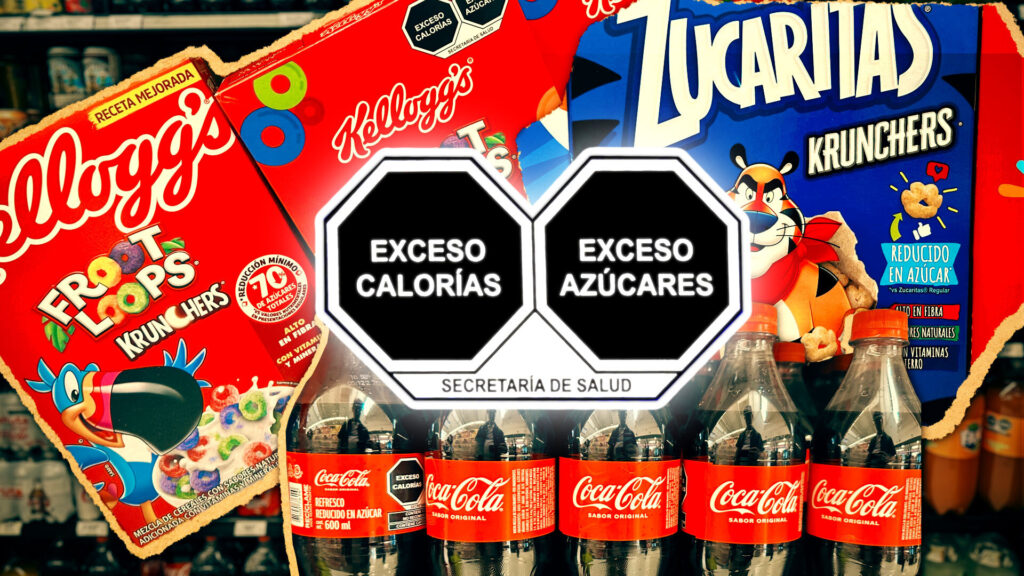
MEXICO CITY — Kellogg’s is waging a war here over Tigre Toño and Sam el Tucán.
A 2019 policy requires companies that make unhealthy foods to include warning labels on the front of any boxes they sell in Mexico to educate consumers about things like excess sugar and fat. Any food with a warning label — like Kellogg’s Fruit Loops or its Frosted Flakes, which typically contain more than 37 grams of added sugar in a 100-gram serving — is also banned from including a mascot on its packaging.
Kellogg’s, the company behind the mascots known in the United States as Tony the Tiger and Toucan Sam, has already sued the Mexican government over the labeling policy. And now, it’s ratcheting up its marketing to keep Toño and Sam alive: Toño has curated a Spotify playlist, starred in a commercial alongside a famous Mexican soccer announcer, and even has seen his likenesses illuminated in the sky by drones, in a light show high above Mexico City.
In supermarkets, you’ll still see Toño and Sam on the shelves. They’re advertising new versions of Fruit Loops and Frosted Flakes that claim to be low in added sugar; the nutrition facts for both products say they have roughly one gram per serving. The company replaced sugar with the sweetener allulose.
Mexican authorities expected this. They included a provision in the policy that required companies to also warn when products contained artificial sweeteners. But, according to media reports, the food industry successfully lobbied the Mexican government to not classify allulose as a sweetener. “We fully comply with the regulation requirements, while at the same time we developed different new food options for our consumers,” Kellogg’s said in a statement, adding that “allulose is clearly labeled and fully meets the regulatory requirement in Mexico.”
Kellogg’s isn’t the only company throwing everything they have at fighting Mexico’s policy, and finding loopholes to exploit. Companies like Coca-Cola and Kraft Heinz have begun designing their products so that their packages don’t have a true front or back, but rather two nearly identical labels — except for the fact that only one side has the required warning. As a result, supermarket clerks often place the products with the warning facing inward, effectively hiding it. Dozens of companies have also sued; several cases have already made it up to the Mexican Supreme Court.
Now, U.S. regulators are considering a similar policy, because they say it will help consumers make healthier decisions. The details haven’t been ironed out yet — the Food and Drug Administration just announced it is studying the idea. The reforms seem likely to be more modest; the FDA already appears to have rejected the stark, stop-sign-like warnings on Mexican packages and hasn’t mentioned banning mascots. But advocates in both Mexico and the United States say that U.S. regulators should prepare for a years-long political fight.
“We are defending this on a daily basis,” said Simón Barquera, director of the Nutrition and Health Research Center at Mexico’s National Institute of Public Health. (Barquera, like STAT, receives funding from Bloomberg Philanthropies.) While there are “very good arguments in terms of health, productivity, well being, even economic growth” for a front-of-package label policy, he said, regulators “should be worried about industry response.”
“They never stop,” said Eric Crosbie, an associate professor at the University of Nevada, Reno. “They will fight like hell to disrupt anything [aimed at] making that policy successful.”
Below are four lessons U.S. regulators could take from Mexico’s fight over food labels.
There will be lawsuits, lots of them
The food industry has filed dozens of legal challenges against the Mexican labeling policy. But the challenges — known as amparos — aren’t public, so no one knows for sure how many have actually been filed. Some groups peg the number at 70, while others say it’s over 100.
However, advocates and journalists have gathered that several of the largest food makers have filed these challenges, including Unilever, Coca-Cola, and Frito-Lay.
Several challenges are already pending before the Mexican Supreme Court. So far, it looks like Mexico’s policy will survive those challenges. Mexico’s court releases public discussion drafts of the court’s opinions before they are finalized, and three public drafts all reject the food industry’s arguments against the policy.
It seems inevitable that a U.S. labeling policy will end up being challenged in the courts as well. Food companies here have already indicated they believe mandatory food labels would likely violate the U.S. Constitution.
“There is a strong argument that, to the extent FDA were to impose the schemes it is testing as mandatory labeling requirements, they would be vulnerable to a constitutional challenge,” FMI, The Food Industry Association wrote in recent comments to the FDA.
One legal expert emphasized that the food companies suing over a policy is generally the mark of a strong law.
“It’s a good sign when we see that the industry is very uncomfortable and angry about something. Because that generally is a sign that it was well done,” said Isabel Barbosa, a senior associate for the O’Neill Institute for National and Global Health Law at Georgetown University.
But Barbosa acknowledged that the U.S. will have a harder time defending a mandatory labeling policy in the courts, because the U.S. is far more conservative in its approach toward regulating so-called commercial speech.
“It’s an uphill battle,” acknowledged Barbosa, the Georgetown professor. “What I wouldn’t want is for this … to keep [regulators] from taking any action.”
The policy could prompt an international trade dispute
If the U.S. moves forward with mandatory front-of-package labeling, it could land itself in front of an international trade tribunal being threatened with millions — if not billions — in retaliatory tariffs.
Because so many food companies are multinational, they have argued that elements of Mexico’s policy created unfair trade barriers. A coalition of food lobbies, including the American Bakers Association and the American Frozen Food Institute has argued, for example, that the ban on cartoon characters “runs counter to Mexico’s obligations in trade agreements.”
So far it appears that there haven’t been any formal challenges in international tribunals against Mexico’s policy, but there are a number of ways food companies could pursue such a challenge.The first is asking the United States or another nation to file a complaint at the World Trade Organization, where an international tribunal would hear the case and then authorize sanctions against Mexico if the country was found to have violated trade rules. Companies themselves could also bring lawsuits in so-called investor state dispute settlement tribunals, international arbitration bodies that allow companies that invest in a company to challenge that country’s laws.
It wouldn’t be the first time that food companies used trade treaties to challenge U.S. food and nutrition policy. When the U.S. passed a law in 2002 requiring that meat packages include the country of origin on the label, Canada and Mexico challenged it at the behest of their domestic meat industries. One billion dollars in sanctions were authorized by the WTO and Congress finally folded and repealed the law in 2015.
Every detail of the policy will be contested
The food industry pushed Mexican regulators for countless changes to its packaging policy, and while most of their suggestions were ignored, the effort foreshadows how food makers might push U.S. regulators to tweak an eventual labeling policy.
The food industry pushed back, for example, on a provision in the Mexican policy that would prevent foods bearing warning labels from also including endorsements from professional health associations. The juice company Jumex argued that provision would hurt regulators’ credibility because those associations have ties to the ministry of health.
The meat industry also argued that Mexico’s warnings should state that foods are “high in” certain nutrients, like sugars and fats, rather than warning that the foods have “excessive” fats and sugars.
Both of those requests were ultimately denied.
Already, the U.S. food industry is pushing for tweaks to the FDA’s plan, which hasn’t even been unveiled yet.
Groups like the National Confectioners Association, for example, have argued that the FDA shouldn’t consider color-coded labels because “consumers may find it difficult to understand traffic light labeling when a combination of colors is used on the same package.”
Crosbie, the University of Nevada professor who has documented industry’s efforts to change Mexico’s policy, said that U.S. officials need to lean on regulators and civil society groups in countries like Mexico that have implemented their own front-of-package law to understand what changes are actually helpful for public health, and which are simply efforts to weaken the rules.
“Industry is just lightyears ahead, they’re very crafty,” said Crosbie. “As each country adopts this we learn, ‘Okay, that is what you don’t do … but this is also what you do do.’”
Any loophole will be exploited
While most food companies, by and large, appear to be complying with Mexico’s new front-of-package labeling policy, companies like Coca-Cola, Kellogg’s, and Kraft have gotten remarkably creative at finding ways to minimize its effectiveness.
Full sugar sodas sold in Mexico, for example, should carry a label warning of the products’ high calorie and sugar content. Most do, but they’re easy to miss — soda companies are printing similar labels on the front and back of their bottles, but only printing the warning on one side so they are easily hidden on shelves.
STAT visited three supermarkets in August. At each, we observed large displays where a significant percentage of soda products had their warning labels hidden. At a Walmart in the Condesa neighborhood of Mexico City, for example, warnings were visible on just one-third of the Coke bottles and cans arranged in a display that was roughly 7 feet by 5 feet. At another supermarket, just 10 cans in a display of more than 60 Fanta sodas displayed the required warning labels.
Soda companies aren’t the only ones using this strategy. Philadelphia Cream Cheese, which is made by Kraft, also used labels on two sides of the containers. So did Yoplait yogurt and Ben and Jerry’s ice cream.
Eva Greenthal, senior policy scientist at the Center for Science in the Public Interest, argued that the tactic “points to the need for guidance for retailers about how to display products.”
Other companies have gotten creative in finding ways to keep their mascots, even without reformulating their foods, as is required by law. Bimbo, the international bread company that owns brands in the United States such as Entenmann’s and Takis, for example, technically removed its mascot from its packaging. It instead printed the mascot on the actual food product — a ready to eat pancake — and made the packaging clear, so the mascot is still visible to consumers.
Already, U.S. advocates are bracing for the food industry to use similar tactics in the U.S. and are urging the FDA to write their rules in a way that closes the existing loopholes in the Mexican policy.
“The food industry will be looking for every loophole, and the FDA needs to have the foresight to prevent this,” said Greenthal.
STAT’s coverage of the commercial determinants of health is supported by a grant from Bloomberg Philanthropies. Our financial supporters are not involved in any decisions about our journalism.