

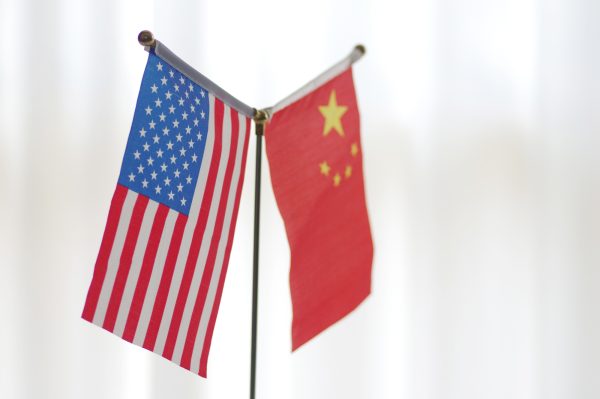
The Diplomat author Mercy Kuo regularly engages subject-matter experts, policy practitioners, and strategic thinkers across the globe for their diverse insights into U.S. Asia policy. This conversation with Dr. Allen Morrison – professor of global management at the Thunderbird School of Global Management at Arizona State University, co-author of “Enterprise China: Adopting a Competitive Strategy for Business Success” (Wiley), and former CEO and director general of Thunderbird – is the 391st in “The Trans-Pacific View Insight Series.”
Examine the divergence of China-U.S. trade relations as China’s trading trajectory is increasingly shifting toward developing countries and Russia.
As its trade relations with the U.S. sour, China is increasingly turning to the emerging markets as a source of supply and as a target for its exports. Supply chains are shifting as U.S. companies show a greater interest in diversifying risk away from the China market and are embracing a “China plus 1” sourcing strategy.
With this change, American companies are seeking new suppliers in countries like Vietnam, Indonesia, and Mexico. However, they are finding that many of these new local suppliers are affiliated directly with the Chinese companies they sought to diversify away from.
In terms of raw materials and other commodities, trade frictions with the U.S., Canada, Australia and beyond combined with near desperation from Russia have pushed China to diversify sourcing towards Russia. But it is also moving aggressively into Indonesia, Mongolia, Brazil, and the African countries of Angola and the Democratic Republic of Congo. Perhaps at no other time in recent memory have global supply chains been more in flux.
China is using its Belt and Road Initiative as a means to open doors in the emerging markets. Also, as China’s efforts to source state-of-the art microchips from the West have been stymied, it is relying on second- and third-generation IT products for sales. While these products may be at a competitive disadvantage in the U.S., they are often “good enough” for eager consumers in the emerging markets.
Identify the risks facing the U.S. and EU as they become less reliant on Chinese supply chains.
Diversifying away from Chinese supply chains brings its own set of problems. First, as the “factory of the world,” China’s manufacturers are often the lowest cost producers and offer the highest value to customers when adding quality to the equation. Diversifying suppliers may well result in higher prices and potentially inferior quality, at least during a transition period while other supply chains are established.
This is certainly the case in EV batteries, where Chinese giants, like Contemporary Amperex Technology, have an estimated 30 percent cost advantage over Western competitors. Lower labor costs, fewer regulations, and subsidized financing give Chinese EV manufacturers a reported 10,000 euro cost advantage over European automobile companies.
Many U.S. retailers and by extension U.S. consumers are also addicted to Chinese imports. Walmart relies on China for approximately 25 percent of its supplies. Target’s exposure to China is about 33 percent. Mattel sources about two-thirds of its toys from China.
U.S. and EU companies doing business in China have for decades been attracted to China because of the country’s robust ecosystems of suppliers and buyers. Companies that have explored alternate sourcing options have often found that only China can provide key skills or produce certain products. For companies like Apple and Nike, only China can supply the massive numbers of temporary and mobile workers necessary to optimize their suppliers and contractors’ factories. Hence, most companies find that they can geographically diversify some but not all of their supply chains away from China.
What is the impact on China as more Western companies offshore, reshore, or friend-shore production away from China?
China is facing significant economic headwinds just as Western companies are ramping up efforts to reshore their supply chains. Over the past 10 years, the number of foreign companies with manufacturing operations in China has declined over 25 percent. Some of this capacity has been taken up by their Chinese partners, but not all.
COVID setbacks, draconian Chinese state regulations, tightening oversight of technology and data, rising political tensions, and a host of domestic economic challenges have soured many Western companies on China. China has gone from being either the world’s number one or number two recipient of FDI to, in 2023, a net loser of FDI. During the past 18 months, Western companies have pulled over $150 billion out of China. Some of the money has been repatriated, but most has been shifted to third countries as Western firms reduce their exposure to China.
Just as Western companies have been pulling resources out of China, Chinese companies are following suit. Chinese companies are increasingly targeting Vietnam, Eastern Europe, and Mexico as manufacturing bases that allow them to circumvent trade barriers and speed delivery. A 2019 study by the European Commission found that nearly 10 percent of of foreign companies in Europe were owned by Chinese enterprises. As the challenges in China’s domestic market mount, no doubt Chinese companies will continue to look abroad for greener pastures.
Identify the drivers of China-U.S. decoupling and the emergence of trading spheres.
We have now entered a state of conflict and competition that is causing Western firms and China to rethink more than 40 years of engagement. Welcome to the new era of decoupling from China.
It represents a paradigm shift in terms of geopolitics, economics, business strategy, and leadership. Fundamentally, decoupling between China and the West is about the two countries and economic systems moving away from each other, not closer. It is about loosening the connections, not tightening them, and lowering, not raising, the level of integration.
The causes of decoupling are complex. They are rooted in politics, national pride, declining trust, and yes, money. China is bound and determined to prevail in its economic and political model, to shake its dependency on the West, and to take its rightful place as the Middle Kingdom. To this end, China’s aim is to take the lead in setting the technology standards and trading rules while subordinating the rest of the world to its political and moral leadership.
For their part, Western businesses, tired of being subjected to decades of Chinese technology “expropriation,” and facing punishing investment terms including forced apologies for feigned offenses, have woken up to the risks of doing business with China Inc. Complicating matters: political actors and business leaders in both China and the West are increasingly joining forces adding to the tug of decoupling.
While China and the West are moving directionally in favor of decoupling, no one can fully understand what decoupling will look like, how far it will go, or what all the consequences will be. We are in uncharted waters. What we do know is that decoupling will be costly. A study by McKinsey indicated that full costs of decoupling would range between $22 trillion to $37 trillion of economic value, or between about 15 to 26 percent of global GDP.
Assess the geopolitical dimension of China-U.S. trade trends and bifurcation of the global economy.
A decoupled world, or even a partially decoupled one, will no doubt add to the ongoing rise of nationalism seen throughout the world. In times of political stress at home, scapegoating foreigners and blaming domestic failures on foreign cheating can be a winning strategy. Consequently, the wedge separating China from the West will continue to grow – at least in the short term.
The rise of Xi Jinping was predicated on reasserting the CCP in Chinese society. It was a grand bargain with unknown consequences. Yet as time has moved on, the laws of fundamental economics seem to be prevailing. Growth in China has slowed, entrepreneurial activity in China has waned, debts are rising, and Western firms are pulling back. Lousy demographics including a significant and predictable decline in China’s population and high youth unemployment will only add to the country’s problems. For China, in particular, the economic consequences of a “stay the course” path are not good. And as goes an economy, so too goes political influence.
And yet China seems more eager than ever to assert itself politically and even militarily. Being the world’s second largest economy does have its benefits. While endless war games have been played out on an invasion of Taiwan, the consequences of a more politically and militarily assertive China are already playing out. Recently, the U.S., Australia, and the U.K. formed AUKUS, a military alliance. Other countries in the region including the Philippines, Singapore, Japan, and Vietnam have announced plans to strengthen their militaries and move closer to the U.S.
This will not prevent China from seeking to attract satellite countries that embrace its model and leadership role. Nor will it discourage China from increasing its military budget.
Over time, politics drive economics and economics drive politics. If care is not taken, we may end up with the worst of all possible outcomes: decoupling and military conflict. De-escalation will require the best efforts on both sides of the brewing conflict. More trust enhancing activities, better and more frequent communications, and the application of fair and understandable rules of engagement – from both sides – will be necessary.