

The recent discovery of substantial lithium deposits in Thailand’s southern Phang Nga province has the potential to be a pivotal development, with economic and diplomatic implications for the country. The discovery comes amid a surge of activity from both German and Chinese electric vehicle (EV) manufacturers in the region, reflecting a global race to secure critical resources for the burgeoning EV market.
The lithium deposits in question were originally poised to be among the world’s richest. However, subsequent clarifications have cast doubt on these initial claims. It has been revealed that the initial announced size of the deposit (14.8 million tons) referred to mineral resources that included lepidolite, a common mineral containing lithium, with an actual lithium content of only about 0.45 percent. This significant discrepancy has led to debates within the scientific community and among government officials about the significance of the discovery.
Jessada Denduangboripant, a lecturer from Chulalongkorn University, provided a reality check via his Facebook page, estimating that the actual amount of extractable lithium might be only around 60,000 to 70,000 tones. This figure significantly contrasts with the initial announcement and has led to a call for more accurate assessments of the deposits.
As Thailand’s Prime Minister Srettha Thavisin seeks to revive the country’s stagnating economy, his administration is strategically capitalizing on the EV sector to foster industrial advancement.
The vision for Thailand’s EV market is twofold: amplifying production to meet a 30 percent target of Zero Emission Vehicles by 2030, roughly equivalent to 1.4 million vehicles, and rolling out the EV 3.5 package. This initiative is an open invitation to new manufacturers, offering a comprehensive support system for the EV industry, including significant tax cuts and subsidies and reduced import duties for EV companies that set up operations in Thailand.
Simultaneously, the government’s provision of substantial subsidies for a range of EVs, tailored by vehicle type and battery capacity, reaching up to $2,900 per vehicle, underlines the commitment. This is designed to escalate consumer uptake and catalyze the market, establishing Thailand as a cornerstone of both EV innovation and adoption in the region.
In Southeast Asia, Thailand is already firmly established as an automobile manufacturing hub. Thailand’s automotive industry began in the 1960s and evolved into a major center for car manufacturing by the 1970s, significantly contributing to the country’s industrialization. Following strategic governmental policies Thailand emerged as a significant automotive exporter, with major Japanese companies like Toyota and Nissan leading the market.
With automobile manufacturing now accounting for roughly 10 percent of GDP, decisively steering its crucial manufacturing sector toward the adoption of EVs is a Thai government priority. This strategic shift is set against the backdrop of a global paradigm shift in the automobile industry, where the successful navigation through structural changes toward EV manufacturing may very well determine which manufacturers will thrive in the coming decade.
For some nations, the significance of these structural shifts cannot be overstated. Germany’s economy, grappling with the challenges of a recession, is beginning to exhibit structural vulnerabilities. The traditional German business model, which has long depended on affordable energy supplies from Russia and robust export markets in China, now finds itself at the mercy of geopolitical tumult. With the automotive sector accounting for approximately 5 percent of Germany’s GDP, the largest of the country’s various manufacturing sectors, any missteps in the crucial transition to EVs could spell catastrophic consequences for the nation’s economic stability.
Amid the strategic shifts in the global automotive industry, German automakers are confronting the dual challenge of adapting to the EV revolution and diversifying their market and production footprint, particularly in response to geopolitical problems and competitive pressures in China. In this context, “derisking” and “decoupling” stand for strategic approaches employed by countries like Germany to manage their economic and geopolitical relations with China. Germany’s approach involves diversifying trade and reducing reliance on China to mitigate risks without severing ties, a strategy that may blend into decoupling as EU policies evolve. This necessitates not only a recalibration of market strategies by German automobile manufacturers, but also a geographical diversification of their manufacturing bases.
In this sense, Thailand is emerging as a potential key ally for Germany in this crucial transitionary period. Though the country is a traditional ally of the U.S. in the region, China has made substantial diplomatic advancements there, especially since 2014.
With the Thai government’s proactivity in offering incentives, including tax breaks and subsidies for EV production, Germany’s automotive sector, including major players like Mercedes-Benz, sees Thailand as a crucial hub in Asia. In the first half of 2023 alone, German firms invested over €150 million in Thailand’s automotive and mechanical sector, signaling strong confidence in the country’s potential as a manufacturing and export base for EVs and related technologies.
Mercedes-Benz has strategically positioned Thailand in its production network, launching the fully electric Mercedes-EQS and its lithium-ion batteries in the country. The significance of Thailand in Germany’s overseas automotive strategy is underscored by the establishment of Mercedes-Benz’s sixth global EV battery factory there in 2018, reflecting a deeper commitment to the EV market in the region.
Thailand’s strategic positioning as a manufacturing nexus extends well beyond the scope of German automakers. Its competitive labor costs and conducive business climate, shaped by supportive political and administrative frameworks, have long been attractive to a diverse set of players. Historically, Japanese firms have maintained a robust manufacturing presence in Thailand centered on the automotive sector, and the nation is now witnessing a surge of investments from emerging Chinese competitors.
Significantly, Great Wall Motor has made strides by commencing the production of its electric vehicles in Thailand, notably the GWM Ora 03, the first mass-produced Chinese electric vehicle manufactured outside of China. Furthermore, the entrance of other Chinese electric vehicle manufacturers, such as BYD and Changan Automobile, into Thailand signifies a deepening interest from Chinese firms in leveraging Thailand’s manufacturing potential.
The automotive industry’s maneuvers are not merely market-driven but are deeply intertwined with geopolitical currents. German automakers are navigating the complexities of EU-China relations, especially considering potential Chinese reprisals to EU scrutiny over subsidies. This tension underscores the challenges faced by German firms reliant on China’s vast markets amid escalating Sino-American tensions.
The German domestic context adds layers to this dynamic, with internal debates over EV policy heating up. Economic Minister Robert Habeck’s (Green Party) approach has faced criticism for potentially lagging behind competitors and impeding electric car adoption, a contention that resonates with broader industry apprehensions about severing ties with China.
In search of alternative markets and production locales, some German industry advocates are looking towards Southeast Asia and India to diversify their global footprint. Yet, this strategic pivot may clash with Germany’s value-driven foreign policy, championed by figures like forging minister Annalena Baerbock (also the Green Party), which emphasizes issues like human rights and democratic principles.
The case of Thai King Vajiralongkorn’s activities in Germany encapsulates these complexities, where diplomatic sensitivities intersect with national laws and values. Vajiralongkorn has been closely scrutinized in Germany, especially by Baerbock, for potential tax discrepancies related to his property and inheritance in Bavaria and for conducting political affairs from German soil, which contradicts German foreign policy and legal expectations. German officials have communicated their stance to the Thai government, emphasizing that activities conducted on German soil must align with German law and international human rights standards.
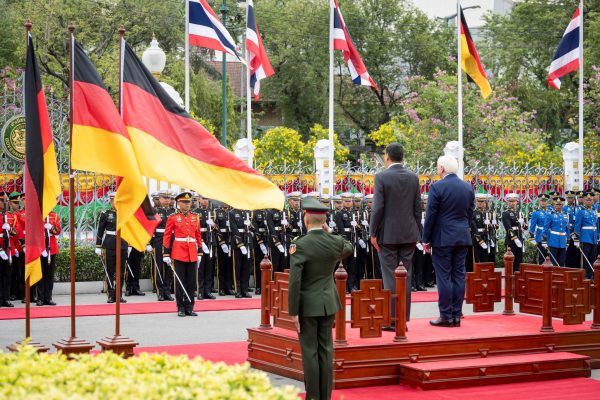
Amidst these various challenges, Germany has initiated a diplomatic engagement with Thailand, highlighted by President Frank-Walter Steinmeier’s visit to the kingdom last week. During a meeting with Srettha, Steinmeier discussed elevating the Thailand-Germany relationship to a strategic partnership. This discussion included a focus on renewable energy technologies and EVs. Steinmeier also visited the Mercedes-Benz factory in Samut Prakan province, celebrating the production of the company’s 200,000th car in Thailand.
As Germany grapples with its multifaceted economic challenges, it will be forced to balance its economic and strategic interests against its value-based foreign policy ethos – a dilemma that epitomizes the trade-offs between economic pragmatism and principled diplomacy. While nations like Thailand or Vietnam potentially stand to gain from strategic shifts in Germany’s foreign policy, the German, European, and American elections of the next few years will shed light on the way ahead for German-Southeast Asian relations.