

The recently concluded Computex 2024 in Taipei gathered the world’s most renowned computer manufacturers, and invited an unprecedentedly large number of CEOs of chip manufacturers to be its keynote speakers. The themes of the exhibition were artificial intelligence (AI), green energy sustainability, and innovation, with particular emphasis on the arrival of the 3 nm process era in AI. The 3 nm GPU products introduced at the keynote include Nvidia’s Rubin platform, Intel’s Lunar Lake, AMD’s MI350 series, and even ARM’s v9.2 architecture based on 3 nm.
In the AI field, the difference of computing power between 7 nm and 3 nm chips lies in the number of transistors. Comparing Nvidia’s 7 nm A100 with the company’s 4nm B200, the number of transistors increases significantly from 54.2 billion to 208 billion, nearly quadrupling. In terms of half-precision floating point (FP16) computation, the B200 delivers 2,250 TFLOPS, while the A100 delivers 312 TFLOPS, a more than seven-fold increase. Taking into account the performance of peripheral components and ecosystems, the actual computing power of the 3 nm chipset far surpasses the multiplier mentioned above.
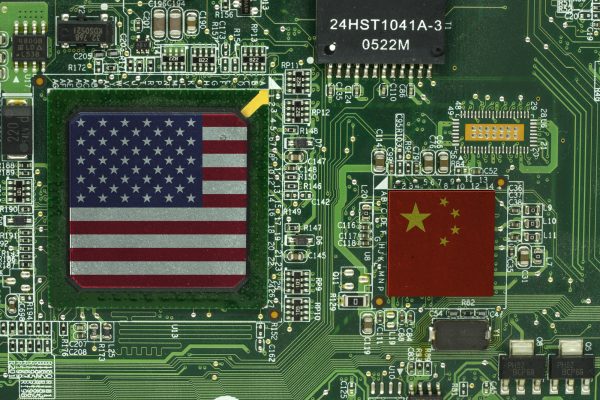
The goals of the Biden administration’s technology policy – described as a “small yard, high fence” approach – are to impede, cripple, and delay China’s development of precisely this kind of advanced chip technology. By doing so, Washington seeks to halt China’s progress in AI and high-performance computing (HPC) capabilities and thereby buy time for the U.S. and its allies to expand their lead in cutting-edge technology. But so far, the measures have seen only limited success.
Four Holes in the “High Fence”
Under U.S. sanctions, China has encountered significant challenges in its advanced chip manufacturing. To address the challenges in acquiring AI chips, China has responded in four ways: first, stockpiling significant quantities of AI chips; second, upgrading its local foundry processes and design tools; third, illegally importing chips through third parties; and fourth, utilizing offshore AI services.
Prior to U.S. restrictions on the export of AI chips to China on October 7, 2022, China’s major AI companies and cloud service vendors had already accumulated or ordered a considerable number of AI chips. While the actual quantity delivered to China is unknown, it is plausible that China has sufficient chips available to develop needed AI models until the end of 2024. In order to extend the duration of advanced chip supply, China employs advanced chips exclusively for model training that requires the most computing power.
Due to the U.S. export restrictions, U.S. chip companies are unable to export their advanced Graphics Processing Units (GPUs) to China. Consequently, China’s leader Xi Jinping frequently calls for “self-reliance” in chip supply and “autonomous and controllable” technology advancement. Recently China has allocated an additional $48 billion with the objective of strengthening domestic chip-making capabilities, despite the corruption found in the previous chip funds, which totaled $50 billion.
Notwithstanding the fact that previous endeavors did not achieve the desired results, there has been some advancement. Currently, there are many homegrown AI chip suppliers in China, such as Hisilicon’s Ascend 910B (7 nm) and Kunpeng-920 (7 nm), Baidu’s Kunlun Gen 2 (7 nm), Alibaba’s T-head (12 nm), Tencent’s Zixiao (12 nm), Taishan’s V120 (7 nm), etc. Hisilicon’s new AI chipset has emerged as a viable alternative to the U.S. companies’ chips. Chinese-made chips have historically lagged behind their Western counterparts in terms of performance and stability, which has hindered the development of large-scale AI models in China. However, they can still build models by aggregating many chips together.
In addition, China subsidizes many small chip design companies, enabling them to design single-function AI chips for diverse applications. These chips can only be manufactured locally through the use of SMIC’s 7nm process. However, since SMIC’s limited capacity is fully occupied by Huawei’s demand, some IC design companies have been compelled to downgrade their processors and seek assistance from Taiwan’s TSMC. TSMC has declined such requests.
As is the case with the West’s restrictions on Russia’s access to dual-use components, imports from a third party have also become a loophole in semiconductor export restrictions on China. The Bureau of Industry and Security (BIS) of the U.S. Department of Commerce banned the export of Nvidia’s A100 and H100 chips to China in October 2022. This prohibition was extended to the A800 and H800 chips in the following year. However, the results of these restrictions have been unsatisfactory. Some of the chips have been privately imported into China through shell companies. This is the reason why the U.S. government is concerned about the Middle East’s significant purchases of AI chips. While there is no evidence that the Chinese government is involved in facilitating the smuggling, such a possibility cannot be ruled out.
An alternative approach for Chinese companies to evade the restriction is to rent cloud services located in the United States. The U.S. government has not yet proposed any effective measures against this vulnerability. Even if this loophole is fixed, it remains unclear whether Chinese AI companies will be able to use cloud services in other places, such as Europe or the Middle East.
China’s Continuing Advancements in AI Chips
The results indicate that the Biden administration’s “small yard, high fence” policy has presented challenges for China in obtaining advanced AI chips. For example, TSMC started to produce 16 nm semiconductors in 2015, while Huawei started to produce 14 nm in 2019, with a gap of four years. TSMC started to produce 7 nm chips in 2018, and SMIC started in 2023, with a gap of five years. However, judging from the many obstacles in designing, manufacturing, and talent restriction set up by the Biden administration, the effect of the policy on widening the technological gap between China and the West is not very significant, especially as the policy fails to slow down China’s ambition to make progress in semiconductor fabrication processes beyond 7 nm.
If, as reported in the media, China has already commenced production of 5 nm chips, then the wall has already been breached. China’s only remaining vulnerability now is the higher cost of homemade 7 nm chips, which are not commercially viable in the long run without Chinese government subsidies.
Another concern for the West is China’s aggressive investment in mature processes over the past few years. China’s global share of mature processes is projected to grow from 26 percent in 2022 to 45 percent in 2027, surpassing Taiwan to become the world’s largest producer. Mature processes can generate sufficient profits for China to subsidize the advanced processes.
This strategy of subsidizing the losses of advanced processes with the profits from mature processes is the semiconductor industry’s version of “encircling the cities from the countryside,” a geographical strategy introduced by Mao Zedong to conquer the cities (in this metaphor, advanced processes) by establishing bases in rural areas (mature processes) and bolstering its military power from the countryside until the opportune time to capture the cities.
Enlarging “Digital Solidity”
To sum up, it would be unrealistic to focus only on sanctioning advanced processes in order to widen the technology gap between the West and China. Instead, measures against both advanced and mature processes used in China should be considered simultaneously in order to effectively defend U.S. national interests in technology.
With respect to advanced processes, the U.S. has already taken many restrictive measures. Further restrictions could start by restricting China’s use of the ARM v9.2 3 nm architecture. On the mature process side, since China has already localized the semiconductor fabrication tools it needs, increasing tariffs on consumer electronics could limit China’s competitiveness and global market share in mature processes and reduce China’s ability to subsidize the advanced processes with mature process products.
All these will require the United States to persuade its allies to take more joint actions, which is one of the aims of the “Digital Solidity” concept promoted by the U.S. Department of State.