

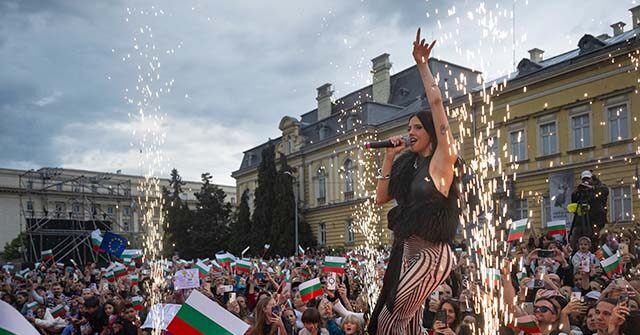
Crowds estimated to be in the tens of thousands flooded the streets of Sofia, Bulgaria, on Tuesday to welcome returning pop singer Dara, who became the country’s first-ever champion at the Eurovision Song Contest this weekend.
Dara’s song “Bangaranga,” named after a Jamaican word roughly translating to “riot,” was crowned the winner of the annual competition on Saturday, receiving overwhelming scores from both the professional jury and the public, who vote for their favorites. This weekend marked the 70th anniversary of the continental song contest, which was established in the aftermath of World War II to promote unity and healthy patriotism. It is widely believed to be the world’s most watched live music event, attracting tens of millions of spectators; estimates suggest nearly half of all Bulgarians tuned in live on Saturday.
It was also the least controversial edition of the contest in recent memory as authorities cracked down on the pro-Hamas mobs and hostile competitor behavior against Israel, a participant in the competition since 1973 and four-time winner, that had defined the tone of Eurovision since the October 7, 2023, Hamas massacres. Israel took a distant second place – with the song “Michelle” by performer Noam Bettan – with 173 fewer points than Bulgaria.
The victory was a historic one for Bulgaria, an outlier nation in the contest’s history that competed for the first time in 2005. Countries compete through their public broadcasters and their relationship with the European Broadcasting Union (EBU). Bulgarian National Television (BNT) had not been able to compete in Eurovision since 2022 due to financial difficulties and returned this year in the aftermath of an anti-Israel boycott that saw five nations – Spain, Iceland, Ireland, Slovenia, and the Netherlands – withdraw from the contest.
To celebrate, the local government in Sofia organized a welcome-back party and concert for Dara on Tuesday in Knyaz Alexander I Square, the center of the city. Images from the event showed entire blocks of the city full of people waving Bulgarian flags and holding up supportive signs for the singer. Connected to the stage was a nearly 200-foot-long red carpet. Crowd size estimates online varied widely, from about 30,000 to 100,000 people. At press time, the Bulgarian government has not confirmed those reports.
As part of the event, Sofia Mayor Vasil Terziev presented the artist with a key from the city, which he said was a metaphor for opening the hearts of the Bulgarian people. Several other high-ranking politicians, including a deputy prime minister, were in attendance.
The event concluded with Dara performing the winning song.
Reports from Bulgaria detailed that the homecoming event required significant security logistics, including shutting down entire blocks of the city and establishing six security checkpoints, as well as blocking individuals believed to be intoxicated and banning any firearms or dangerous weapons. As the tradition in Eurovision is for the champion country to host the event next, the Bulgarian news outlet Nova observed that pulling off the homecoming concert was in part a display on the part of the country’s authorities that they are capable of successfully hosting the Eurovision Song Contest.
“The organizers emphasized that Sofia has the necessary capacity to meet major international events, citing good infrastructure, tourism growth and the city’s experience from previous large-scale forums,” Nova shared.
The BNT director-general, Milena Milotinova, immediately announced the country’s intention to host the event in 2027 following Dara’s win on Saturday.
“Sofia can do it, Bulgaria can do it and BNT can do it,” Milotinova asserted. “We are winning Eurovision for the first time and hosting the contest for the first time. This is a huge thing for Bulgaria.”
The welcome party on Tuesday followed an ebullient and chaotic welcome for Dara upon her arrival in Sofia’s airport from Vienna, Austria, which hosted this year’s edition of Eurovision. Large crowds of fans greeted the singer at the airport, holding flowers and stuffed animals – and erupting in cheers upon her disembarking with the Eurovision trophy in tow.
Dara is the first Eurovision winner in three years not to break her trophy immediately following her victory. Last year’s winner, Austria opera singer JJ, broke his trophy via improper shipping, as he revealed that it appeared already cracked when he opened his luggage upon returning home from host city Basel, Switzerland. The 2024 Eurovision winner, non-binary rapper Nemo, broke the trophy while celebrating on stage immediately after his victory. Nemo would go on to ship the trophy back to the EBU in December in protest of the organization’s decision to allow Israel to continue to participate in the aftermath of the October 7 massacre of an estimated 1,200 people by Hamas. The trophy, according to anonymous reports, returned shattered and covered in toilet paper.