

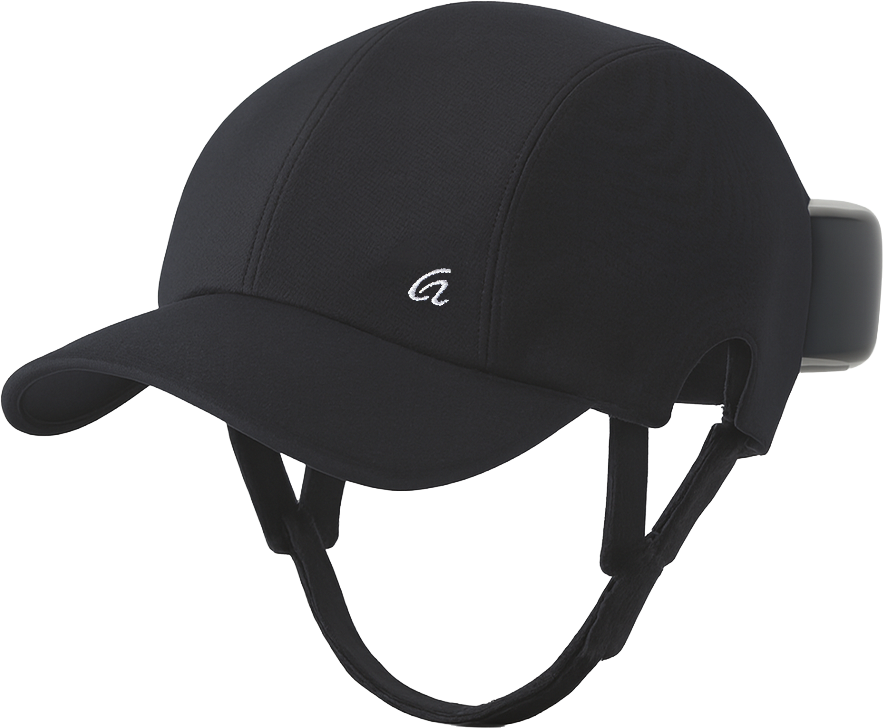
Universal Brain’s electroencephalography device is a wearable cap.
Universal Brain, Inc.
Universal Brain just announced an FDA 510(k) clearance for its Neurotique™ platform, which offers a five-minute assessment to measure cognitive and emotional brain function in support of psychiatric diagnosis and treatment.
The device is an eight-channel dry EEG baseball cap with two electrooculography (EOG) electrodes to detect eye movement, along with a rechargeable battery and integrated digital testing platform that uses event related potentials (ERP) to generate specific task-based measurements.
CEO Kazu Okuda founded Universal Brain in 2022 and recruited Greg Hajack, a clinical psychologist and professor at Santa Clara University to join as chief scientist in 2024. Hajack formerly led Google X’s Project Amber, a three-year attempt to build a custom neurotech device to discover a single biomarker for depression that came to a premature conclusion in 2020.
A groundbreaking paper published in Nature in 2024 by Stanford professor of psychiatry Leanne Williams reframed depression as a condition with several subtypes. In the last six years EEG companies have proliferated as cutting edge machine learning methods have become democratized.
The company is backed with $7.9 million in seed funding and has recently secured a $2m grant from Japan’s government. The company will launch their clinical offering this summer starting with a group of 250 clinics that have expressed early interest.
They are pursuing pharma contracts as well. Okuda mentioned two active pilot projects in life sciences, one in mental health and another in mild cognitive impairment. They also announced two new studies in the US and Japan to study biomarkers of treatment resistance and treatment response. These and other planned studies will add to the data driving platform development while validating new applications in market.
The Growing Market of Frontier Psychiatry
Universal Brain is targeting clinics offering transcranial magnetic stimulation (TMS) as well as Esketamine for treatment resistant depression. The company will sell their devices and charge a usage-based revenue share driven by existing CPT reimbursement codes for EEG/ERP recording.
Patient interest in alternative treatments in mental health is growing and evolving quickly. This has created a new segment of early adopters in outpatient mental health care to deliver these new treatments, a segment known as frontier psychiatry.
A private report last year by investment bank Edgemont Partners estimated that of the 21 million Americans living with depression, only 12.8 million seek treatment, and 6.7 million do not respond to drug treatment, of whom 5.4 million are considered eligible for TMS or Esketamine.
The report projected TMS is growing at nearly eight percent a year, on course to exceed a half a billion dollars by 2030. Today, Esketamine and ketamine treatments are already worth an estimated $1.5 and $3.5 billion respectively. Meanwhile, the administration has softened its regulatory stance on psychedelic medicines, which could introduce new treatments in the coming years.
Venture-backed psychiatry clinics are emerging to meet growing the patient interest in these new treatments. Radial launched late last year with $50m and has expanded to seven locations. Salma Health launched with $80m this spring across three locations in California, and also offers clinical trial recruitment services.
A Shifting Treatment Landscape
TMS has come a long way since the FDA approved use for treatment resistant depression in 2008, with a number of other indications from Migraines to OCD also gaining approval alongside eligibility expansion for age and comorbidity.
Traditional TMS treatment by market leaders like Neuronetics and BrainSway takes up to 30 separate visits spanning over a month. A variety of shorter-form treatments have emerged in recent years that could re-shape the treatment landscape.
- Stanford Accelerated Intelligent Neuromodulation Therapy (SAINT) involves an intensive five-day treatment, developed by the late Nolan Williams and cleared by the FDA in 2022. SAINT incorporates functional MRI scans, recently shown in a head to head comparison to improve clinical outcomes for more people compared to those treated without neuroimaging, but at a cost greater cost running into thousands of dollars per scan.
- Last year a startup called Ampa secured FDA clearance for their one-day TMS treatment, which they have rolled out nationally as an off the shelf option available for a flat monthly fee. Ampa’s system uses a scalp-based measurement rather than a brain scan.
- Last month, Wave Neuroscience secured an FDA clearance for use of their EEG-guided TMS treatment called MeRT, for people with post-traumatic stress disorder (PTSD). The company stated it is pursuing additional indications through its treatment platform, which follows the traditional five-week course of treatment.
As of yet, there are head-to-head comparisons of costs and clinical outcomes in EEG versus fMRI versus non-targeted treatments. Other companies are also advancing non-invasive treatment as well as different forms of targeting therapy. Some older clinics are retrofitting their care models to meet evolving demand, while some leading health insurers have eased restrictions.
Against this complex backdrop, Universal Brain’s EEG test offers clinical leaders and technology executives another option to consider. Okuda’s vision is clear: Mental health’s shift to developing and delivering personalized treatments will require functional assessments, rather than reliance on symptom reporting.
“Our approach is ten times cheaper, ten times faster, and more reliable,” Okuda said. “We’re convinced that psychiatry is moving towards a different paradigm driven by objective and reliable biomarkers.”