

Xi Jinping, president of China and general secretary of the Chinese Communist Party (CCP), traveled to Shanghai in mid-July. While the major reason for his trip was to open an international AI conference, he also had another priority: symbolically addressing concerns related to the distressed property market.
Xi began his Shanghai visit with an inspection tour in Huangpu District, the traditional heart of the old city of Shanghai. Huangpu is home to the Bund and its 19th century British-built buildings. Xi met local citizens and CCP officials alike, and made a point of focusing on their standard of living, rather than suggesting that they should move into newly constructed housing, often in the outer suburbs of the city or beyond.
Of all of China’s domestic priorities, home ownership and property investment has been both a boon and a bane.
Professor of Economics Kenneth Rogoff of Harvard University, in the Brookings Podcast on Economic Activity, stated in April that “real estate has been the cornerstone of the Chinese growth model, and if you include infrastructure which is closely related, it accounts for roughly a third of demand in China over a very long period. It has been the engine along with exports of China’s growth.”
Rogoff stressed that “the collapse in housing prices is a huge collapse in wealth, because Chinese citizens hold over 70 percent of their wealth in housing… the first order problem is that people feel a lot poorer and cut back their consumption accordingly.”
Deutsche Welle (DW), Germany’s state-funded international broadcaster, reported in December 2025 that the real estate market is so sensitive that in November 2025, Chinese officials “told private data providers to stop publishing home sales figures, cutting off one of the few independent windows into the current woes in the real estate market.”
DW noted that “the move followed a 42 percent year-on-year drop in new home sales by the top 100 builders in October, the largest monthly drop in 18 months, according to China Real Estate Information.”
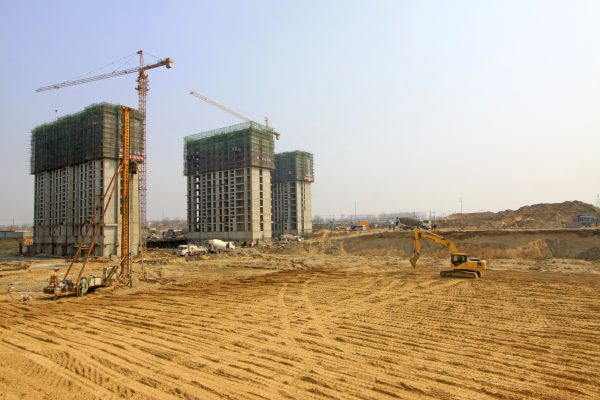
The problem has not improved much since. In May, the New York Times reported that although “property prices in Shanghai, in particular, are rebounding, the national market still faces an enormous overhang – 90 million empty or unfinished apartments.”
To acknowledge his commitment to resurrecting the property sector, Xi selected for his inspection tour the one district of Shanghai that best symbolizes the role of the CCP to deliver responsible governance. The CCP was born in Huangpu, and its First National Congress, held during July and August of 1921, took place at No. 76 Xingye Road.
However, aside from making sympathetic noises about living standards, Xi offered no new wisdom or solutions for the housing crisis. The July meeting of the Politburo similarly had no answers, although it did pay tribute to the scale of the crisis by admitting “it is necessary to attach great importance to the difficulties and challenges in economic performance.” The proposed solution, however, appears to be more of the same, with the Politburo recommending that cadres “give full play to the effectiveness of all existing policies.”
China’s property bust, which came so soon after home ownership was reinstated in the 1990s, is a tragedy for the hundreds of millions of Chinese buyers who have either lost their homes, or who are so far underwater with the loans they do have that neither re-financing nor selling the property is a possibility. The decline of this prime economic mover is a risk to the financial health of ordinary citizens. The resolution of the problem does not seem to be forthcoming from leadership. China watchers take note.