

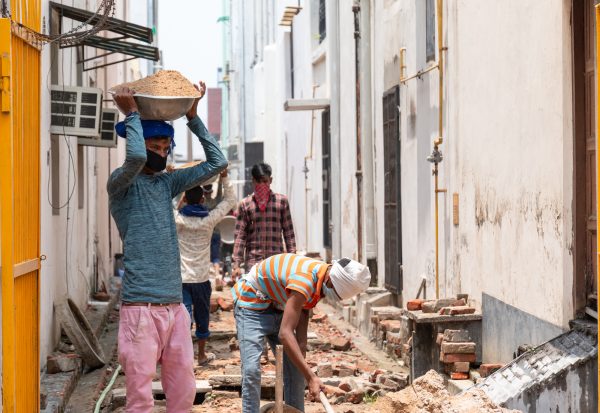
Exposure to extreme heat is costing the South Asian workforce a significant chunk of their pay every year, a series of recently published reports show. The single largest economic cost of heat comes from labor productivity losses, but there are other factors as well. A report from the World Bank predicted that South Asia’s regional GDP could be reduced by nearly 7 percent by 2050 if no adaptation measures are taken.
A recent report from Bangladesh, which is based on interviews with 175 households engaged in informal work such as construction, rickshaw pulling, and garment manufacturing, found that outdoor workers lost about 8.5 percent of their annual income, as they lost roughly 24 working days a year. Indoor workers lost 14 working days and 4.5 percent of their annual income. For both groups, illness caused by heat and reduced productivity are the largest causes of workdays lost.
The report, titled “No escaping the heat: Health and economic impacts of heat stress on informal workers in urban Bangladesh,” estimates the nation is losing about 0.9 percent of its GDP due to workday losses. That figure further increases if the cost of kidney-related ailments due to frequent dehydration is taken into account. Workers reported low mood, mistakes at work, anxiety, and irritability, as well as difficulty sleeping.
The London-headquartered International Institute for Environment and Development (IIED) conducted the study jointly with the Dhaka-based Ovibashi Karmi Unnayan Program (OKUP). The report comes close on the heels of two other publications that point to similar findings for the South Asian region.
A July 2026 report by IIED said India’s nationwide cost of heat-related kidney problems, combined with employees’ reduced ability to work during heatwaves, is estimated to be $78 billion in lost wages – equivalent to 1.99 percent of India’s GDP in 2024. Based on a survey conducted on 538 informal worker households in three Indian cities, Ajmer, Delhi, and Agra, the IIED study found a picture very similar to that of Bangladesh.
Those in outdoor industries like construction, road laying and brickmaking lost about 24 days of work annually due to heat, costing them the equivalent of $151 — nearly a tenth of their annual earnings. Indoor workers engaged in food packaging, garment manufacturing, and stonemasonry lost roughly 15 days — the equivalent of $89.
The overall loss of work hours translates to a massive scale of lost employment opportunities. Regarding South Asia, a World Bank report, titled “A Livable Future: Tackling Extreme Heat for Jobs and Growth in South Asia’s Cities,” published at the end of July, said that extreme heat “already subtracts the equivalent of 31 million full-time jobs a year across the region.”
The report examines how urban heat threatens the job market in Bangladesh, Bhutan, India, the Maldives, Nepal, and Sri Lanka. It estimates that, on average, rising temperatures will lower labor productivity in South Asia by 11 percent below the baseline by 2050. This is the largest estimated loss for any emerging market and developing economy region.
As another 2026 report on South and Southeast Asian cities, titled “Hot Cities Make Hard Work Harder,” points out, even in a Himalayan city like Nepal’s Kathmandu, 85 percent of respondents reported wage losses and increased healthcare expenses due to extreme heat. In Delhi, they found workers risk being sent home without pay when the heat slows output and targets are missed.
Sri Lanka is not immune from heat stress either. A 2025 study reported that the island nation lost a total of $10.87 billion in 2023 due to reduced work hours.
According to Ritu Bharadwaj, IIED’s director of climate resilience, finance, and loss and damage, for these workers, heat exposure doesn’t end when their shift ends. “They leave a hot worksite for a home with a tin roof, one fan, and frequent power cuts, giving no chance to recover,” she said.
Across South Asia, many informal workers in megacities and other urban settlements live in slums. Their homes are built of substandard materials, have tin or asbestos roofs and little ventilation, and are usually cramped for space.
The World Bank report says that while heat reduces productivity in existing work, it also discourages investments required for new jobs. Health burden and cooling have their own cost. For example, 90 percent of New Delhi’s street vendors reduced working hours due to heat in summer 2025, while 72 percent lost their stock of perishable food items to heat damage.
Power outages add to the crisis. When temperatures exceed 40 degrees Celsius, power outages in India increase by 20-50 percent, with the duration rising proportionally. Without action, cooling could account for 45 percent of India’s peak electricity load by 2050, up from 10 percent in 2016. This will not only put pressure on industrialization, but also leave workers with fewer chances to recover from the day’s stress.
The World Bank report pointed out that 120 million people in India, Bangladesh, and Nepal live in locations where outdoor heat stress already exceeds theoretical coping limits for at least one month annually. It highlighted a cost-benefit analysis, which found that heat early warning systems in Indian cities return roughly $50 for every $1 spent on them. Based on this, the report argued that authorities can protect residents and keep local economies working through the hottest months of the year by strengthening preparedness and response at the subnational level.
“In future decades, physiological and behavioral adaptation will undoubtedly help South Asians cope as heat stress levels rise. But the pace and scale of projected warming will increasingly test the limits of individual adaptation,” said the World Bank report.
Recently, the Indian government added heat waves to the list of natural calamities. This can help the government access funds for sustainable development goals (SDG). A policy framework for providing relief assistance through state and federal disaster response fund is being prepared, the government told Parliament in August. Heat Wave Mitigation Projects are now eligible under the Disaster Mitigation Funds, it added.
Rights activists, however, point out a crucial gap — labor laws in South Asian countries neither set any temperature threshold for safe work nor recognize heatstroke or kidney disease as occupational illnesses worthy of compensation. The IIED report on Bangladesh calls for heat protection at work to become a binding legal requirement.
Such steps could prove useful for the entire South Asian workforce.