

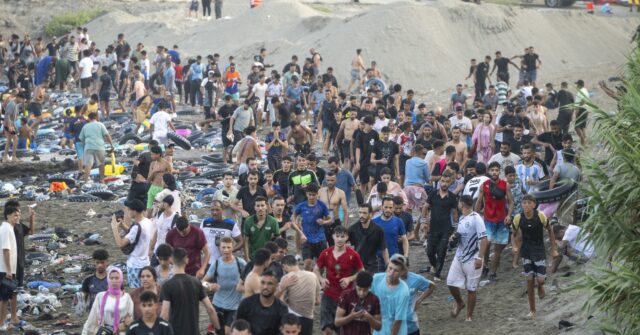
Brussels has claimed that Meta and TikTok have voluntarily agreed to ramp up censorship efforts in the wake of the Ceuta migrant invasion last month.
The European Commission said last week that following talks with the two American tech giants, held under the ever-present threat of hefty fines from the bloc, Facebook owner Meta and TikTok said that they would take it upon themselves to ramp up measures to stem the spread of so-called disinformation surrounding the storming of Spain’s Ceuta territory by over 72,000 illegals from Morocco within just a day.
Footage of the thousands of mostly young males clambering across the ill defended border sparked widespread condemnation over the open borders policies of both the socialist government in Madrid and the globalist overseers in Brussels.
The record-setting rush has left various parties pointing fingers in search of someone to blame, with some in Spain blaming the Islamist Moroccan government, others pointing at the pro-mass migration Socialist Workers Party government of Prime Minister Pedro Sánchez in Madrid, and others still suggesting that people smuggling networks were behind the migrant invasion.
However, Brussels appears to be setting up one of its favourite punching bags, social media, to take the blame for the Spanish — and therefore EU — border being completely overrun by tens of thousands of aliens. According to the European Commission, rumours circulated in the hours before the invasion claiming that “the Ceuta border is open”.
A spokesman for the bloc’s federal branch, Balazs Ujvari, said that the Commission has come to an agreement with the European police force, Europol, and the two social media platforms to adopt a mechanism to coordinate in real time during major events with local fact-checkers, Le Monde reported.
The mechanism can be activated under the EU’s Digital Services Act (DSA) censorship framework and was voluntarily triggered by both Meta and TikTok amid the Ceuta crisis. The system, coordinated by the EU Commission, seeks to provide “better information from fact-checkers” and allows Brussels to flag “harmful disinformation related to, for example, a potential new mass crossing of the border.”
“The platforms confirmed that they activated their crisis protocols and… it was decided that an ad hoc escalation and cooperation mechanism would be put in place,” Ujvari said. “For now, we think that this is an effective tool. But of course, if needed, we are ready to go further.”
Under the Digital Services Act, the European Union can fine large social media companies up to 6 per cent of their global revenue for failing to remove so-called disinformation and hate speech from their platforms. Of the major American social media firms, only Elon Musk’s X platform has faced significant fines since the DSA came into effect.
While the bloc officially claimed that the fine was primarily due to “deceptive practices” related to the blue checkmark verification, observers have suggested that the €120 million was retaliation for Musk reducing censorship on the platform.
A Meta spokesman said that it has devoted a team of employees dedicated to “monitoring the situation in Ceuta in real time and removing content that violates our policies – including content that offers to provide, facilitate or seek human smuggling services.”