


Uzbek Forum for Human Rights (Uzbek Forum) today published its report on the 2023 cotton harvest in Uzbekistan. Monitoring in 23 districts in five regions revealed that although forced labor in the cotton sector was not systematic or widespread, officials resorted to forced labor to address shortages of voluntary pickers. Despite privatization of the cotton sector through the establishment of so-called cotton clusters – private enterprises that produce, process and manufacture cotton products – the government ultimately retains full administrative control of the cotton sector including the obligation of officials to oversee, manage, and fulfill cotton production targets for every district in the country.
Uzbek Forum has monitored every cotton harvest in Uzbekistan since 2009, including during the darkest days of the Islam Karimov regime when an estimated 1 million adults and children were forcibly mobilized to the cotton fields. Following Karimov’s death in 2016, the new Uzbek president, Shavkat Mirziyoyev, made a public commitment to eradicate child and forced labor, which he once personally oversaw as prime minister under Karimov for 13 years. Reforms were introduced and by 2021, Uzbek Forum monitoring findings concluded that there was no evidence of systematic, government-imposed forced labor or centrally organized forced mobilization of pickers.
Based on these findings, the Cotton Campaign lifted a pledge made by over 300 brands and retailers not to source Uzbek cotton. It was what rights defenders had campaigned for for over a decade, but it was also a defining moment for the Mirziyoyev government that reinforced its well-crafted public image as an open, reforming country that could be trusted to implement international rights standards. The tenet in the international community was: “There is no going back.”
Cotton field in Andijan. Photo provided by Uzbek Forum.
Reforms at Risk Without Social and Political Change
Uzbek Forum has repeatedly warned that ending administrative control of the cotton sector and further political and social reforms are necessary to ensure that forced labor remains a thing of the past. However, calls to uphold the government’s commitments to labor rights and to simplify procedures for the registration of independent NGOs and trade unions that create an enabling environment to monitor and report on rights violations have gone unheeded.
Since the lifting of the pledge in 2022, independent human rights groups continue to face overly burdensome restrictions to register or receive foreign funding, and freedom of speech has come under intense restriction with the jailing, harassment, and intimidation of bloggers and journalists, as well as the closure of independent media outlets. The only known democratically elected trade union in Uzbekistan, established in 2021 at cotton-producing company Indorama Agro, has faced incessant attempts by both company management and government officials to undermine its legitimacy. By the end of 2022, its membership had been decimated following the reclassification of some 370 employees as “service providers.”
The 2023 harvest was marked by an acute shortage of pickers in numerous districts throughout the country. A combination of factors contributed to the shortage: Many migrant workers, who had returned home to Uzbekistan during the pandemic in 2021 and 2022, have since left again to earn more money abroad, while rural residents reported that they could earn more harvesting other crops, for which farmers were paying higher rates. In addition, a government program allocating plots of land to some 600,000 citizens had, according to the government, created an extra 2 million jobs in the rural economy.
Administrative Control and Coercion
The shortage of pickers during the 2023 harvest tested the limits of the reforms in the face of insufficient voluntary pickers. But instead of creating incentives, such as higher rates of pay to attract more pickers or higher prices for cotton for farmers so that they could pay pickers more, officials simply resorted to the trusted (and cheaper) method of coercion. Although in today’s Uzbekistan there is widespread awareness that forced labor is prohibited by law, local officials were faced with a difficult choice: either comply with the cotton production schedule, which meant recruiting sufficient numbers of cotton pickers by whatever means possible, or risk prosecution or public humiliation and reprisals from their superiors for failing to meet production targets.
Hokims (the heads of local administrations) are required to attend daily cotton meetings to report to the presidential adviser on the progress of the harvest in their districts. Those lagging behind in fulfilling production targets are often berated, humiliated, and threatened with punishment. In one leaked video of an online conference call attended by hokims, deputies, and other officials, the presidential adviser for agrarian development, Shukhrat Ganiev, threatened and insulted his subordinates and was even heard threatening to open a criminal case against an official. During the meeting, Ganiev implied that several regions could not mobilize tens of thousands of people to pick cotton and were significantly behind with the cotton harvest schedule as a result.
Under threat of penalty, hokims resorted to coercion to find people to pick cotton. The coercion was then passed down the chain of command through mahalla (neighborhood council) officials, who are traditionally tasked with the recruitment of pickers in their communities, until finally, employees of state-owned organizations and banks were told to either go to the fields themselves or pay for replacement pickers.
According to a leaked document dated October 4, 2023, titled “Operational Summary of the Cotton Harvest 2023,” which was widely circulated via Telegram, 13 bank branches in Namangan region sent 1,448 people to pick 82,182 kilos of cotton that day. In some cases documented by Uzbek Forum, employees had to pay up to 100,000 Uzbek som ($8) per day for up to 10 days for replacement pickers. With an average monthly salary of approximately $250-$300, this accounts for a substantial reduction in earnings for the benefit of private cotton companies.
During the 2023 harvest, farmers, who generally lease their land from the state for a period of 30 years, were still obliged to grow cotton on one-third of the total area of cultivated land and sell the entire crop to the clusters, although a new decree was passed in December 2023 that grants farmers the freedom to sell cotton on the local exchange if they produce cotton with their own grounds. Farmer contracts with clusters are often held by local administrations where officials ensure they are signed without a minimum guaranteed price for the cotton they are expected to deliver. Because often only one cluster operates in each district, farmers have little bargaining power to seek better prices, terms, and conditions elsewhere. Failure to meet production targets can result in termination of land lease agreements; this lack of autonomy essentially traps farmers between clusters and the state.
Farmers who attempt to escape the cluster system by establishing independent cooperatives have faced obstruction, closures, and intimidation. The Inspectorate for the Control of Agro-Industrial Complex recently filed for the closure of three cooperatives, claiming that they are forbidden to operate in the same districts where clusters are located by citing Presidential Decree No. 4633. However, this is a misinterpretation of the decree, which clearly does not prohibit the existence of cooperatives in the same district as clusters.
Cooperatives, unlike clusters, receive no state subsidies and yet manage to produce cotton at a profit. As one farmer pointed out, “If cooperatives develop a successful model of cotton production, more and more farmers will want to leave the cluster system, and then clusters [will] be left without guaranteed cheap raw cotton.”
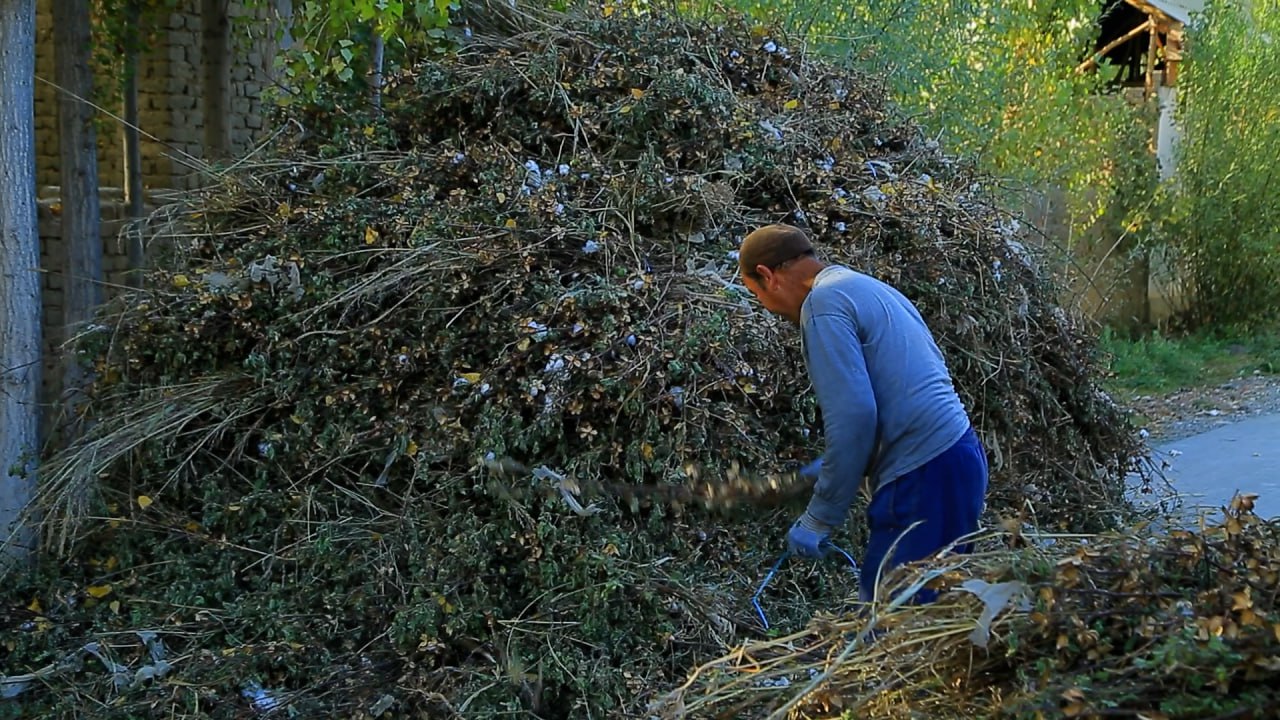
Cotton branches piled in Andijan. Photo provided by Uzbek Forum.
Reforms at Risk Without Social and Political Change
For the most part, Uzbek Forum monitors who conducted interviews with people involved in the cotton harvest did not experience any obstruction to their work. However, retaliations and intimidation by government officials, including threats of criminal charges against a human rights monitor for interviewing workers, were observed at Indorama Agro, one of Uzbekistan’s largest cotton producers operating in Syrdarya and Kashkadarya regions and in receipt of loans of $130 million from the European Bank for Reconstruction and Development (EBRD) and the International Finance Corporation (IFC). Such events send chilling signals to investors, brands, and retailers who are obliged to comply with supply chain codes and legislation in the EU, Germany and elsewhere by verifying that no rights violations are occurring in their supply chains
If the Uzbek government wants to convince investors and the international community that it is truly open for business, it must recognize that basic rights need to be respected. It must free up space for civil society activity to allow independent monitoring. It should abolish the allocation system that serves no other purpose than to guarantee clusters a steady supply of cheap cotton, which is pushing many farmers deeper and deeper into debt. It should remove the interference of government officials in the organization of the harvest and their obligation to fulfill production targets. It should introduce incentives for farmers to grow cotton instead of imposing penalties for failing to achieve artificial targets. It should empower farmers to choose freely what they want to grow and to whom to sell it and the freedom to negotiate prices, terms, and conditions with clusters without interference by officials. Finally, the Uzbek government should desist from the use of forced labor when the availability of voluntary cotton pickers dries up. These are the steps that would ensure that Mirziyoyev’s reform process is founded in a rights-based approach and ensure that cotton from Uzbekistan is no longer associated with rights violations. Otherwise, the Uzbek government is putting at risk its international reputation as a destination for investment in its textile sector.